

You have prayed. You have fasted. You have tithed every month without missing, stood at the altar and given your biggest offering yet, and believed with everything in you that this time something would shift. Some of you have done this for years, and the numbers in your account still tell a different story from the promises you have been standing on. If you have ever wondered why Christians struggle with money even when their faith is real, you are not alone, and you are not imagining it.
That gap between your faith and your finances is not a small thing to carry. It touches more than your bank account. It touches your belief in God, your confidence in prayer, and your sense of whether you are doing something wrong that everyone else is quietly getting right.
I want to address that honestly, not to shake your faith or pull you from your church, but to have the conversation most Sunday services never quite get around to having.
Here is what I have come to understand after a long time sitting with this question. Most believers who struggle with money are not struggling because of a spiritual failure. The root of it is a thinking problem, and that distinction matters more than most people realize.
I used to believe money would come the same way a testimony comes at church: pray hard enough, sow the right seed, and wait for it to land. For years, work was never the first thing I reached for. Prayer was. I would ask God for breakthrough, give whatever I could into the offering, and then wait, as if the waiting itself was the faith part. I did not connect the ability to build something with the answer I was praying for. I thought those were two separate lanes, one spiritual and one practical, and I only trusted the spiritual one. It took me a long time to see that I had been treating prayer and sowing as a replacement for building, instead of what they were meant to be alongside it.

The Question Worth Asking First
Think about the people you know who are genuinely building something financially. Growing businesses, stable income, money set aside for their children. How many of those people are the loudest in prayer meetings? How many of them say their last fast is the reason their business is doing well?
Now think about the people who never miss a service, give at every offering, tithe without fail no matter how tight things are. Ask yourself honestly where most of them are financially right now.
Prayer, giving, and faith all matter, but if those things alone were enough to produce financial stability, the most devoted believers would be the wealthiest people in every community. And we both know that is not what we see when we look around. Something is missing from how most of us were taught about money and faith. This article is an attempt to name it.
The Verse Most Churches Skip Over
Deuteronomy 8:18 says: "But thou shalt remember the LORD thy God: for it is he that giveth thee power to get wealth."
Read that carefully, because God gives you the ability to produce wealth, not the wealth itself dropped in your lap while you wait. He gives you the gift, the skill, and the mind that can build something of value, then expects you to work with what He placed inside you.Proverbs 22:29 says: "Seest thou a man diligent in his business? he shall stand before kings; he shall not stand before mean men."
Notice it is not the most anointed person or the one who prays the longest who ends up in that position. It is the skilled person, the one who developed what God placed in them and put it to work.Ecclesiastes 10:10 adds: "If the iron be blunt, and he do not whet the edge, then must he put to more strength: but wisdom is profitable to direct."
These verses do not talk about supernatural provision landing on you from outside. They are talking about what grows from inside you when you develop what God put there: the gift, the skill, the discipline to learn and improve and build. This is the principle most believers struggling with money were never taught. Prayer activates the spirit, but skill activates the provision, and you need both to work together. When you develop only one and ignore the other, the results will always be incomplete, no matter how sincerely you believe.

The Beliefs Working Against You Without You Knowing
Most of these beliefs were passed on with good intentions, by people who genuinely loved God. The problem is that what got passed on was incomplete, and incomplete truth, held sincerely, still produces incomplete results.
Money is the root of all evil.
1 Timothy 6:10, says the love of money, not money itself, is the root of all evil.Money on its own is neutral. It reflects the character of whoever holds it. When someone grows up believing money is spiritually dangerous, they unconsciously avoid it, feel guilty when they have it, and find ways to stay separated from it. That belief costs more than most people realize.
God will provide.
He will provide, and that part is true, but look at how He provided throughout scripture. He gave manna in the desert, and the Israelites still had to go out every morning to collect it. He multiplied the fish and the bread, but there was still a boy who packed a lunch and brought it. Provision from God almost always meets human effort somewhere in the middle. When "God will provide" becomes a reason to avoid planning, learning, and taking responsibility, it stops being an expression of faith and starts looking like passivity dressed in spiritual language.
Rich people are greedy.
Abraham was wealthy. Isaac was wealthy. Jacob built significant flocks and herds over decades of careful work. Job was restored to greater wealth after his trials. Solomon's wisdom produced financial abundance the world had not seen. Joseph managed the economic resources of an entire nation. These are not footnote characters in the Bible. They are the central ones. The Bible never presented wealth as the problem. It consistently presented the condition of the heart as what mattered.
Wanting more is selfish.
There is a version of wanting more that is selfish. Wanting more so you can live in excess while ignoring the people around you is a heart problem. But wanting more so your children do not carry the financial stress you carried, so you can give without it hurting, so you can build something that creates work for other people, that is the desire of a responsible steward, not a selfish one. The Bible consistently celebrates it.
I carried that guilt myself for years. There was a season where I priced my own work far below what it was worth, because charging what it actually deserved felt greedy to me. I remember typing out an invoice, cutting the number down before I sent it, and feeling relieved instead of proud that I had discounted myself. It took me a long time to see that the relief was not humility. It was guilt wearing humility's clothes, and it was never coming from scripture in the first place. It came from a message I had picked up somewhere along the way and never once stopped to question, until the day I finally did.
These beliefs do not announce themselves. They sit underneath your decisions, quietly shaping what you reach for and what you hold back on. Until you examine them against what the Bible says, they will keep producing the same results.
The Tithing Conversation Few Finishes
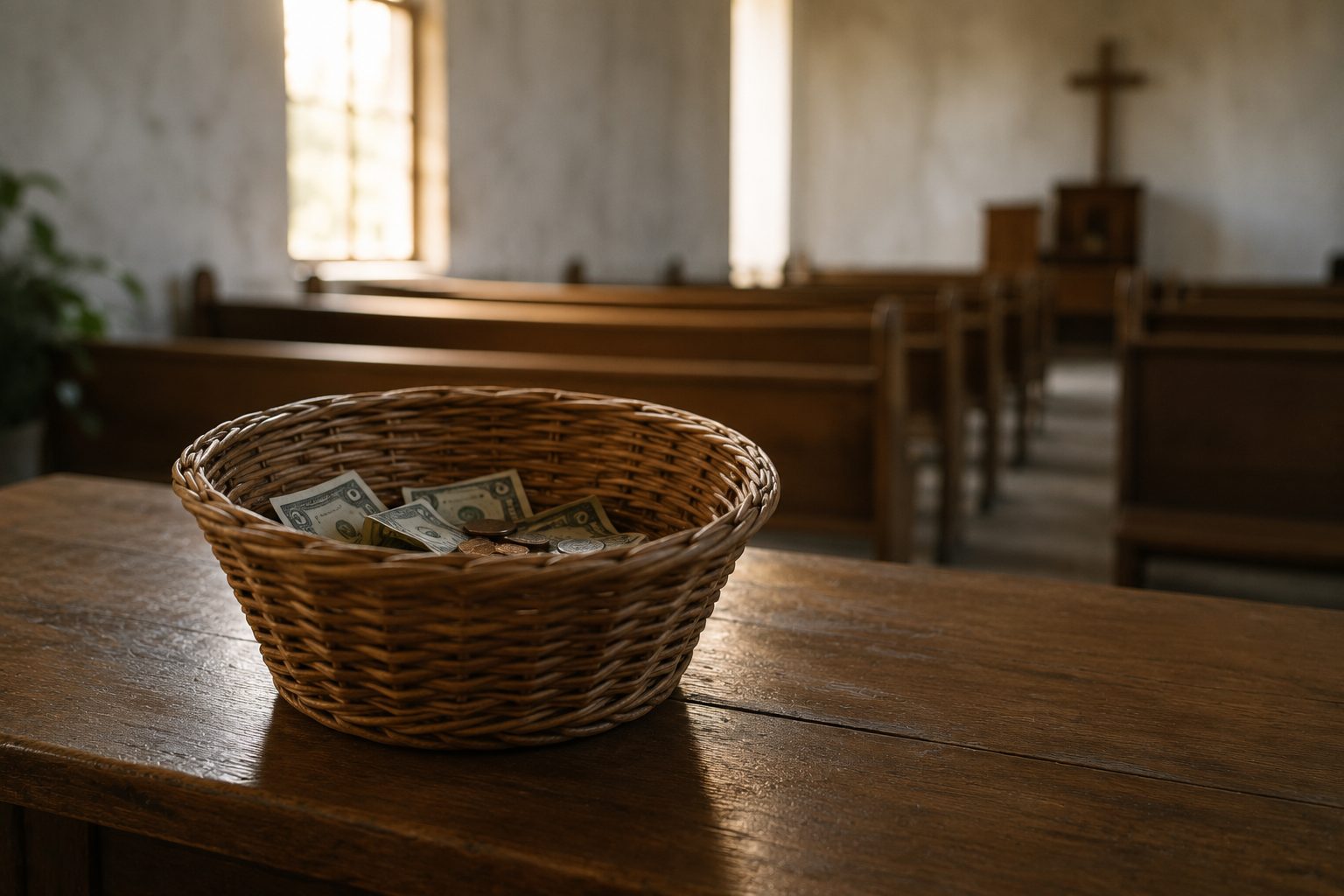
Tithing was never designed to be a financial strategy. It is an act of worship and obedience, but the moment you treat it as anything else; the whole thing gets twisted. The moment you give your ten percent primarily because you expect thirty or sixty or a hundredfold back, you have turned an act of worship into a transaction.
Picture a Sunday night altar call. The pastor says whatever you sow tonight determines what God releases over your finances this year. A young father in the third row empties his account into the offering basket, certain this is the seed that finally breaks the cycle he has been in since he graduated. Three months later he is calling his sister to borrow rent money, quietly wondering whether his faith was too small, when what actually happened was never really about the size of his faith at all.
God does not need what is in your wallet, since He owns everything already. What He invites you into through giving is a condition of the heart, a posture of generosity, trust, and open-handedness that reflects His own nature. That changes who you are as a person. But the bank account does not respond to the size of the offering. It responds to the wisdom and the decisions you make with what remains after you have given.
Giving with the expectation of receiving is not faith. It is a business arrangement dressed in church language, and God is not a business partner you negotiate with through the offering plate.
What Stewardship Actually Means
The key word in Deuteronomy 8:18 is ability, not result. A steward manages something that belongs to someone else. They are accountable for what they do with it. They are expected to produce something from what they have been given, not simply preserve it and wait.
The parable Jesus told in Matthew 25 makes this plain. The master gave each servant a different amount, then left for a long time. Two of the servants doubled what they were given. The third buried his portion because he was afraid of losing it. When the master returned, he did not rebuke the third servant for being unlucky. He called him lazy, because the issue was never failure, it was inaction.
Think about that third servant for a moment, because he is rarely lazy in the way we normally use that word. He worked hard at staying safe, digging a hole, burying the money, and likely checking on it now and then to make sure it was still there. That took real effort, but it was effort spent protecting what he had rather than building something new, and that is exactly the pattern many believers fall into with the ability God gave them. They protect the gift far more often than they ever deploy it.
I recognized myself in that third servant more than I wanted to admit. I taught myself to code years before I ever let anyone outside my own house see anything I had built. I told myself I was refining it, waiting until it was good enough, being careful and wise about the timing. The honest truth was that I was protecting myself from the risk of showing people work that might fail in front of them, and calling that caution instead of what it actually was.
If there is a gift you are not developing, a skill sitting unused, or an idea you have been holding without acting on it, the invitation of scripture is not to wait for better conditions. It is to work with what you have been given right now, in the conditions you are currently in. Luke 16:10 says he that is faithful in that which is least is faithful also in much, and faithfulness in small things is what opens the door to larger ones.
Five Shifts In Thinking That Change The Results You Are Getting
These are not tricks. They are honest corrections in how you see money and provision, and they come directly from what the Bible teaches when you read it without the filter of what you were told it says.
From "God will provide" to "God has already provided, what am I doing with it?"
The provision is often already inside you in the form of a skill, a piece of knowledge, a relationship with the right people, or an idea that keeps returning. The question is not whether God will show up. It is whether you are showing up and working with what He has already placed in your hands.
From "money is dangerous" to "money reflects whoever holds it."
Money in the hands of someone generous, disciplined, and anchored in their values does a great deal of good. The goal is not to avoid money out of fear. It is to become the kind of person who can be trusted with it.
From "I tithe so I will be blessed" to "I steward faithfully and I grow."
Almost every financial blessing in scripture followed a period of faithful management of smaller things. Start with what you have, manage it with genuine care, and let that faithfulness become the ground growth comes out of.
From "wanting more is greedy" to "wanting more so I can do more is stewardship."
Check your honest motivation. If you want more to serve better, provide well, give generously, and build something lasting, there is nothing in scripture that condemns it. That is the heart of a good steward.
From "I am waiting for my breakthrough" to "I am building toward it."
Noah built the ark before the rain came. David spent years as a shepherd developing the courage and skill that eventually put him before Goliath. Joseph ran someone else's household with full excellence before God trusted him with the resources of a nation. Every breakthrough in those stories found someone already moving, already faithful, already working with whatever they had been given at that point.
What The Bible Actually Says About Building Wealth
Proverbs is the most practical financial text in the Bible. It does not read like a collection of miracle promises. It reads like hard earned wisdom from someone who lived it.
On planning: "The thoughts of the diligent tend only to plenteousness; but of every one that is hasty only to want." (Proverbs 21:5)
On saving: "There is treasure to be desired and oil in the dwelling of the wise; but a foolish man spendeth it up." (Proverbs 21:20)
On debt: "The rich ruleth over the poor, and the borrower is servant to the lender." (Proverbs 22:7)
On multiple income streams: "Cast thy bread upon the waters: for thou shalt find it after many days. Give a portion to seven, and also to eight; for thou knowest not what evil shall be upon the earth." (Ecclesiastes 11:1-2)
That one line predates modern advice to diversify your income by roughly two thousand years. Most Christians have never heard it preached on a Sunday, yet secular finance books repeat the same principle every year as though they discovered it.
This framework was sitting inside the pages of the Bible all along. It just rarely makes it into the Sunday morning message, and people who struggle with money are not missing prayer. They are missing this.
The Joseph Principle: Excellence Before Elevation
If you want a single life to study how this all works together, study Joseph. Not the version of his story that jumps straight from the pit to the palace, skipping the years in between. The years in between are the actual lesson.
Sold into slavery by his own brothers, Joseph ended up running Potiphar's household. Genesis 39 says the Lord was with him and he prospered, but notice what that prospering looked like in practice. It looked like Joseph managing someone else's estate with such competence that Potiphar handed him full authority over everything he owned. Then Joseph was falsely accused and thrown into prison, and even there, scripture says the same thing again. He was put in charge of the other prisoners because the warden could see he ran things well.
Nobody handed Joseph a shortcut. He built a reputation for excellence in a household that was not his, and then again in a prison he did not deserve to be in, long before Pharaoh ever heard his name. When the moment finally came to interpret Pharaoh's dream and propose a plan to save Egypt from famine, Joseph did not offer vague spiritual encouragement. He proposed an actual administrative system, a percentage to store each year, a structure for managing grain across a nation over more than a decade. That is not a man who got lucky with one dream. That is a man whose character and competence had already been tested in rooms nobody else was watching.
This is the pattern most believers skip when they read Joseph's story looking only for the part where God elevates him. God did elevate him, but only after years of Joseph doing excellent work in low positions with no promise that anyone would ever notice. The elevation was the visible part. The years of quiet, faithful competence were the actual qualifications.
If you are praying for a door to open into something bigger, the honest question worth asking is whether you are currently running your own version of Potiphar's house with excellence, or whether you are waiting for the palace before you decide the small assignment is worth your full effort.

What To Do From Here
You do not need to stop praying, tithing, or believing God for things you cannot yet see. What you need to do is add four things that have most likely been missing: real knowledge, an honest plan, a developed skill, and patience.
Knowledge means spending real time learning how money works. Understand what a budget is and how to build one. Learn the basics of saving, managing debt, and eventually investing. Hosea 4:6 says my people are destroyed for lack of knowledge, and that applies to financial knowledge just as much as anything else.
A plan means writing down where your money goes each month, then making a deliberate decision about where it should go instead. A written plan is not a lack of faith. Luke 14:28 asks, "For which of you, intending to build a tower, sitteth not down first, and counteth the cost, whether he have sufficient to finish it?" That is God's instruction, not the world's advice.
Skill means identifying what you can do well that genuinely helps other people and developing it with intention. Proverbs 22:29 says the skilled person stands before those with influence and power. Skill is not separate from God's provision. It is often the exact form His provision takes.
Patience means accepting that stable, growing financial lives are built through many small decisions made consistently over years. There is rarely a single breakthrough moment. There is almost always a long stretch of faithful, unglamorous work that most people quit before it pays off.
None of this asks you to trust God less. It asks you to let your faith show up in more places than the offering line and the prayer closet. A man who prays for wisdom and then refuses to read a book on budgeting is not being spiritual. He is being inconsistent. A woman who fasts for a business breakthrough and then never studies the market she wants to enter is not trusting God with the outcome. She is skipping the part of the process He expects her to walk through.
Keep praying through all of it. Keep giving. Keep trusting God with what you cannot control. But do all of that as someone who is also actively learning, planning, building, and working with what God has already placed in your hands.
You are not in this financial place because God forgot you, or because something in you is spiritually broken beyond repair. You are here because somewhere along the way, someone taught you half of what the Bible says about money and called it the whole thing. I know what it is like to sit in that gap, praying sincerely and still watching the account say the same thing every month, and I want you to hear that reading half the book was never a spiritual failure on your part or mine. It was simply what we were handed. The other half has been sitting in the same book the entire time, waiting for someone to read it out loud, and that is what the rest of this series is for.
Common Questions About Why Christians Struggle With Money
Is it a sin for a Christian to want to be wealthy?
No. Wanting more so you can give more, provide for your family without stress, or build something that creates work for others reflects the heart of a good steward, not a selfish one. Abraham, Job, and Solomon were all wealthy, and the Bible never treats their wealth as the problem. What matters, 1 Timothy 6:10 makes clear, is the love of money, not money itself.
Why do faithful, tithing Christians still struggle financially?
Usually not because their faith is weak. Most were taught the giving side of money and never the building side. Deuteronomy 8:18 says God gives the ability to produce wealth. That ability still has to be developed and used.
Does the Bible say faith alone will make you rich?
No. The parable of the talents in Matthew 25 shows two servants who worked with what they were given and one who buried his out of fear. God rewarded the work, not the waiting.
Does the Bible say money is the root of all evil?
No, and this is one of the most misquoted verses in scripture. 1 Timothy 6:10 says the love of money is the root of all evil, not money itself. Money is neutral. It reflects the character of whoever holds it.
What does the Bible actually say about tithing and financial blessing?
Tithing is an act of worship, not a financial strategy. Giving with the expectation of a guaranteed return turns an act of worship into a transaction. The bank account responds to the wisdom applied to what remains after giving, not to the size of the offering.
What does the Bible actually teach about money and provision?
It teaches skill, diligence, planning, and generosity working together, not prayer replacing effort. Proverbs 21:5 and Proverbs 22:29 both connect diligence and planning directly to profit and standing before people of influence.
Where to Read Next
Why Do Christians Pray for Financial Breakthrough and Nothing Happens?
The Poverty Mindset the Church Accidentally Gave You
Why Do Non-Christians Have More Money Than Christians? What the Bible Says
Is It a Sin for a Christian to Want to Be Rich?
What Is Wrong With the Prosperity Gospel? The Problem Nobody Names Clearly Enough
Why Tithing Alone Will Not Make You Wealthy and What the Bible Says It Actually Does
Shame and Financial Failure as a Christian: What the Bible Says About the Weight You Are Carrying
What Did Joseph Do to Succeed in the Bible? What Most Christians Refuse to Do
Why God Cannot Bless a Plan You Never Made
My Honest Story of a Christian Struggling With Money: Empty Hands and What I Finally Learned
Why Is God Delaying My Financial Breakthrough Even Though I Pray Every Day?
Is It Biblical to Pray a Prayer That Invokes Wealth From God?
What Does the Bible Say About Your Relationship With God and Money?
Found this helpful? Share it with someone who needs it.
Related articles