
Words such as invoke wealth can sound spiritual while carrying an idea that Scripture does not require: that a particular arrangement of words can summon money into a person's life. Biblical prayer is powerful, but its power is not magic. It comes from relationship with the living God.
A child of God can ask for provision, wisdom, opportunity, favour and the resources needed to fulfil responsibility. We can pray boldly because our Father cares. But prayer does not place God under a formula, and it does not turn wealth into a spirit we call forth by technique. In fact, I wrote about this very trap in my post on what is wrong with the prosperity gospel, because treating God like a vending machine damages our walk with Him.
The question is therefore not whether money may be mentioned in prayer. It is what kind of relationship with God the prayer reveals, and what kind of obedience we are prepared to offer after we say amen.
Prayer and Invocation Carry Different Ideas
Before going any further, it is worth being clear about the difference between asking God and invoking wealth, because the two things are fundamentally different in both their nature and their direction. We need to understand that prayer is rooted in submission, while invocation is rooted in control.
Prayer, in the biblical sense, is communication with God. It is the act of coming before Him honestly, submitting to His will, expressing need and gratitude and trust, and waiting on His response. James 4:2-3 says that you do not have because you do not ask God. When you ask, you do not receive, because you ask with wrong motives, that you may spend what you get on your pleasures. Prayer in this verse is clearly directed toward God. He is the one being addressed. He is the one who responds. The believer comes in humility, with right motives, and receives according to His will.
"Ye ask, and receive not, because ye ask amiss, that ye may consume it upon your lusts." (James 4:3, KJV)
Invocation is something entirely different. To invoke, in the spiritual sense, is to call upon, awaken, or summon something through words, rituals, or repeated declarations. It is the language of those who believe that the right combination of words, spoken with enough force and faith, will activate a spiritual force or attract a desired outcome. This is the territory of incantation and ritual, not of biblical prayer. If you want to understand why so many believers hit a wall here, take a look at why Christians struggle with money, where we break down the gap between emotional declarations and actual biblical stewardship.
Can a Christian Bring Financial Needs to God in Prayer?
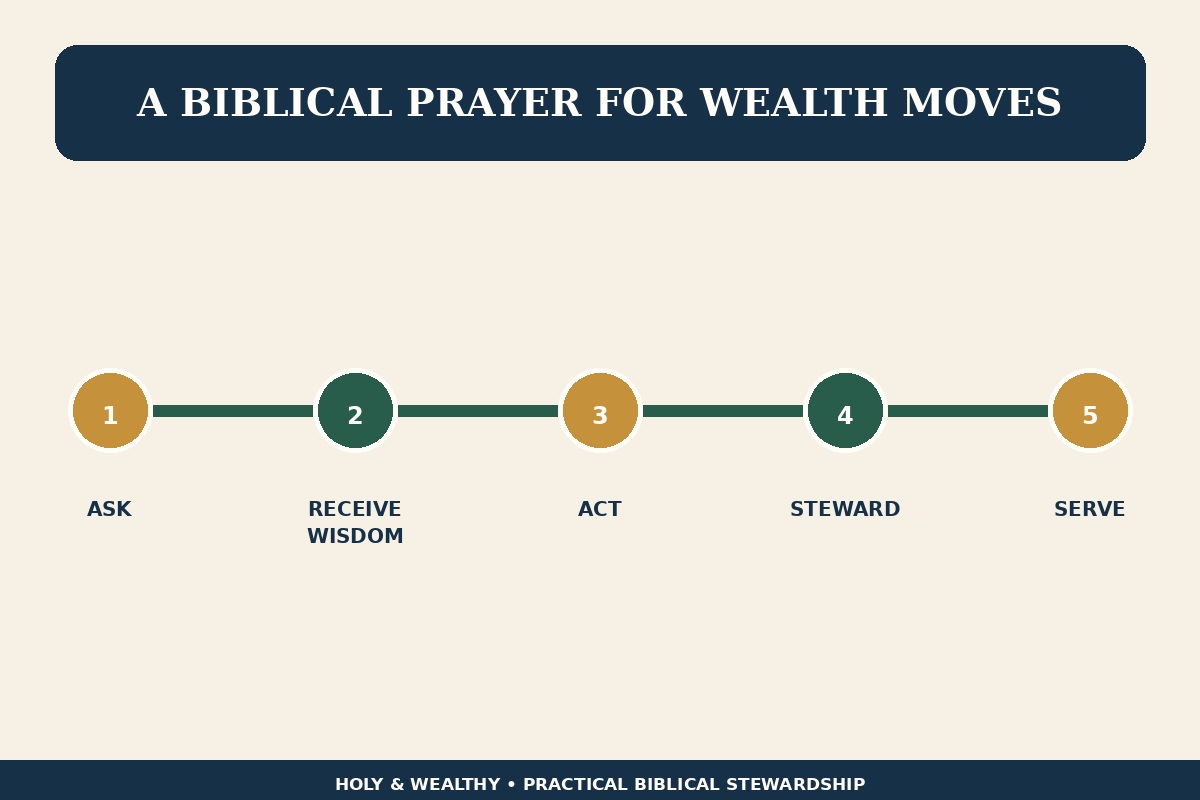
Can a Christian pray for money? The answer requires a distinction that most teaching on this subject skips over entirely. You can bring every genuine need before God, including financial need.
Matthew 6:11 records Jesus teaching His disciples to pray, Give us this day our daily bread. That petition is practical and material. It is asking God for the physical provision needed to live. Philippians 4:6 says, Be careful for nothing; but in every thing by prayer and supplication with thanksgiving let your requests be made known unto God. Every situation includes financial situations. Presenting your requests to God is biblical, appropriate, and something Jesus Himself taught.
"Give us this day our daily bread." (Matthew 6:11, KJV)
Biblical prayer joins asking to faithful obedience. Proverbs 28:20 says, A faithful man shall abound with blessings: but he that maketh haste to be rich shall not be innocent. The contrast is between steady faithfulness and the urgency that searches for a shortcut. Prayer can produce courage, wisdom and direction, but those gifts must still be carried into daily action. If your financial life feels stagnant, you might want to read my thoughts on why God is delaying your financial breakthrough even though you pray every day.
What Does the Bible Say About Praying for Wealth?
Is praying for wealth selfish? Not necessarily. The motivation behind the request matters more than the request itself. When Solomon asked for wisdom instead of riches in 1 Kings 3, God gave him both because his heart was focused on serving the people rather than inflating his own ego.
Scripture consistently warns against the blind pursuit of riches for its own sake. 1 Timothy 6:9 reminds us that they that will be rich fall into temptation and a snare and into many foolish and hurtful lusts. But the Bible never condemns having wealth. It condemns wealth having you. When we pray for financial increase, we must examine whether our hands are open to manage what God gives or closed tightly around our own desires.
Brethren, God is not opposed to blessing you financially. He is opposed to greed replacing Him on the throne of your heart. Once your motives align with His kingdom, asking for provision becomes an act of trust rather than an exercise in greed.
God Responds to More Than a Requested Amount
There is a wiser way to frame the prayer, and it comes directly from scripture. Instead of praying for money to come out of thin air, the Bible consistently shows God responding to requests for wisdom, ideas, direction, and the grace to work faithfully with what is already in your hands.
James 1:5 says, If any of you lack wisdom, let him ask of God, that giveth to all men liberally, and upbraideth not; and it shall be given him. The passage directs us to ask for wisdom rather than treating money itself as the first answer. And wisdom, applied diligently to a real problem that real people face, is what produces the financial result. The prayer for wisdom that leads to a business idea, a service offering, or an innovation that solves something people are willing to pay to have solved is a prayer that scripture directly supports and that God directly responds to. I covered this extensively in my guide on what Joseph did to succeed in the Bible.
"If any of you lack wisdom, let him ask of God, that giveth to all men liberally, and upbraideth not; and it shall be given him." (James 1:5, KJV)
Proverbs 29:18 says, Where there is no vision, the people perish: but he that keepeth the law, happy is he. Praying for clarity of vision, for the specific idea that your particular combination of gifts makes you uniquely capable of delivering, is precisely the kind of prayer that positions a person for financial movement. God gives ideas, but you have to execute them.
Why Do Non Christians Often Have More Money Than Believers?
Here is a question worth sitting with honestly. If invoking wealth through prayer were the biblical mechanism for financial breakthrough, why are more than half of the wealthiest people in the world not known for their prayer lives? Why do people who have never opened a Bible consistently outperform sincere believers in financial terms?
The answer is not that God is unfair or that wealth comes from dark sources in every case. The answer is that God embedded certain principles into creation itself, and those principles work for whoever applies them, regardless of their relationship with Him. Proverbs 22:29 says the skilled person stands before kings. Not the most prayerful person. The skilled one. Luke 16:8 records Jesus acknowledging that the children of this world are often wiser in the application of practical principles than the children of light.
A person who spends two hours a day in financial declarations and the remaining hours without a plan, without a skill in development, and without careful attention to how money is managed will consistently be outperformed by a person with no prayer life who wakes up early, develops their craft, studies their market, manages their income carefully, and serves their customers with consistency. If you want to dig deeper into this reality, read my article on why non-Christians have more money than Christians.
How to Align Your Prayers With Biblical Stewardship

When you bow your head to pray about your finances, your petitions should shift from demanding a harvest to preparing your heart for stewardship. God does not fund laziness. He funds faithfulness.
Consider changing your prayer points from empty formulas to actionable requests:
Ask for the discipline to budget and manage what you currently earn, no matter how small it feels.
Pray for wisdom to identify genuine problems you can solve for others through honest work.
Ask for patience to build wealth slowly and honestly rather than chasing get-rich-quick schemes.
Pray for a generous heart that remembers the poor and supports the work of the kingdom.
When your prayer life drives you toward diligence rather than passivity, you begin to see real change in your bank account and your character.
Frequently Asked Questions
Is it a sin to pray specifically for money?
No, it is not a sin to pray for money when you have genuine needs, as Jesus taught us to pray for our daily bread. The issue arises when money is pursued as an idol or when prayer is used as a magic formula to bypass hard work and wise stewardship.
What does the Bible say about speaking wealth into existence?
The Bible teaches faith and confession, but it does not support treating words as incantations to summon cash. Scripture pairs provision with diligence, planning, and wisdom rather than repeated verbal formulas that attempt to bypass the laws of stewardship.
Why do my financial prayers sometimes go unanswered?
James 4:3 tells us that unanswered prayers are often the result of wrong motives or asking to spend provision solely on our own pleasures. Additionally, God often withholds financial release until we develop the character and discipline required to manage it without destroying ourselves.
How can I pray effectively for financial breakthrough?
Pray for wisdom, for open doors to serve others, for diligence in your work, and for the discipline to manage your resources according to biblical principles. Combine your prayer time with practical budgeting and skill development.
Where To Read Next
If this article helped shift your perspective on prayer and finance, I want to encourage you to keep exploring these truths with these related posts:
Why Christians Struggle With Money: The Honest Truth Nobody Preaches On Sunday
Why Is God Delaying My Financial Breakthrough Even Though I Pray Every Day?
Why Do Non Christians Have More Money Than Christians? What the Bible Says
What Did Joseph Do to Succeed in the Bible? What Most Christians Refuse to Do
- How Does Money Change Relationships According to the Bible? — Another piece in this series.
- What Does the Bible Say About Your Relationship With God and Money? — Another piece in this series.
- My Honest Story of a Christian Struggling With Money: Empty Hands and What I Finally Learned — Another piece in this series.
- Why Christians Struggle With Money: The Honest Truth Nobody Preaches On Sunday
Found this helpful? Share it with someone who needs it.