
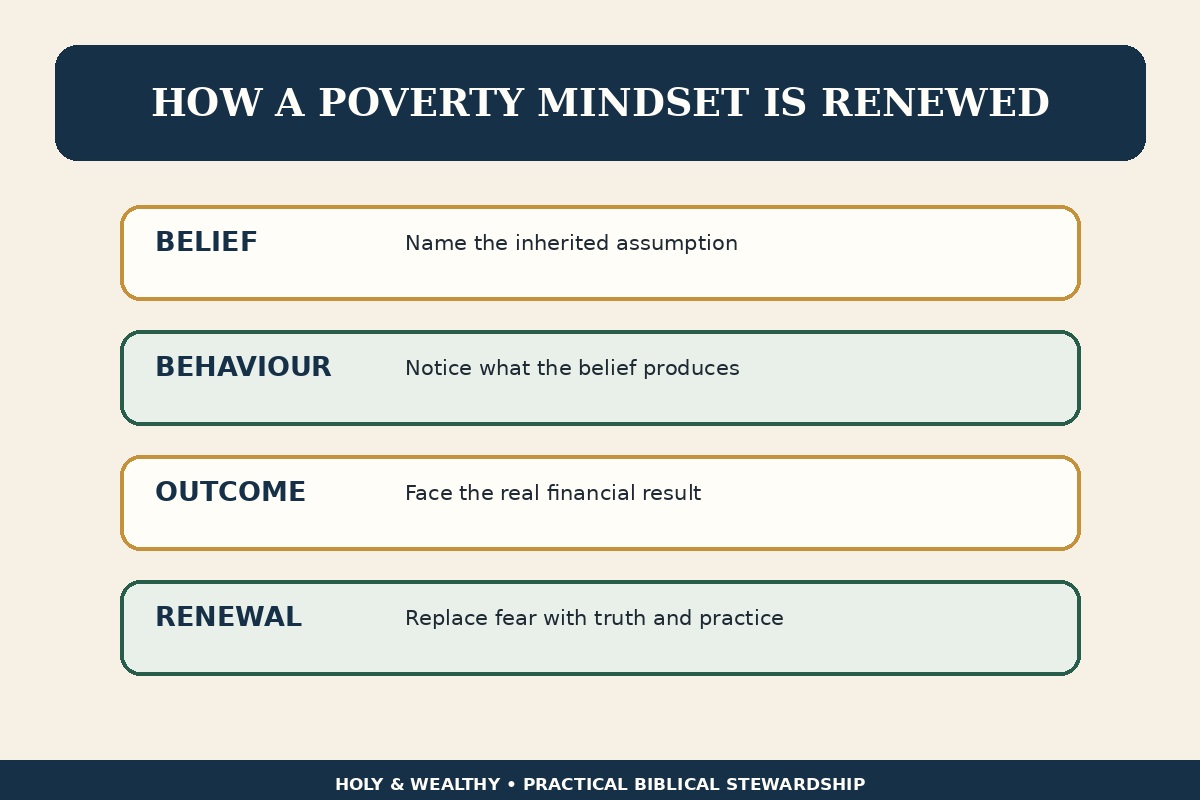
Not every poverty mindset begins in a greedy heart. Some begin in a church pew, under sincere teaching delivered by people who love God. A believer hears that wanting progress is worldly, that planning shows weak faith, or that poverty makes a person more spiritual. Years later, that teaching is no longer only a sentence they remember. It has become the permission they need to remain small, even when capacity and opportunity are present. I am not attacking the Church.
I am part of the Church, I serve in ministry, and I know how easily an incomplete message can be repeated until it feels like Scripture. But honour does not require silence where people are being damaged. Jesus confronted traditions that made the Word of God ineffective in people's lives. We must also be willing to test what we inherited with courage and humility. The freedom we need is neither greed nor shame. It is a renewed mind that can hold humility, work, stewardship, generosity and growth together. If you have ever felt guilty for wanting to build a stable financial foundation for your family, you need to read my thoughts on whether it is a sin for a Christian to want to be rich.
Humility Was Never the Worship of Lack
Jesus said in John 8:32 that ye shall know the truth, and the truth shall make you free (KJV). That is one of the most quoted verses in the church. But in many church environments, the truth about money has been one of the things most carefully managed and least openly taught. Hosea 4:6 says that my people are destroyed for lack of knowledge (KJV). The destruction came through a lack of knowledge, not a lack of seed offerings or anointing. The knowledge of what the Word of God actually says, versus what tradition and the doctrines of men have taught in its place.
The poverty mindset in the church did not develop randomly. It was built, teaching by teaching, through things presented with spiritual authority that had little or no foundation in what the Bible actually says. We cover this broader deception deeply in our main guide on why Christians struggle with money, because until we name the root cause, we will keep fighting the wrong battles.
When Tradition Becomes Louder Than the Word
In Mark 7:7-8, Jesus said to the religious leaders of His day that howbeit in vain do they worship me, teaching for doctrines the commandments of men. For laying aside the commandment of God, ye hold the tradition of men (KJV). He was speaking to the Pharisees. But the principle He named applies wherever human tradition replaces the actual Word of God. And it applies with full force to financial teachings that have taken root in many churches today.
The Bereans in Acts 17:11 were commended specifically because they searched the scriptures daily, whether those things were so (KJV). Not because they doubted the teacher. Because they understood that even a trusted voice must be checked against the Word. That habit, examining everything against scripture, is what protects a believer from the doctrines of men that produce the poverty mindset in the church.
The larger diagnosis in Why Christians Struggle With Money shows why beliefs about money eventually become habits, and why spiritual language alone cannot correct a pattern we refuse to examine.
How Seed Language Can Be Misused
Few teachings have caused more financial damage to sincere believers than seed sowing presented as a financial strategy. The teaching promises that giving money to a man of God or a ministry will trigger a financial harvest in return. The bigger the seed, the bigger the harvest. The transactional extreme is examined directly in What Is Wrong With the Prosperity Gospel?. Jesus gives seed a deeply spiritual meaning in the parable of the sower. Luke 8:11 says, the seed is the word of God (KJV). The condition of the ground determines how that seed is received and whether it becomes fruitful.
This should govern every message about sowing: the heart, the Word and obedience must never disappear while attention is placed only upon the money being given. The parable is rich enough to illuminate many areas of life, including stewardship, but its first anchor in the text remains the Word of God. Financial teaching should grow from that anchor rather than remove it and make money the controlling subject. And the version of this teaching that pushes hardest for a bigger seed is often, not coincidentally, the version that benefits most from the seed being sown.
When Programmes Replace Personal Leading

Jesus said in John 16:13 that the Spirit of truth would guide believers into all truth (KJV). The Holy Spirit is meant to be the active guide in every believer's life. He speaks, directs and gives wisdom beyond what any programme or church calendar can produce. But in many church environments, the calendar is so full of services, conferences, and special events that there is no space left for genuine leading. Sunday morning, Wednesday evening, Friday prayer, Saturday programme. Week after week. Ask why any of it is there and many cannot give a clear scriptural answer. It has simply always been done this way.
This is what the Bible describes at Gilgal. It was a place where the form of religion remained while the presence of God had quietly departed, leaving people to go through the motions and leaders to perform traditions without stopping to ask whether God was directing any of it.
You are always connected to God. You do not need a programme to access Him. The same Spirit that raised Christ from the dead lives in you and is more than capable of leading your financial life if you will learn to hear Him. There was a period in my own life where I tracked how close I was to God by counting how many services I had attended that week, as if showing up more often was the same thing as actually hearing from Him.
The clearest direction I ever received about a decision I was wrestling with came on an ordinary Tuesday morning, sitting alone with my own thoughts, nowhere near a church building or a church calendar.
The Weaponisation of the Camel and the Needle's Eye
One of the most persistent ways church culture keeps believers financially timid is the misuse of Matthew 19:24. Jesus says, it is easier for a camel to go through the eye of a needle, than for a rich man to enter into the kingdom of God (KJV). For decades, preachers have used this verse to paint wealth as an inherent barrier to salvation, implying that having money makes you spiritually suspect.
But if you study the cultural context and the architectural structure of ancient Jerusalem, the eye of the needle was a low, narrow pedestrian gate beside the main city gates. For a camel to pass through it, the beast had to be unloaded of all its heavy cargo and forced to kneel down and crawl through on its knees.
Wealth itself was never the condemnation. The reliance on riches rather than God was the danger. Abraham was extremely wealthy in cattle, in silver, and in gold, as Genesis 13:2 records, yet he was called the friend of God. Job was the greatest of all the men of the east before and after his trial. God is not opposed to His children holding resources. He is opposed to resources holding His children. Once you untangle this theology, you begin to see why understanding biblical stewardship versus ownership changes how you view every coin in your hand. You stop feeling guilty for earning, and start feeling responsible for managing.
What Breaking Free Looks Like in Daily Life
Breaking free from the poverty mindset the church gave you begins with the exact same thing Jesus pointed to. You must read the Word of God for yourself. Do not read it through the narrow filter of what you have been told it says during chruch service.
Read it with entirely fresh eyes and a genuine question in your heart: what does God actually say about money, work, wealth, and provision? For a careful examination of desire after fear has been confronted, read Is It a Sin for a Christian to Want to Be Rich?. What you will find in scripture is a highly consistent, practical, and wisdom based picture. You will find diligent people building real enterprises. You will find skilled workers being honored before kings. You will find meticulous planners prospering while lazy dreamers stay hungry.
Proverbs 10:4 tells us that he becometh poor that dealeth with a slack hand: but the hand of the diligent maketh rich (KJV). Notice that the Bible does not blame God for the poverty, nor does it spiritualise the slack hand as humility. It calls it what it is. If your bank account is empty because of poor planning, stop waiting for a miraculous angel to deposit cash and start asking the Holy Spirit for the wisdom to build a budget, learn a skill, and work with excellence. If you want a practical roadmap for turning your God-given abilities into steady income, take a look at my guide on developing a 90 day christian skill development plan.
Why Generational Poverty Breaks When We Renew Our Minds
When you carry a poverty mindset handed down by religious tradition, it affects more than just your wallet. It affects your children. You teach them to fear success, to suspect anyone who has built a business, and to treat financial survival as the highest spiritual achievement. Romans 12:2 instructs us not to be conformed to this world: but be ye transformed by the renewing of your mind (KJV).
That renewal includes purging out the religious lies that taught you to celebrate lack. God wants to use your hands to build generational stability so that your children and your grandchildren can focus on advancing the kingdom without the constant panic of empty cupboards. If you are tired of living paycheque to paycheque and wondering why your prayers haven't shifted your financial reality, you need to read why am I living paycheque to paycheque as a christian to start building real financial breathing room.
Where To Read Next
Why Is God Delaying My Financial Breakthrough Even Though I Pray Every Day? — Worth reading next.
What Does the Bible Say About Your Relationship With God and Money? — Worth reading next.
How Does Money Change Relationships According to the Bible? — Worth reading next.
If this message resonated with you, I want to invite you to go deeper into these truths. Unlearning religious money blocks takes time, but Scripture gives us all the tools we need to rebuild correctly. Here are a few articles I recommend reading next: Start with our core pillar page on Why Christians Struggle With Money to get the complete picture of how spiritual and financial beliefs collide.
Read shame and financial failure as a christian to lift the heavy emotional burdens you might still be carrying from past money mistakes.
Explore what is wrong with the prosperity gospel so you can spot unbalanced extremes and find the biblical middle ground of true stewardship.
Take a look at is it biblical to pray a prayer that invokes wealth from god to realign your petitions with biblical wisdom.
Frequently Asked Questions
Did Jesus teach that Christians should be poor?
No, Jesus never taught that poverty is a requirement for holiness. He warned against the dangers of greed and making wealth an idol, but He also commended faithful stewardship, industrious work, and the wise use of resources as seen in the parable of the talents.
Why do many churches teach against financial success?
Many churches overcorrect due to the abuses of the prosperity gospel, mistakenly equating the pursuit of wealth with greed. This creates a culture that spiritualises lack and views financial struggle as a sign of spiritual purity.
How can I overcome religious guilt about wanting to make money?
You can overcome this guilt by studying what the Bible actually says about work, diligence, and stewardship from Genesis to Revelation. God gives power to get wealth to establish His covenant, and wanting to provide well for your family is a godly desire when anchored in proper motives.
What does the Bible say about generational wealth?
Scripture repeatedly affirms that a good person leaves an inheritance to their children's children. Abraham, Isaac, and Jacob all built significant material and generational wealth as a direct result of walking in covenant obedience and diligent stewardship with God.
Found this helpful? Share it with someone who needs it.