Your relationship with money is part of your relationship with God because money touches trust, fear, identity, generosity, and obedience. It can expose what we believe about tomorrow, what we consider security, and how far our compassion extends when resources become tight. As I found out when I finally stopped making excuses for my own financial blind spots, money is never neutral. It is a spiritual mirror.
Jesus called mammon a master. The word carries the idea of wealth or property trusted as a source of security. Money does not need a mouth before it begins giving instructions. It speaks through anxiety, comparison, secrecy, and the belief that we will finally become somebody when a certain amount arrives. If you want to understand why so many believers live in quiet desperation despite their faith, you have to look at what I covered in my post on why Christians struggle with money, because the root is almost always misplaced trust.
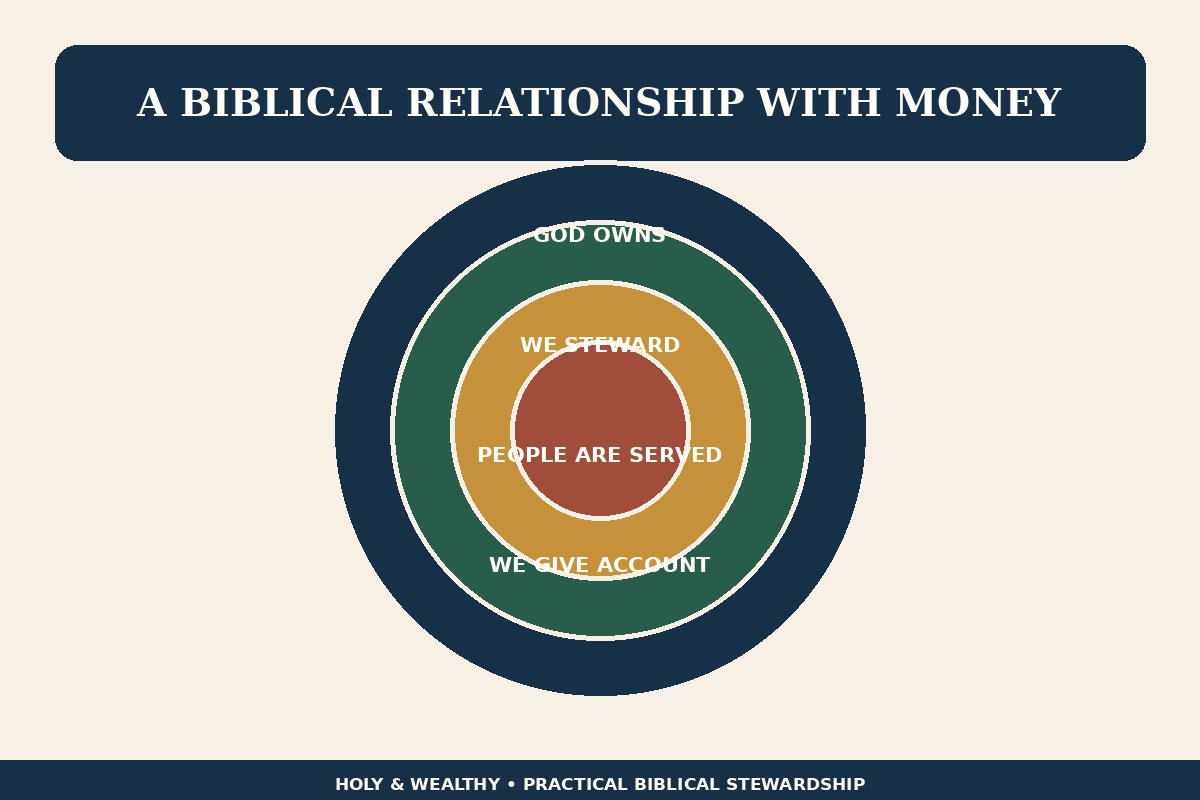
The answer is not to pretend money has no power in daily life. The answer is to settle ownership and lordship once and for all. God owns what we steward, and God leads while money serves. When that order is preserved, resources can be handled without becoming worship. For a deeper look at this shift, read my thoughts on biblical stewardship versus ownership, which completely changed how I view my bank account.
Render to God What Carries His Image
The coin in Matthew 22 had the inscription of the Roman emperor on it. In the ancient world, the image stamped on a coin or monument represented the authority and influence of the ruler who placed it there. When a king's image appeared somewhere, it meant that king's rule extended there. Jesus pointed to the inscription and said give Caesar what bears his image.
"Render therefore unto Caesar the things which are Caesar's; and unto God the things that are God's." (Matthew 22:21, KJV)
Then He said give God what belongs to God. The question that follows naturally from that instruction is what bears God's image. Genesis 1:27 answers it directly: "So God created man in his own image, in the image of God created he him; male and female created he them" (Genesis 1:27, KJV). The human being bears the image of God. Not a coin, or a nation's currency. You carry the inscription of God the way that coin carried the inscription of Caesar.
The implication of Jesus's statement is that what belongs to God and must be rendered to God is not primarily a financial offering. It is you. Your life, your attention, your first loyalty, your orientation. In Matthew 22, the Greek word for image is eikōn, meaning an image or likeness, while Genesis 1:27 uses the Hebrew tselem for the image of God. The passages arise in different languages, but together they sharpen the contrast: a coin can bear Caesar's likeness, while the whole human being bears God's image.
When we get this backwards, we try to pay God off with a tithe while keeping our hearts locked away in our own private vault. But God is not after your wallet first. He is after your allegiance. If you have ever wondered why your giving feels dry or transactional, you might want to read why tithing alone will not make you wealthy, because mechanical obedience without heart surrender misses the entire point of the Kingdom.
Seek the Kingdom Before Financial Security
Matthew 6:33 is one of the most quoted verses in the church and one of the least understood in its practical application. Jesus said that "But seek ye first the kingdom of God, and his righteousness; and all these things shall be added unto you" (Matthew 6:33, KJV). The verses immediately before it describe the anxiety people carry about food, clothing, and daily provision. Jesus acknowledges the reality of those concerns directly. He does not dismiss them. He reorders them.
"But seek ye first the kingdom of God, and his righteousness; and all these things shall be added unto you." (Matthew 6:33, KJV)
The word seek in that verse comes from the Greek zeteo, which means to search for, to desire, to require, to demand. It is an active, intentional word. Seeking the kingdom first is not passive spiritual activity. It is an active orientation of your entire life toward the rule and purpose of God. And the word kingdom, basileia in Greek, means the reign, the rule, the active governing authority of a king. When Jesus said pray that God's kingdom comes, He was asking His followers to pray for the active reign of God to be established in every territory of their lives, including the financial one.
I learned this the hard way when I was staring at bills I could not pay. I was praying for money, but I was not yielding my financial decisions to God's rule. Once I started inviting His governance into my budget, things shifted. If you are stuck in that same cycle, my guide on breaking the paycheque-to-paycheque cycle offers practical steps for aligning your finances with Kingdom order.
Mammon Competes for Trust and Service
Matthew 6:24 says that "No man can serve two masters: for either he will hate the one, and love the other; or else he will hold to the one, and despise the other. Ye cannot serve God and mammon" (Matthew 6:24, KJV). The word translated as money in this verse is the Aramaic word mammon, which carries a meaning deeper than simple currency. Mammon refers to wealth as an object of trust, something a person relies on for security, identity, and direction.
"No man can serve two masters: for either he will hate the one, and love the other; or else he will hold to the one, and despise the other. Ye cannot serve God and mammon." (Matthew 6:24, KJV)
Jesus was not saying that handling money is incompatible with following God. He was saying that when money becomes the thing you trust most, the thing that determines your decisions and your sense of security, it has taken the place that belongs to God alone. The question of desire under that lordship test is examined closely in my post on whether it is a sin for a Christian to want to be rich.
The word serve here is the Greek douleuo, which means to be a slave to, to be in bondage to, to be completely subject to the will of. Jesus was describing two possible conditions. Either God is your master and money is your tool, or money is your master and God is an afterthought you consult when you need a bailout. This is why seeking God first is not simply a spiritual instruction disconnected from financial life. It is the most practically important financial decision a believer can make.
Solomon Reached the End of What Money Could Build
No one in scripture tested the limits of what wealth could provide more thoroughly than Solomon. Ecclesiastes 2:4-8 records his massive experiment with property, projects, servants, and silver. He had everything that money and power could build. Yet, when you read his conclusion in Ecclesiastes 12:13-14, it wasn't a celebration of his portfolio:
"Let us hear the conclusion of the whole matter: Fear God, and keep his commandments: for this is the whole duty of man. For God shall bring every work into judgment, with every secret thing, whether it be good, or whether it be evil." (Ecclesiastes 12:13-14, KJV)
After experiencing everything wealth could offer, the wisest and richest man who ever lived came back to the exact same starting point Jesus described in Matthew 6:33. Money could buy him pleasure, but it could not buy him peace. It could construct palaces, but it could not construct purpose. If you are building your life purely around financial accumulation, you are running toward a finish line that vanishes the moment you cross it. For more on building wealth with an eternal perspective, take a look at my article on wealth with a Kingdom purpose.
You Were Created to Govern Resources
Genesis 1:28 gives the original mandate God placed on human beings: "And God blessed them, and God said unto them, Be fruitful, and multiply, and replenish the earth, and subdue it: and have dominion over the fish of the sea, and over the fowl of the air, and over every living thing that moveth upon the earth" (Genesis 1:28, KJV). Three key words in that verse carry root meanings that change how you understand the financial life of a believer.
The word fruitful comes from the Hebrew parah, meaning to bear fruit, to grow, to increase, to be productive. God's first instruction to His image-bearers was to be productive. Not to accumulate passively, but to produce actively from the resources He placed in their hands. Dominion comes from the Hebrew radah, meaning to rule, to govern, to manage with care. You were never designed to be crushed by money or terrified of lack. You were designed by God to govern resources under His authority.
When you embrace this identity, fear loses its grip. Money stops being a master and goes back to being a tool for the Kingdom. If you are ready to learn how to manage that tool wisely without letting it manage you, my comprehensive guide on practical money management for Christians is a great next step.
Frequently Asked Questions
What does the Bible actually say about money and God?
The Bible treats money as a tool and a test of spiritual loyalty, warning that we cannot serve both God and mammon simultaneously.
Is having money a sign of God's blessing?
Scripture shows that wealth can be a result of diligence and wisdom, but it is never a definitive measure of spiritual maturity or God's favour.
How can I align my finances with God's will?
You align your finances by acknowledging God as the ultimate owner, practicing biblical stewardship, giving generously, and seeking His kingdom first in your budget and planning.
What is the difference between stewardship and ownership?
Ownership implies control and final rights, whereas biblical stewardship means managing resources that belong to God according to His instructions.
Where To Read Next
If this helped reframe your view on money and faith, here are a few other posts I wrote that will take you deeper into your financial journey:
Why Christians Struggle With Money: The Honest Truth Nobody Preaches On Sunday
Biblical Stewardship Versus Ownership: The Truth That Frees You From the Fear of Loss
Why Tithing Alone Will Not Make You Wealthy and What the Bible Says It Actually Does
- How Does Money Change Relationships According to the Bible? — Another piece in this series.
- Is It Biblical to Pray a Prayer That Invokes Wealth From God? — Another piece in this series.
- Why Is God Delaying My Financial Breakthrough Even Though I Pray Every Day? — Another piece in this series.
Found this helpful? Share it with someone who needs it.