
I remember sitting in my car outside a grocery store several years ago, staring at a bank balance that could not cover my shopping basket, whispering the exact same frustrated question. Why is God delaying my financial breakthrough when I pray every single day? It felt as though heaven had gone quiet. If you are struggling to understand why your financial situation hasn't shifted despite your faithfulness, you might want to read my thoughts on why Christians struggle with money to see that you are far from alone in this frustration.
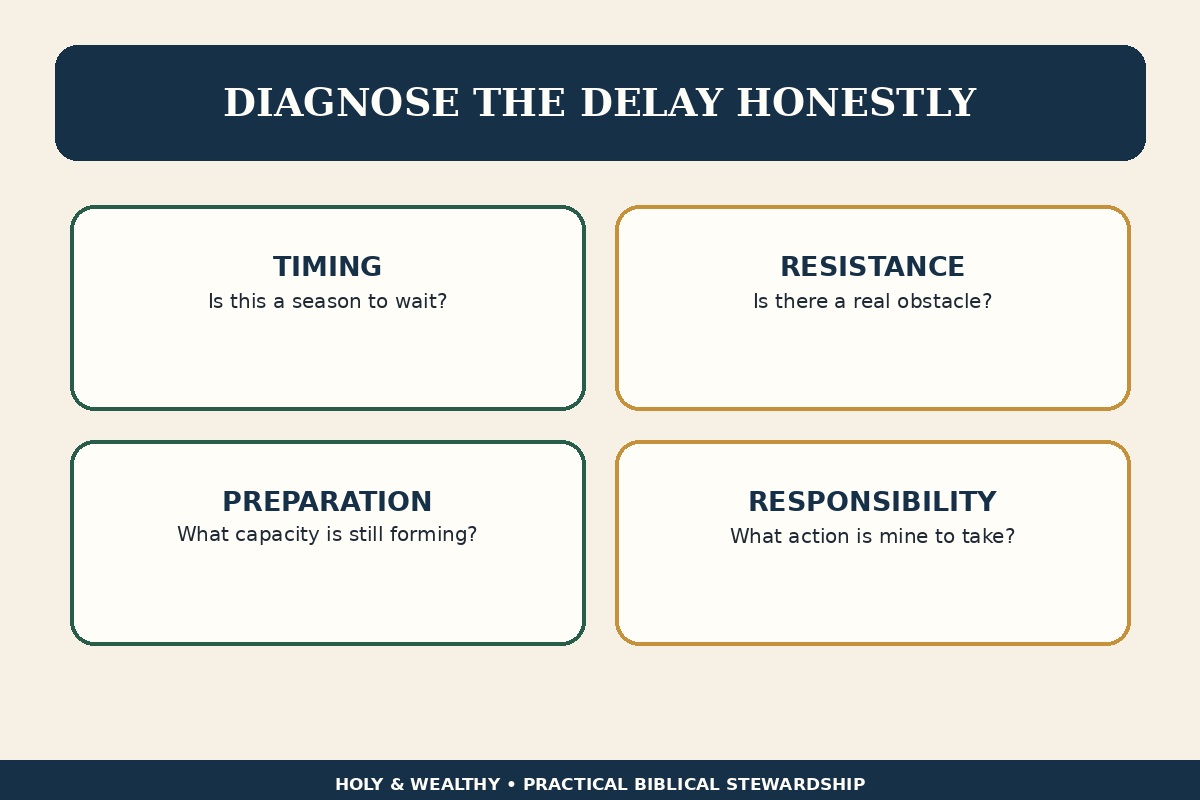
Yet we must examine the word delay. Sometimes God is preparing a person, protecting them, or ordering timing. Sometimes spiritual resistance is real. Sometimes the condition is being extended by habits, fear, or a responsibility we already know but have avoided. At other times, the answer has begun arriving as an idea, work opportunity, correction, or small resource, but we reject it because it does not look like the amount we requested. Discernment asks which situation we are actually facing. Wisdom refuses to call every closed door the same thing.
First Define the Financial Breakthrough You Are Asking For
Before addressing the delay, it is worth defining what breakthrough actually is, because most of the frustration believers carry around this topic comes from expecting one thing while the Bible describes something else entirely. If your prayers feel repetitive and unanswered, you may find clarity in looking at why Christians pray for financial breakthrough and seeing where expectations collide with biblical reality.
The word breakthrough comes from a military context. It describes the moment an army penetrates a line of resistance that has been holding it back, moving from a place of being stopped into a place of forward movement. In a financial sense, a breakthrough is not a miracle deposit appearing in your account from nowhere. It is the moment something that has been blocking your forward movement gives way, and you begin to move.
Financial blockage cannot be reduced to one source. Spiritual resistance is real, yet many attacks reach a person through fear, deception, neglected knowledge, harmful habits, and repeated decisions. This is why discernment must examine both the spiritual realm and the life being lived. Across the global church, believers rightly take demonic resistance, generational patterns, and evil intentions seriously, but we must also ask whether the enemy is exploiting an unrenewed mind or an unmanaged financial pattern. For a deeper look at how old mindsets hold us back, have a look at the poverty mindset the church accidentally gave you.
We often treat God like a cosmic vending machine where we insert prayers and expect immediate currency. But God is a Father building character. When you ask why your financial breakthrough is delayed, you have to ask whether you are praying for cash or praying for capacity. Cash without capacity is simply a temporary delay before a bigger disaster.
God's Timing Is Never Careless
Throughout the Bible, God's timing looks wrong to the people living inside it. Abraham waited twenty-five years for the son God had promised him. Joseph spent over a decade in slavery and imprisonment before his purpose was fulfilled. Lazarus was already four days in the tomb before Jesus arrived. In every one of those situations, the people involved had every reasonable ground to conclude that God was late. In every one of those situations, He was not. For a study of faithfulness when people forget you, read Diligence in the Forgotten Place.
"He hath made every thing beautiful in his time..." (Ecclesiastes 3:11, KJV)
Its beauty appears in God's appointed time rather than the timetable we would choose. The word used there carries the meaning of the right season, the appointed moment, the point at which something is exactly what it needs to be. A mango pulled from the tree too early is hard and bitter. The same mango, left until the right season, is everything it was designed to be. God remains purposeful in His timing, even when we do not yet understand the season.
When you are waiting, the silence of God is not absence. It is often the workshop where your endurance is being forged. James 1:4 reminds us to let patience have her perfect work, that ye may be perfect and entire, wanting nothing. We want the prize without the process. We want the harvest without the winter.
Five Different Realities That Feel Like Delay
Here is an answer that requires honesty from us. Sometimes the delay involves God's timing, while at other times what feels like delay is a pattern within the person asking the question. Discernment refuses to accuse God, deny spiritual resistance, or excuse the responsibility that already belongs to us.
Luke 16:10 says that he that is faithful in that which is least is faithful also in much: and he that is unjust in the least is unjust also in much. This verse brings character into what God entrusts to a person based on how they handle what they have already been given. A person who mismanages their current income, spends without a budget, saves nothing, plans nothing, and makes financial decisions from impulse rather than wisdom is not being prepared for more by that behaviour. They are demonstrating, consistently, that more would not improve their situation. It would simply give them more to mismanage.
Let us look at the five distinct realities that create what we call delay:
Divine Timing: Seasons ordained by God that require patience and endurance.
Spiritual Opposition: Genuine warfare that requires standing firm in prayer and faith.
Character Preparation: Building the internal capacity to handle greater resources without destroying your life.
Unaddressed Stewardship Gaps: Continuing to neglect the practical management of what is already in your hand.
Misdirected Prayers: Asking for wealth to consume upon your lusts rather than to fund Kingdom purposes.
Jesus Taught His Disciples to Gather What Remained
In John 6, Jesus fed five thousand people with five loaves of bread and two fish. Every person ate until they were full, and there was still food remaining. What Jesus said after everyone had eaten is one of the most overlooked financial instructions in the Gospels. John 6:12 records that when they were filled, he said unto his disciples, gather up the fragments that remain, that nothing be lost.
Five thousand people had just been fed miraculously. The disciples could reasonably have assumed the leftovers were inconsequential. Jesus did not. He said gather them, specifically so that nothing would be wasted. The miracle did not exempt what remained from careful management. If anything, the miracle made the responsibility to manage what remained more serious, not less.
That principle is the financial breakthrough most believers are waiting for. Not a miraculous multiplication of what they do not yet have. The faithful, careful, zero-waste management of what they already have. If you want to understand how this connects to daily living, my article on biblical stewardship versus ownership explores how shifting your mindset changes everything about how you treat your current resources.
Abraham Carried Administration With Increase

Genesis 13 records a moment in Abraham's life that reveals something important about how his wealth actually grew. His flocks and herds had multiplied to the point where the land could no longer support both his livestock and the livestock of his nephew Lot. Genesis 13:6 says that the land was not able to bear them, that they might dwell together: for their substance was great, so that they could not dwell together.
This verse is describing overflow. Abraham and Lot had both grown to the point where they needed to separate simply because there was not enough room for both of them together. That kind of growth does not happen through occasional lucky moments. It happens through consistent, careful, long-term stewardship of what you have been given, tended faithfully across enough time that the accumulation becomes substantial.
Abraham was not a man waiting for his next financial breakthrough. He was a man managing what he had with enough diligence that the management itself produced growth. He understood administration long before he inherited the land. If you are waiting for abundance, ask yourself what systems you currently have in place to administer the little you hold.
Why Your Current Plan Might Be Blocking Your Breakthrough
Sometimes God is not delaying your breakthrough; He is waiting for you to write a plan. Proverbs 21:5 tells us that the thoughts of the diligent tend only to plenteousness; but of every one that is hasty only to want. Hasty prayers combined with zero planning will keep a person running in circles.
During my own season of waiting, I realized I was praying for an harvest while refusing to touch the soil. I kept asking God to fill my pockets while ignoring the holes in my purse caused by sheer disorganisation. Proverbs 12:24 adds that the hand of the diligent shall bear rule: but the slothful shall be under tribute. When we avoid planning under the guise of trusting God, we are actually sliding into laziness.
We often want God to bless our confusion. We want Him to step into our financial chaos, override our poor decisions, and deposit wealth into an unorganised life. But Scripture consistently shows a God who partners with order. Look at Nehemiah when he rebuilt the wall. He did not just pray; he assigned families to specific sections, set guards, and created a system. Prayer initiated the work, but planning sustained it.
If you have never sat down to map out where your money goes, how you earn, how you save, and how you give, stop asking why God is quiet. He is waiting for you to take responsibility for the pencil He already placed in your hand. You can read more about this connection in my piece on why God cannot bless a plan you never made.
Aligning Your Heart With Kingdom Economics
James 4:3 gives us a sobering warning about why some prayers bounce off the ceiling: ye ask, and receive not, because ye ask amiss, that ye may consume it upon your lusts. When our financial prayers are entirely self-centred, focused purely on luxury, comfort, and keeping up with social expectations, heaven pauses.
Kingdom wealth has a directional flow. It comes to us so that it can flow through us. Abraham was blessed so that all families of the earth would be blessed through him. When God entrusts resources, He looks for an open conduit, not a closed reservoir. If your vision of financial breakthrough stops at your own bank account, you might find that God is withholding the harvest until your motives mature.
This doesn't mean it is a sin to want stability, comfort, or nice things. But it does mean that your financial breakthrough is tied to a divine assignment. When your prayers shift from "Lord, give me money so I can be comfortable" to "Lord, equip me so I can fund Your purposes, care for my family, and be a blessing in my community," the entire spiritual atmosphere around your finances changes.

If you are praying and waiting while actively maintaining faithful stewardship, budgeting, and working diligently, it is likely a season of testing and divine timing. If you are repeating the same financial mistakes without making practical changes, God is likely asking you to adjust your strategy and habits.
Frequently Asked Questions
Why do faithful Christians struggle with money for years?
Faithful Christians often struggle financially because faith in God does not automatically replace practical financial literacy, budgeting, and disciplined stewardship. Spiritual devotion must be paired with biblical wisdom regarding work, debt, saving, and planning.
Is financial delay always a sign of spiritual warfare?
No. While spiritual opposition is real in Scripture, many financial delays are the natural result of poor planning, unaddressed habits, economic conditions, or God's timing in building personal character and endurance.
How do I know if God is testing my patience or telling me to change my strategy?
Does tithing guarantee an immediate financial breakthrough?
Tithing is a foundational act of obedience and worship, not a financial transaction or lottery ticket. While Malachi 3:10 promises God will open the windows of heaven, Scripture consistently pairs tithing with broader principles of diligence, wisdom, and honest labour.
Where To Read Next
If you want to go deeper into understanding how faith intersects with your daily finances, here are a few other articles you should read right now:
Why Christians Struggle With Money: The Honest Truth Nobody Preaches On Sunday
Why Do Christians Pray for Financial Breakthrough and Nothing Happens?
Biblical Stewardship Versus Ownership: The Truth That Frees You From the Fear of Loss
- How Does Money Change Relationships According to the Bible? — Another piece in this series.
- What Does the Bible Say About Your Relationship With God and Money? — Another piece in this series.
- Is It Biblical to Pray a Prayer That Invokes Wealth From God? — Another piece in this series.
Found this helpful? Share it with someone who needs it.