
A vague desire is difficult to steward. When I first started trying to fix my finances, praying for a financial breakthrough felt spiritual, but honestly, it was just lazy. Saying I wanted my situation to change did not give God a blueprint to work with. In fact, why Christians struggle with money often comes down to this exact mismatch between big prayers and empty notebooks. As I explored in Why Christians Struggle With Money: The Honest Truth Nobody Preaches On Sunday, vague intentions do not build anything. God cannot bless a plan you never made because faith requires an anchor in reality.
Planning is not an attempt to remove God from the future. It is a way of bringing responsibility into the present. The word provide comes through the Latin providere, meaning to see ahead. Provision and vision belong close together. We look ahead so that today's resources can be directed towards tomorrow's need.
God can interrupt any plan, enlarge it, or redirect it. But refusing to plan is not surrender. Sometimes it is simply fear of discovering what the vision will require from us.
Scripture Repeatedly Joins Faith With Planning
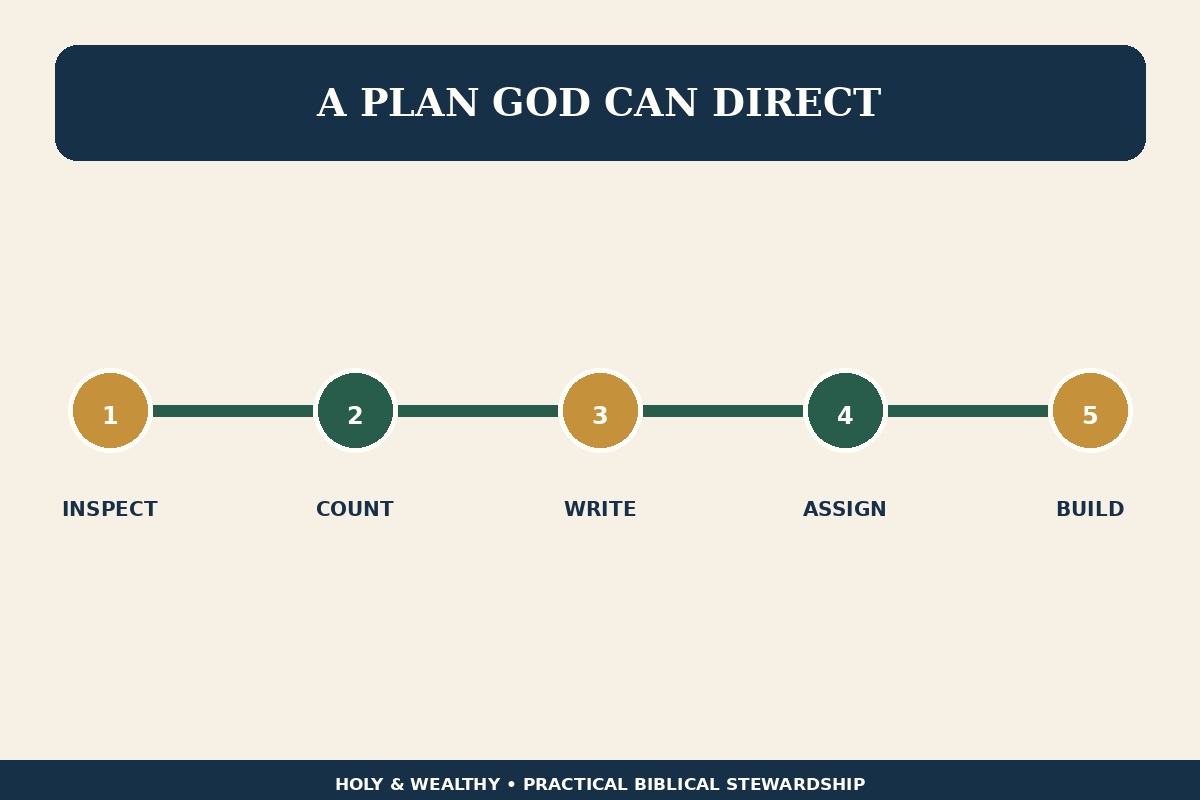
Success in the Bible does not begin in the moment something is accomplished. It begins much earlier, on paper, in the quiet work of thinking something through before it ever takes physical shape. Habakkuk 2:2 says, "Write the vision, and make it plain upon tables, that he may run that readeth it" (KJV). God did not tell Habakkuk to simply remember the vision or feel strongly about it. He told him to write it down and make it plain.
This is why planning matters in the kingdom of God. It is not a worldly add-on to our spiritual walk. It is the practical expression of taking a vision seriously enough to give it form. If you want to understand how this connects to daily living, take a look at my thoughts on How to Create a Christian Budget When Money Is Tight: A Biblical Step by Step Guide, where we break down the mechanics of putting numbers to your faith. Once you have got your numbers set up there, you will also find it helpful to read my guide on How to Save Money on a Small Income as a Christian Without Living in Fear to protect what you build. Clarity comes from the discipline of sitting down and working out, in detail, what your stewardship requires.
Proverbs 21:5 reinforces the same principle from a different angle: "The thoughts of the diligent tend only to plenteousness; but of every one that is hasty only to want" (KJV). Diligence is not just working hard with your hands. It is working thoughtfully with your mind before your hands ever touch the task.
Many believers treat budgeting and financial planning as secular chores that distract from spiritual devotion. But when you look closely at Proverbs, diligence is framed as a spiritual requirement. God does not bypass your analytical thinking to drop wealth into your lap. He expects you to engage your mind. The diligent person thinks ahead, calculates risks, sets aside reserves, and builds a sustainable path forward.
Creation Reveals Order Before Occupation
If anyone had the power to act without planning, it would be God. He could have spoken creation into existence in any order, yet the pattern scripture shows us is one of deliberate, orderly preparation. Ephesians 1:4 says God chose us in Christ before the creation of the world, working backward from a plan that existed before anything was made.
Genesis 1 shows a clear, ordered sequence. Light came first, then the sky, then land and vegetation, then the luminaries, and only after every system needed to sustain human life was in place did God create man. The earth was fully prepared before the person meant to live in it ever arrived. That is what planning looks like at the highest possible level.
This matters because it answers a question many believers quietly carry. Does planning mean a lack of trust in God? The opposite is true. When we align our finances with Kingdom Money Principles From the Bible, we realize that preparation is an act of obedience. God is an orderly God, and He invites us to mirror that order in our personal economies.
When you refuse to set up a monthly spending plan or track where your income goes, you are essentially living in chaos and expecting heaven to bless the confusion. Order invites peace. Chaos breeds anxiety. If you want to experience peace in your household finances, you have to establish structural order first.
Provision Looks Ahead
There is a detail in language that most people miss entirely, and it changes how you should think about provision. The word provide comes from the Latin providere, which means to see ahead, to foresee, and to prepare in advance for something before it arrives. When you sit down and map out your finances, you are participating in this exact dynamic.
Many believers think of provision as something that simply shows up when needed, like a cheque arriving exactly when the bill is due. But the actual meaning of the word points somewhere else entirely. To provide is to see a need before it fully arrives and to prepare for it ahead of time. That is why a believer who refuses to plan is, often without realising it, refusing to participate in the very process the Bible calls provision.
If you find yourself constantly living from crisis to crisis, you might want to read my guide on Why Am I Living Paycheque to Paycheque as a Christian? to see how foresight breaks the cycle.
Provision is rarely an instantaneous miracle in Scripture. Most of the time, God's provision looks like wisdom applied months before the need arises. Think of Joseph in Egypt. God gave him a dream about seven years of abundance followed by seven years of famine. Did God just plan to rain manna from heaven during the famine? No. He gave Joseph a plan to store grain during the good years so the nation could survive the lean years. Preparation was the miracle.
Solomon and Nehemiah Counted What the Assignment Required

When Solomon was given the task of building the temple, he did not simply begin construction on faith alone. 1 Kings 5:17-18 describes the careful sourcing of large, high-quality stones for the foundation, and verse 18 lists the specific craftsmen who prepared the timber and stone. Solomon calculated what materials were needed and assembled the skilled workers required to complete the project.
Nehemiah shows the same pattern centuries later when he was burdened to rebuild the walls of Jerusalem. Before he ever picked up a tool, Nehemiah 2:13-15 describes him surveying the broken walls at night, examining the damage personally, and assessing exactly what needed to be done before announcing his plan to anyone else. Both men, given a clear assignment from God, responded by planning thoroughly before acting.
Luke 14:28-30 records Jesus Himself teaching this exact principle: "For which of you, intending to build a tower, sitteth not down first, and counteth the cost, whether he have sufficient to finish it? Lest haply, after he hath laid the foundation, and is not able to finish it, all that behold it begin to mock him, saying, This man began to build, and was not able to finish" (KJV).
Jesus is not discouraging us from stepping out in faith. He is warning us against launching into major life undertakings without sitting down to count the cost. Faith without calculation is presumption. When you make a financial plan, you are counting the cost of your future.
Planning Usually Looks Ordinary
Years ago, I had a business idea I genuinely believed in, and I needed funding to get it started. I went to my brother, and the first thing he asked for was a business plan. At the time, it felt like an obstacle standing between me and what I wanted to build. Looking back, I understand exactly why he asked. A plan is evidence.
It shows whether you have actually thought through what you are asking support for, or whether you are simply hoping enthusiasm will be enough to carry the idea forward. People extend trust, resources, and support to plans they can see and evaluate, not to feelings they cannot measure. As we build our capacity for stewardship, learning How to Choose an Income Producing Skill That Fits Your God Given Abilities becomes just as important as writing down your financial goals.
God honours the ordinary work of mapping out your next steps. He fills the plans you actually make, not the blank spaces you left behind out of fear or laziness. Write down your numbers. Set your savings targets. Map out your debt repayment strategy. Bring your spreadsheets and your notebooks into your prayer time, and ask the Holy Spirit to guide every line you draw.
Where To Read Next
If this resonated with you, let us keep exploring what faithful stewardship looks like together through these related guides:
Why Christians Struggle With Money: The Honest Truth Nobody Preaches On Sunday
How to Create a Christian Budget When Money Is Tight: A Biblical Step by Step Guide
- How Does Money Change Relationships According to the Bible? — Another piece in this series.
- What Does the Bible Say About Your Relationship With God and Money? — Another piece in this series.
- Is It Biblical to Pray a Prayer That Invokes Wealth From God? — Another piece in this series.
Frequently Asked Questions
Is financial planning a lack of faith for Christians?
Not at all, brethren. Biblical faith and practical planning work hand in hand. Throughout Scripture, figures like Joseph, Solomon, and Nehemiah planned meticulously before executing God-given assignments, treating preparation as an act of faithful stewardship.
What does the Bible say about writing down financial plans?
Habakkuk 2:2 instructs us to write the vision and make it plain. In financial terms, this means moving your goals, budgets, and spending intentions out of your head and onto paper so you can steward them with clarity and accountability.
Why do my prayers for financial breakthrough feel unanswered?
Often, we ask God to bless unstructured chaos. If you have not defined your financial destination or set a realistic plan for your income and expenses, faith has no practical framework to anchor onto. God honors diligence alongside prayer.
How can I start planning my finances from a biblical perspective?
Start by assessing your current reality with complete honesty, just as Nehemiah surveyed the broken walls. Count your actual income and expenses, write down clear goals that align with your purpose, and commit your steps to God daily in prayer.
Does Jesus teach financial planning in the Gospels?
Yes. In Luke 14:28-30, Jesus explicitly teaches about counting the cost before building a tower, warning against starting a project without sufficient resources to finish it. Planning is presented as a mark of wisdom and maturity.
Found this helpful? Share it with someone who needs it.