
Many Christians love the moment Joseph stands before Pharaoh, but the palace can mislead us if we ignore the years that formed the man who entered it. Joseph had a dream, yet the dream did not excuse him from service. He carried God's presence into work that was not his, a house he did not own and a prison he did not deserve.
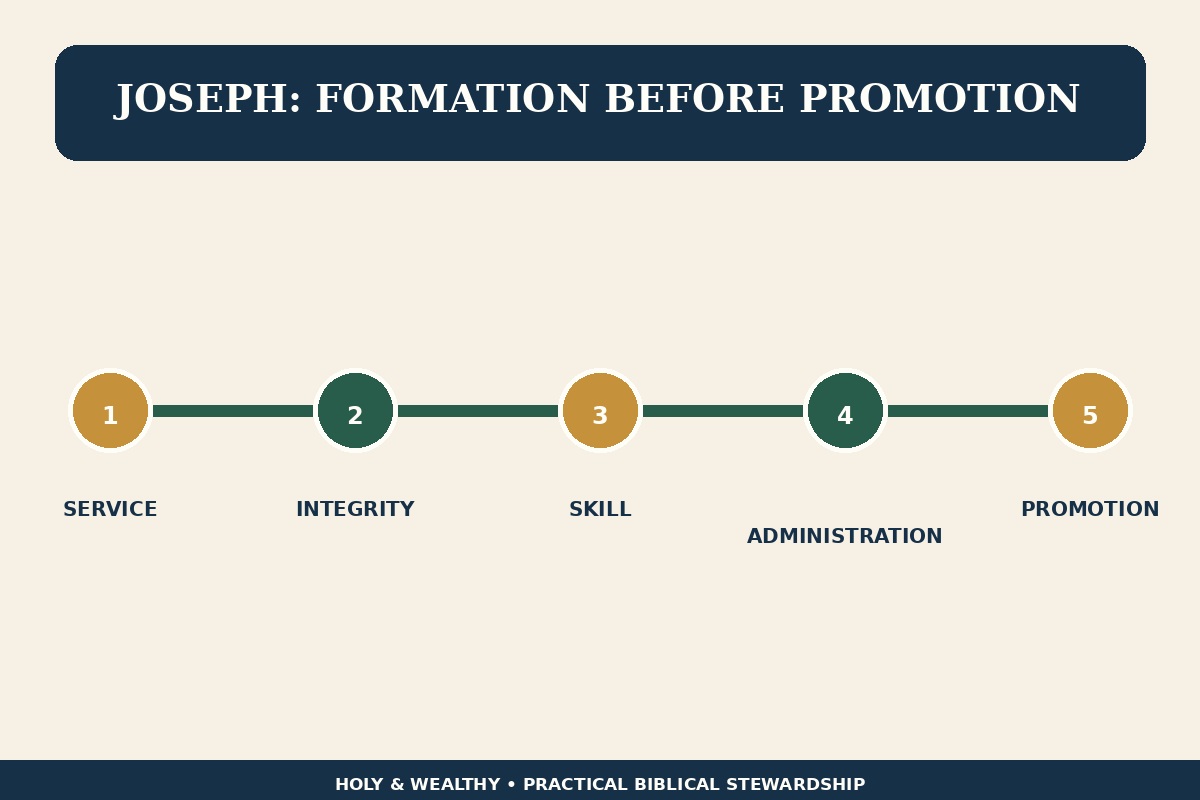
Success in Joseph's life was not merely the change of clothing, title or location. It was the repeated evidence that his inner life could remain faithful while his circumstances changed. Before he managed Egypt, he managed what another person placed in his hands. If you are trying to understand why your own breakthrough feels delayed, why God is delaying your financial breakthrough might be the exact conversation you need to read today. Before he commanded people, he served them. Before he stored grain, he understood the problem and designed a plan.
That is the part many believers want to skip. We want elevation without the discipline required to remain useful after elevation arrives.
What Does Joseph Teach Us About True Biblical Success?
To really understand what Joseph did, we have to look at the root meaning of the word success in Scripture. In Hebrew, the primary word often associated with Joseph's progress is tsalach, which means to push forward, to break through, or to profit through honest labour. When Genesis 39:2 tells us that the Lord was with Joseph and he prospered, it is not talking about an overnight lottery win. It is describing a man being pushed forward into purpose through sustained, faithful execution of daily tasks. True biblical success is never passive. It is the friction of character meeting responsibility in the exact place God has planted you.
Most of us want the crown without ever stepping foot in the pit. We pray for financial abundance while resenting the small budget we currently have to manage. As we explore why Christians struggle with money, the root issue is rarely a lack of divine favour. It is usually a mismatch between the capacity we are asking God for and the stewardship capacity we have actually built in secret.
Joseph Refused to Let His Condition Name His Future
To understand what Joseph did, you first have to understand what slavery meant in his world. A slave had no rights, no future, no path to advancement. His value was measured entirely by his usefulness to his master. Most people in that position would have allowed the circumstance to define them completely, because the circumstance left no obvious room for anything else.
Joseph refused to let the environment write his identity. Genesis 39:2-3 says that the Lord was with Joseph, and he prospered, and he lived in the house of his Egyptian master. When his master saw that the Lord was with him and that the Lord gave him success in everything he did, Joseph found favour in his eyes. Notice what is happening here. Joseph is still a slave. Nothing about his legal status has changed. But he is working with such diligence and excellence that his master cannot ignore what he sees. Joseph did not wait for his circumstances to improve before he decided to bring his full effort.
If your current job feels beneath you, I want to gently remind you that faithful work in someone else's house is often the exact testing ground God uses before He hands you your own. Joseph brought his full effort inside the circumstance he was actually in, and that effort is what eventually changed the circumstance.
He Trusted God Inside an Unfinished Story
It is easy to read Joseph's story from the outside, already knowing how it ends, and assume the path was somehow lighter for him than it would be for anyone else. It was not. Joseph did not know, while he was sweeping floors in Potiphar's house or sitting forgotten in an Egyptian prison, that any of it was leading anywhere good. He had a dream years earlier, given to him as a teenager, but he had no roadmap connecting that dream to a slave's quarters or a prison cell.
Every day that passed without change was a day he had every reason to believe the dream had simply been wrong. Or that he had misunderstood it entirely. Or that it was never going to happen at all. When financial pressure hits us today, we often panic because the story looks unfinished and uncertain. If you are carrying the heavy weight of past financial mistakes, you might find comfort in reading about shame and financial failure as a Christian, because God's redemptive work is never limited by our past chapters.
Genesis 39:21 says that the Lord was with him and showed him mercy, and gave him favour in the sight of the keeper of the prison. Notice where this verse is placed. Not after his release. While he was still in prison, with no indication of when or whether release was coming. Joseph's trust in God did not wait for evidence that the outcome would be good.
Integrity Protected the Man Before It Protected His Position
Potiphar's wife pursued Joseph repeatedly. Genesis 39:10 describes her speaking to him day after day, and Joseph refusing to give in. This was not a single moment of temptation. It was sustained pressure over time, and it came with a particular kind of opportunity that many people in his position would have quietly justified taking. Think about the practical reasoning available to him. He was a slave with no standing of his own. The wife of the most powerful man in his world wanted him.
Saying yes could have meant protection, favour, an easier path through a system that owed him nothing. Many people facing that exact calculation today, in far smaller versions of it, convince themselves that this is simply how advancement works. They believe that compromising quietly in private has no real cost as long as no one finds out. But integrity is not just about avoiding scandal. It is about protecting the vessel that God wants to fill with greater responsibility.
Joseph's answer is recorded in Genesis 39:9, where he asks, How then could I do such a wicked thing and sin against God? Not against Potiphar primarily. Against God. He understood that his integrity was not a performance for an audience. It was a posture before God that held regardless of who was watching.
He Used His Gift Before Anyone Gave Him a Platform

Here is one of the most overlooked details in the entire story. Joseph did not wait for the right environment before he started using his gift. In prison, a place designed to suppress and confine, Genesis 39:22 says the keeper of the prison committed to Joseph's hand all the prisoners that were in the prison. Even in confinement, his administrative gift could not be hidden. He simply used it wherever he was.
Later, when Pharaoh's cupbearer and baker had troubling dreams, Joseph noticed their distress and asked about it. Genesis 40:8 records his response: Do not interpretations belong to God? Tell me them, I pray you. He did not need a stage or permission from a system that owed him nothing. He saw a need in front of him, a gift inside him that could meet it, and he offered it freely.
This is the third thing most believers today refuse to do. They wait for an opportunity to present itself, a platform to be handed to them, a door that someone else opens, before they begin using what God already placed inside them. Joseph's pattern is the exact opposite. He worked where he was planted until the work itself forced the door open.
Promotion Was Followed by Immediate Work
This is perhaps the most important part of the story for understanding biblical success principles, and it is the part most often skipped. After interpreting Pharaoh's dream and being appointed second in command over all of Egypt, Joseph had every justification to settle into the comfort that came with the position. New clothes, a new name, a wife from a respected family, authority over the most powerful nation in the ancient world. He had arrived.
Except he did not stop to celebrate for a year. Genesis 41:46 tells us that Joseph went out from the presence of Pharaoh, and went throughout all the land of Egypt. Immediately. Promotion in the Kingdom of God is never a retirement package. It is an expansion of responsibility. When God increases your income or gives you a financial breakthrough, He is not handing you a bigger luxury budget. He is testing your capacity to manage resources on a larger scale for His purposes.

What Most Christians Refuse to Do Today
Let us be entirely honest with ourselves for a moment. When we look at Joseph's life, we admire the ring on his finger and the chariot he rode in. But we consistently refuse the path that made those things possible. We want the blessing without the breaking. We want the financial harvest without sowing faithful effort in the obscure seasons of life.
Here is what living out Joseph's success actually requires of us as believers today:
Embracing hidden faithfulness when no one is clapping for your work or noticing your financial discipline.
Treating your current job, no matter how small or frustrating, as your primary training ground.
Refusing to compromise your integrity when cutting corners looks like the faster route to financial relief.
Taking personal responsibility for your financial planning instead of waiting for a miraculous bailout.
If you are tired of waiting for things to change, stop asking God to change your address and start asking Him to change your daily diligence. Excellence in the small things is the only bridge to the big assignments.
Where To Read Next
If this conversation resonated with you and you want to keep digging into how God shapes our financial faithfulness and identity, here are a few other posts I want to recommend:
Why Christians Struggle With Money: The Honest Truth Nobody Preaches On Sunday
The Story of Joseph in the Bible: 10 Powerful Lessons From His Life
- How Does Money Change Relationships According to the Bible? — Another piece in this series.
- What Does the Bible Say About Your Relationship With God and Money? — Another piece in this series.
- Is It Biblical to Pray a Prayer That Invokes Wealth From God? — Another piece in this series.
Frequently Asked Questions
What was the secret to Joseph's success in the Bible?
Joseph's success was rooted in God's presence combined with unwavering personal integrity, consistent excellence in obscure places, and practical administrative skill. He treated every role, whether slave or prime minister, as an assignment from God.
How did Joseph prepare for future financial crisis?
During the seven years of plenty, Joseph designed and implemented a systematic storage plan, collecting a fifth of the harvest across Egypt to prepare for the subsequent famine, demonstrating proactive financial stewardship.
Why is integrity emphasized so much in Joseph's story?
Integrity protected Joseph from moral and relational ruin when he was tested in private by Potiphar's wife. Scripture shows that private obedience precedes public trust and long-term stability.
Can Christians apply Joseph's economic principles today?
Yes. Believers can apply Joseph's model by working with diligence in their current jobs, planning ahead for economic uncertainty, refusing compromise, and viewing financial management as stewardship rather than personal ownership.
Found this helpful? Share it with someone who needs it.