
It can disturb a sincere believer to watch someone who does not confess Christ build a stable business, save consistently, and grow in influence while people who pray every week remain trapped in the same financial cycle. I remember looking at a former university roommate years ago, someone who had no time for church or faith, and watching him systematically build three thriving properties while I was still trying to figure out how to stretch my last paycheque to cover rent and tithe. The easy response is to call all unbelieving success corrupt. The honest response is to ask what they may be practising that believers have neglected. That question should lead us towards learning rather than jealousy.
Jesus Himself said that the children of this world are, in their generation, wiser than the children of light. That statement should humble us deeply. It does not make darkness greater than light. It reveals that people can understand timing, preparation, negotiation, systems, and opportunity while those who possess spiritual light refuse to develop practical wisdom.
Money is not salvation, and financial success does not prove that a life is right with God. Yet financial principles still produce results. If we ignore them, our confession will not cancel the consequence. If you have ever felt that quiet friction between your faith and your bank balance, you are not alone. It is part of a broader struggle that I examined closely in my post on why Christians struggle with money, where we looked at the hidden assumptions that keep faithful people financially stuck.
Jesus Gave an Uncomfortable Comparison
Before anything else, look at what Jesus said in Luke 16:8 that rarely makes it into a Sunday message: "For the children of this world are in their generation wiser than the children of light" (Luke 16:8, KJV). Jesus Himself acknowledged that people outside the kingdom often understand and apply principles of wisdom, work, and financial management better than believers do. He was not condemning His followers. He was pointing to a real gap and naming it plainly. The children of the kingdom have access to greater truth and greater wisdom than anyone outside it.
Yet in practice, many are being outperformed by people who are simply paying closer attention to how things work. The Greek word used here for wisdom is phronimos, which implies practical insight, prudence, and shrewdness in human affairs. Unbelievers often excel in phronimos because they study the mechanics of the world with diligence. Meanwhile, believers sometimes substitute passive waiting for active stewardship. We expect God to override economic realities through a miracle while ignoring the natural laws He set in motion. That gap is not God's design. It is the result of a system that taught believers to replace kingdom knowledge with religious performance and called it devotion.
Markets Often Reward Value Before Belief
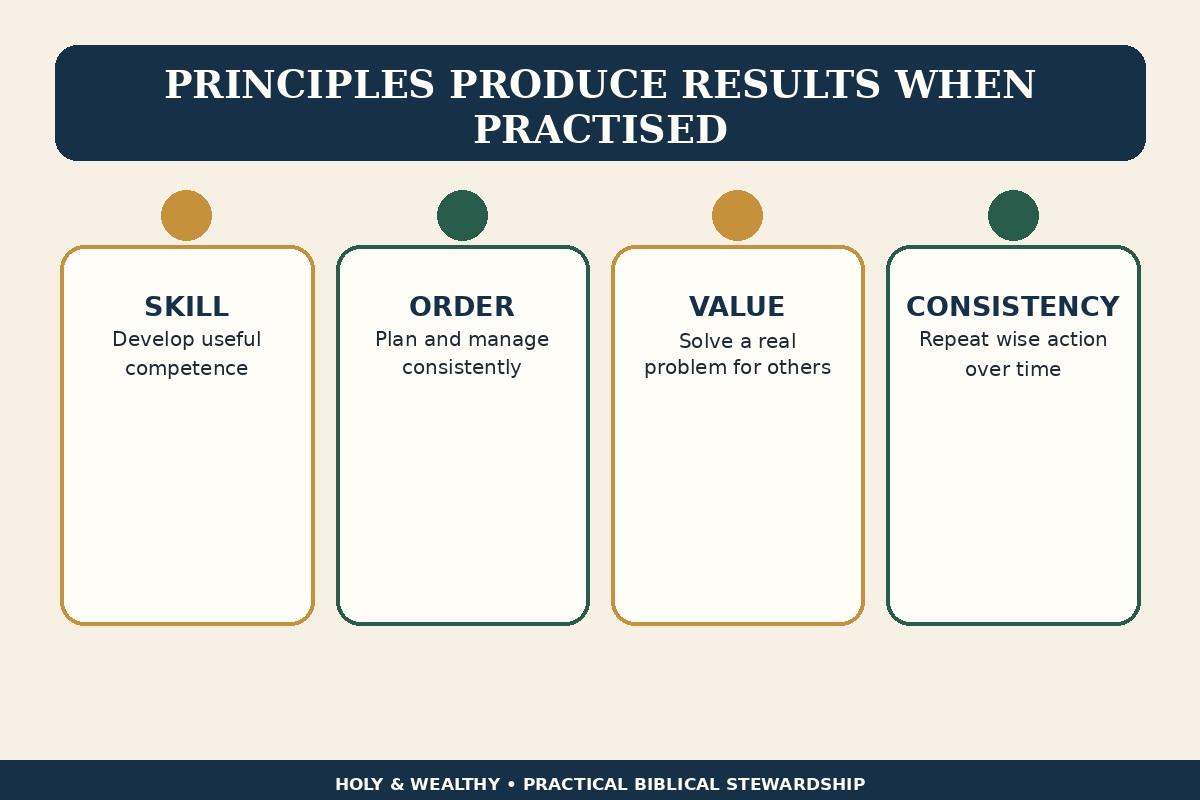
Look honestly at what many people outside the faith are actually doing that produces financial results. They invest in knowledge. They read, study, and learn how money works, how businesses are built, how skills are developed and monetised. They treat the acquisition of useful knowledge as a priority, not a distraction. They build skills that create value for other people. They understand that income follows the ability to solve a problem. Proverbs 22:29 describes exactly this: "Seest thou a man diligent in his business? he shall stand before kings; he shall not stand before mean men" (Proverbs 22:29, KJV).
The Hebrew root for diligent here is mahir, which means prompt, skilled, expert, or quick-handed. The principle belongs to God. But anyone who applies it benefits from it, regardless of whether they acknowledge the source. They plan and manage carefully. They know what they earn and what they spend. They save consistently and invest patiently. And they are patient enough to understand that financial stability is built over years through consistent decisions, not through a single breakthrough moment. None of these things are worldly wisdom in the sense of being opposed to God.
Every one of them is a principle that God embedded into the system of creation and documented in the pages of scripture. The difference is that many believers were told these things were secondary to spiritual activity and were not told that applying these principles was itself an act of honouring God. This is one expression of the wider problem we explored when discussing the poverty mindset the church accidentally gave you, where believers sometimes separate spiritual devotion from the practical wisdom required to produce and preserve value. A principle does not ask who believes it before producing its result.
Joseph Brought More Than an Interpretation
The Bible holds up a clear example in Joseph. He did not stand before Pharaoh because he prayed the loudest or gave the biggest offering. He stood before Pharaoh because he had something no one else in Egypt had at that moment: the ability to interpret a complex problem and provide a clear solution. The practical formation behind that moment is explored in depth in our guide on what Joseph did to succeed in the Bible. Genesis 41:39-40 records Pharaoh's response: "And Pharaoh said unto Joseph, Forasmuch as God hath shewed thee all this, there is none so discreet and wise as thou: Thou shalt be over my house, and according unto thy word shall all my people be ruled: only in the throne will I be greater than thou" (Genesis 41:39-40, KJV). The Hebrew word used for discreet here is navon, which points to discernment, understanding, and the intellectual capacity to separate moving parts and structure them into an orderly plan.
A gift developed through years of faithfulness in genuinely unjust circumstances placed a Hebrew slave in charge of the most powerful nation on earth. The change came as his developed ability solved a real problem for someone in a position of great influence, not as a prophecy or seed offering detached from preparation. That is kingdom economy in action. God gives ability, the person develops it through faithfulness, the ability creates value, and that value can open an opportunity through which provision comes. That chain has been operating since Genesis and it has never stopped working. If you want to dive deeper into how this operational mindset functions, take a look at Kingdom Money Principles From the Bible.
Daniel Joined Conviction With Excellence

The book of Daniel shows what happens when believers apply kingdom principles in an environment that does not share their faith. When Daniel and his companions were selected for service in the king's palace, the standards were extraordinarily high. Daniel 1:4 describes what Babylon required: young men in whom was no blemish, but well favoured, and skilful in all wisdom, and cunning in knowledge, and understanding science, and such as had ability in them to stand in the king's palace.
Knowledge, aptitude, the ability to learn quickly, and practical qualification were the standards of one of the most powerful empires in history. And the believers met them and exceeded them. Daniel 1:20 records that "And in all matters of wisdom and understanding, that the king enquired of them, he found them ten times better than all the magicians and astrologers that were in all his realm" (Daniel 1:20, KJV).
They were found ten times better, not because God gave them an advantage without effort, but because they combined genuine faith with diligence, learning, and excellence. That is the standard the Bible holds up for God's people: excellence rather than mere survival or simply getting by. The kind of quality that makes even those outside the faith take notice. If you want to understand how this translates into modern work, you will find it helpful to read about what Daniel teaches Christians about excellence and skill.
The Kingdom Is Not Short of Capacity
One of the things the poverty mindset produces is a scarcity mentality. The idea that there is only so much to go around, that wanting more is greedy, or that wealth itself is spiritually dangerous. Psalm 24:1 says: "The earth is the LORD'S, and the fulness thereof; the world, and they that dwell therein" (Psalm 24:1, KJV). Deuteronomy 8:18 reminds us: "But thou shalt remember the LORD thy God: for it is he that giveth thee power to get wealth, that he may establish his covenant which he sware unto thy fathers, as it is day" (Deuteronomy 8:18, KJV). The Hebrew word for power here is koach, which means strength, power, or operational capacity. God gives the capacity to produce resources.
There is no shortage in God's design. There is no hoarding culture in His kingdom. There is multiplication, generosity, and abundance for all who apply the principles He created. Laziness is not part of kingdom culture. Financial passivity is not part of kingdom culture. When believers master their craft, manage their resources with discipline, and provide genuine solutions to the world, wealth follows as a natural byproduct of faithful stewardship. For a closer look at how ambition aligns with scripture, read our piece on Is It a Sin for a Christian to Want to Be Rich?.
Where To Read Next
Is It Biblical to Pray a Prayer That Invokes Wealth From God? — Worth reading next.
What Does the Bible Say About Your Relationship With God and Money? — Worth reading next.
How Does Money Change Relationships According to the Bible? — Worth reading next.
If this blog resonates with where you are right now, you do not have to stop here. We have put together several resources to help you bridge the gap between faith and practical financial growth: Start with our pillar guide on Why Christians Struggle With Money to understand the deeper systemic patterns holding believers back.
Read What Did Joseph Do to Succeed in the Bible? to see how preparation meets opportunity in real life.
Explore The Poverty Mindset the Church Accidentally Gave You to break free from unbiblical guilt around financial success.
Check out Is It a Sin for a Christian to Want to Be Rich? for a biblical perspective on ambition and wealth.
Frequently Asked Questions
Is it a sin for a Christian to be wealthy?
No, wealth itself is not a sin in the Bible. Scripture warns against the love of money and trusting in riches rather than God, but many faithful biblical figures like Abraham, Job, and Solomon managed significant wealth while remaining devoted to God. The key issue is stewardship and the posture of your heart.
Why do unbelievers often succeed financially while believers struggle?
Unbelievers often succeed because they apply universal economic laws such as diligence, skill development, risk management, and market awareness. These principles operate regardless of religious affiliation. When believers neglect practical wisdom while relying solely on prayer without action, they often fall behind.
Does the Bible support learning financial skills from secular sources?
Yes, Jesus commended the practical shrewdness of worldly people in Luke 16:8. Wisdom, budgeting, investing, and problem-solving are neutral tools created by God. Learning how markets work and how to manage money effectively does not compromise your faith; it enhances your capacity to give and serve.
How can a Christian start building wealth without compromising their faith?
You can start by identifying an income-producing skill that solves real problems for others, as seen in the life of Joseph. Combine that with biblical stewardship principles like budgeting, avoiding bad debt, saving consistently, and maintaining absolute integrity in all your business dealings.
Further Reading
Found this helpful? Share it with someone who needs it.