
I remember staring at bank statements I could not fix, sitting in a church pew while pretending everything was completely fine. You smile. You shake hands. You sing the worship songs, declaring loudly that God is good. Yet inside your jacket pocket, there is a final notice for rent, and on your phone, there are three missed calls from debt collectors. This is the quiet reality for so many believers today. A person may still greet everyone on Sunday and say they are trusting God, while bills remain hidden in a kitchen drawer and panic keeps them awake at two in the morning.
When money goes wrong in the life of a believer, the financial loss hurts, but the silent embarrassment is what truly crushes the soul. In my core article on why Christians struggle with money, I talked about how deeply we confuse spiritual devotion with practical management. Shame does not only say you made a mistake. Shame says you are the mistake. That subtle lie keeps people hiding long after the numbers could have been faced, repaired, and put right. Right there in the dark. And believe me, it destroys years of your life before you even realize what is happening.
The very first human response after falling into error in the Garden of Eden was hiding. Genesis 3:8 shows Adam and his wife hiding themselves from the presence of the Lord among the trees. Shame still uses that exact same ancient strategy today. It separates you from the light, cuts you off from wise counsel, and breaks the very relationships through which help and restoration might come.
But conviction works in a completely different way. Conviction identifies what went wrong, calls you into the light, and offers a path back to health. If you are experiencing financial failure as a Christian, I am not going to offer you fake comfort or tell you that practical consequences do not exist. Some bad decisions must be repaired, and some debts must be paid. But hear me clearly, child of God: you are not beyond wisdom, mercy, or a fresh starting point.
The Root of Shame: What the Hebrew Language Reveals About Financial Failure
When you feel crushed by financial shame, you need to understand what is actually happening inside your spirit. The word shame in our English Bibles comes from deep root concepts in original scripture. In the Hebrew Old Testament, the primary word for being put to shame is bosh (בּוֹשׁ). It does not simply mean feeling awkward or embarrassed. And believe me, the difference is heavy. The root meaning of bosh is to dry up, to be delayed, to wither, or to be bitterly disappointed because an expectation was completely broken. Not just a minor setback.
You see this exact root used in Psalm 34:5, which promises," They looked unto him, and were lightened: and their faces were not ashamed" (Psalm 34:5, KJV).
When Psalm 34 says their faces were not bosh, it means they were not left dried up or ruined by their trust. But when money fails, when a business idea collapses, or when debt piles up, your mind tells you that you have dried up. You look at your empty hands and feel as though your identity as a believer has withered away. You think, "I am a child of the King, so why is my bank balance zero?"
That clash between who you are called to be and where you currently sit creates deep spiritual friction. Every single day. The enemy takes that disappointment and turns it into a permanent sentence. But the Hebrew Bible shows that bosh is a temporary state, not an eternal identity. When you take your dried-up situation to God without hiding, He specializes in bringing life back to dry places. Your expectation may have failed in one season, but your God has not failed.
Shame and Conviction Do Not Speak the Same Language
The shame that comes with being broke as a believer is not random. It has a specific source, and understanding that source changes how you respond to it. When a man cannot provide for his household, when a woman cannot meet the basic needs of those depending on her, or when you are always the one receiving while never able to give, the emotional pain you feel is real. It hurts deep down. It is the friction of purpose colliding with poor execution. Every single time.
You and I were created in the image of a God who provides, builds, and brings order out of chaos. Genesis 1:27 confirms that God created man in His own image. When you carry that divine identity yet find yourself unable to manage basic financial commitments, your conscience feels a deep jar. Proverbs 10:5 plainly states,
"He that gathereth in summer is a wise son: but he that sleepeth in harvest is a son that causeth shame" (Proverbs 10:5, KJV).
Hear that truth. The Bible does not pretend that financial mismanagement carries no weight. It acknowledges clearly that there is a connection between how we handle seasons of opportunity and the fruit we harvest.
However, you must learn to distinguish between the voice of shame and the voice of the Holy Spirit. Shame speaks in absolute judgements: "You are a total failure, you will never recover, God is finished with you, and everybody in church is judging you." Conviction speaks in specific, restorative terms: "That loan was a mistake, that budget was ignored, and that spending habit needs to stop today. Let us get up and fix this." Shame drives you into a dark corner to hide your account statements. Conviction leads you to open those statements, lay them on the table, and seek biblical wisdom. I remember when I had to confront my own habits, as I wrote in my story of empty hands and hard lessons, hitting rock bottom was actually the exact spot where true financial stewardship finally began.
The Man at the Gate Had More in Him Than His Condition
In Acts chapter 3, Peter and John were walking up to the temple at the hour of prayer when they met a man who had been unable to walk from birth. Every single day, relatives laid him at the gate called Beautiful so he could beg for small coins from worshippers entering the temple grounds. Think about that picture for a moment, brethren. Just let it sink in. He was sitting right at the entrance of a house built for God's glory, yet he was completely dependent on charity just to stay alive. Day after day.
The people passing by daily knew him solely by his condition. He was simply "the beggar at the gate." That is one of the quietest, most painful parts of prolonged financial trouble. When you are always the one without, people begin to attach your financial lack directly to your name. You become known as the relative who always asks for emergency loans, the friend who can never pay their fair share, or the church member who always needs benevolence funding. Acts 3:5 records that when Peter and John approached him,"he gave heed unto them, expecting to receive something of them" (Acts 3:5, KJV).
Notice that detail. He had been sitting in that broken state so long that his expectation had shrunk to small change. He was no longer looking for transformation, health, or a new way of living. He was merely hoping for a temporary handout to survive one more day. That is what financial shame does when you let it settle in your heart. It destroys your vision and trains you to accept survival instead of restoration. But Peter refused to give him temporary coins. Acts 3:6-7 says,
"Then Peter said, Silver and gold have I none; but such as I have give I thee: In the name of Jesus Christ of Nazareth rise up and walk. And he took him by the right hand, and lifted him up" (Acts 3:6-7, KJV).
Peter spoke to the capacity that was buried beneath decades of paralysis. The man stood up, walked into the temple, and began leaping and praising God. Brethren, financial recovery requires that exact same refusal to lie on the ground and live on sympathy.
Unseen Capacity Can Survive a Failed Season

Here is a foundational truth you must grasp if you are going to overcome the weight of past financial mistakes: a failed season does not equal a destroyed capacity. The problem for most struggling believers is rarely a complete lack of ability. Not by a long shot. It is an ignorance of the latent value God has already placed within their hands. Proverbs 18:16 gives us a profound economic principle: "A man's gift maketh room for him, and bringeth him before great men" (Proverbs 18:16, KJV).
Notice that scripture points first to a gift, not to cash flow. A gift in this context is a refined skill, a practical problem-solving capability, or an ability that creates undeniable value for other human beings. When your business collapses, your bank account drops to zero, but your ability to organize, communicate, design, build, teach, or trade remains completely intact. Absolutely nothing changes about your core gifting. The money may be gone, but the engine that produces value is still inside you. If you are wondering how to rebuild after taking a heavy hit, looking into how to turn God-given gifts into honest work will help you shift your attention from what you lost to what you still carry. Every person reading these words was created with purposeful capability. Ephesians 2:10 declares,
"For we are his workmanship, created in Christ Jesus unto good works, which God hath before ordained that we should walk in them" (Ephesians 2:10, KJV).
The works were prepared before you took your first breath, and the capacity to fulfill them was built into your spirit. Financial failure does not delete that original design. It simply covers it under layers of fear, exhaustion, and public embarrassment. Once you strip away the lie of shame, that capacity is still sitting there, waiting to be trained, polished, and put to work.
How to Stop Hiding Your Financial Failure From God and Yourself
You cannot fix a financial issue that you refuse to name clearly. As long as you use overly spiritual vocabulary to mask poor habits, you will remain trapped in the exact same cycle. Calling a lack of budgeting a demonic attack or calling reckless spending living by faith prevents you from taking practical responsibility. If you want to walk out of financial shame, you must begin with ruthless, quiet honesty.
First, bring your real numbers into the light. Take out a pen and paper, sit down at your desk, and write out every single debt, missed payment, and monthly commitment you owe. No exceptions. Do not minimize the numbers in your head. Look at the total figure directly. It may make your stomach drop, but the moment a number is written down, it loses its mysterious, terrifying power. It changes from a dark monster in your imagination into a simple mathematical problem that can be tackled step by step over time.
Second, take those numbers to God in honest prayer. Do not pray polished, fake prayers pretending everything is wonderful. Tell Him, "Father, I managed my money foolishly. I took loans I could not afford, I spent money out of pride, and now I am in trouble. I need Your forgiveness, Your wisdom, and a clear strategy to clean up this mess." James 1:5 promises that if any person lacks wisdom, they can ask of God, who gives liberally without reproaching them. God does not scold you for asking for wisdom to repair a mistake. He simply gives you what you need. He supplies the blueprint.
Third, get practical accountability from mature individuals. Shame thrives in darkness and secrecy. When you keep your financial crisis a complete secret, you are far more likely to make desperate, foolish decisions, such as taking high-interest fast loans to cover existing debt. Talk to a trusted pastor, a financially grounded Christian mentor, or an experienced advisor who will not judge you, but will help you establish a real debt payback plan. In our guide on how to get out of debt biblically, we walk through how structured discipline breaks the cycle without compromising your spiritual integrity.
What Does the Bible Say About Rebuilding Your Life After Going Broke?
When you have suffered a severe financial blow, whether through a failed business investment, job redundancy, illness, or personal mistakes, scripture offers concrete hope for rebuilding. The Bible is full of men and women who experienced catastrophic loss and yet, through God's mercy and practical wisdom, stood back on their feet.
Look at the promise given in Joel 2:25-26,
"And I will restore to you the years that the locust hath eaten... And ye shall eat in plenty, and be satisfied, and praise the name of the LORD your God, that hath dealt wondrously with you: and my people shall never be ashamed" (Joel 2:25-26, KJV).
Read it again. Notice those final words: my people shall never be ashamed. God made that pledge to a nation whose crops had been completely destroyed. They were facing agricultural collapse and economic ruin. God did not tell them that shame was their forever identity. He promised restoration, hard work, harvest, and the total removal of public disgrace.
Rebuilding requires that you replace quick-fix thinking with steady, disciplined effort. Proverbs 13:11 teaches, "Wealth gotten by vanity shall be diminished: but he that gathereth by labour shall increase" (Proverbs 13:11, KJV).
Fast money that comes from get rich quick schemes or desperate gambles almost always leads back to deeper shame. But money built through steady labour, skill development, and careful management grows securely. If you spent years making poor decisions, accept that it may take months or years of quiet, faithful stewardship to rebuild your foundation. That is not a curse; it is character building under the supervision of God.
You must also realize that prayer without a structural plan leaves you vulnerable to repeating the exact same errors. As I explained in why God cannot bless a plan you never made, faith is not a substitute for proper planning. Faith works alongside practical structure. When you combine sincere prayer with a structured monthly budget, a realistic debt repayment schedule, and a commitment to upskilling, God's blessing has a clear channel through which it can flow.
If you feel entirely stuck right now and do not even know what scripture to stand upon during your morning quiet time, taking time to meditate on key Bible verses for breakthrough will help anchor your mind in truth while you execute your practical steps.
Living With Your Head Held High While You Rebuild
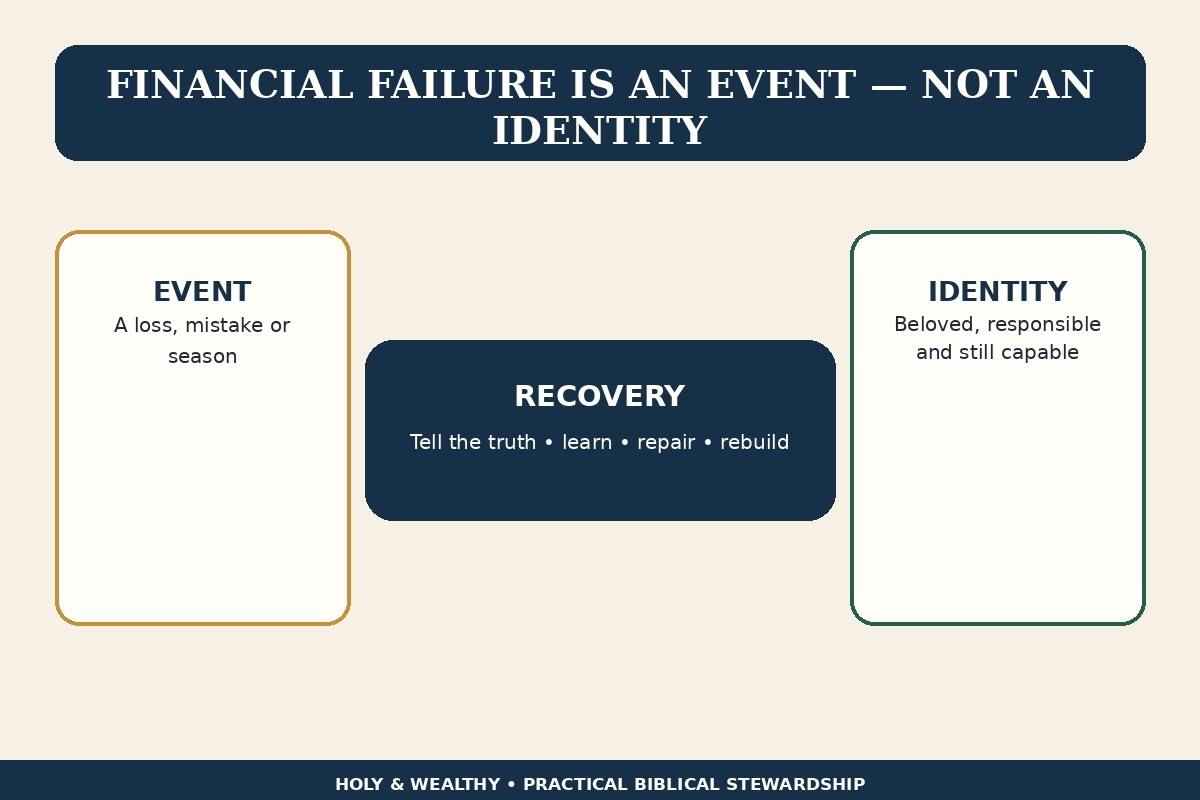
Child of God, you need to understand that your financial net worth is not your spiritual identity. Your bank balance reflects your current asset position; it does not reflect your value in the eyes of Almighty God. Not by a long shot. Jesus Christ paid for your redemption with His precious blood, not with silver or gold. When you stand before God, He sees you through the righteousness of His Son, not through your credit score.
Isaiah 54:4 speaks directly to those who feel humiliated by past failure,
"Fear not; for thou shalt not be ashamed: neither be thou confounded; for thou shalt not be put to shame: for thou shalt forget the shame of thy youth, and shalt not remember the reproach of thy widowhood any more" (Isaiah 54:4, KJV).
This promise was written for people who knew the exact bitter taste of public embarrassment and financial loss. God declares that the day is coming when the pain of your past mistakes will be nothing more than a faint memory, a story of testimony that you use to encourage someone else sitting in the exact same dark place you once occupied.
Stop hiding from church leadership, stop lying to your family members, and stop avoiding the telephone calls. Walk into the room, face the reality of your current numbers, ask God for daily wisdom, and begin taking small, consistent, obedient actions every single morning. The season of hiding is officially over. It is time to let conviction refine your character and let God's truth carry you back into financial health, peace, and fruitfulness.
Where To Read Next
If you are ready to take your practical and spiritual restoration seriously, here are several articles from the blog that will help you build a solid foundation:
Why Christians Struggle With Money: The Honest Truth Nobody Preaches On Sunday
My Honest Story of a Christian Struggling With Money: Empty Hands and What I Finally Learned
How to Get Out of Debt as a Christian Without Stopping Giving: A Biblical Approach
- How Does Money Change Relationships According to the Bible? — Another piece in this series.
- What Does the Bible Say About Your Relationship With God and Money? — Another piece in this series.
- Is It Biblical to Pray a Prayer That Invokes Wealth From God? — Another piece in this series.
Frequently Asked Questions
Is financial failure a sign of God's punishment or disapproval?
No, financial failure is not evidence that God has rejected or cursed you. While bad money decisions carry natural economic consequences, God uses difficult financial seasons to instruct, correct, and mature our stewardship rather than destroy us. Romans 8:1 reminds us that there is no condemnation for those in Christ Jesus.
How do I handle the embarrassment of family and church members knowing I am broke?
You handle it by separating your self-worth from human opinion and focusing on quiet, consistent rebuilding. Stop trying to maintain an expensive lifestyle image to impress people who do not even care about your struggles. Be honest about your current boundaries, refuse to engage in prideful comparison, and let your long-term disciplined progress speak for itself.
What should I do first when I cannot pay my basic living expenses as a Christian?
Your immediate priority must be basic survival costs: food, shelter, utilities, and transport you simply cannot avoid. Just be honest with yourself. List these expenses first, cut out every bit of lifestyle spending that you can live without, and contact your lenders directly to explain your situation before they contact you. Real talk.
Is it wrong to feel guilty about poor financial choices I made in the past?
Feeling godly conviction over past foolish choices is natural and healthy because it leads to repentance and change. However, holding onto constant, paralyzing guilt after you have confessed those mistakes to God is unbiblical. God forgives your past and provides the grace and practical wisdom necessary to rebuild your financial life moving forward.
Found this helpful? Share it with someone who needs it.