
The Gospel That Requires No Price Tag
The deepest problem with the prosperity gospel is not that it expects God to provide. God truly provides, and the problem is not that believers are taught to give. Giving belongs to Christian life. The problem begins when Christ is moved from the centre and a financial mechanism takes His place.
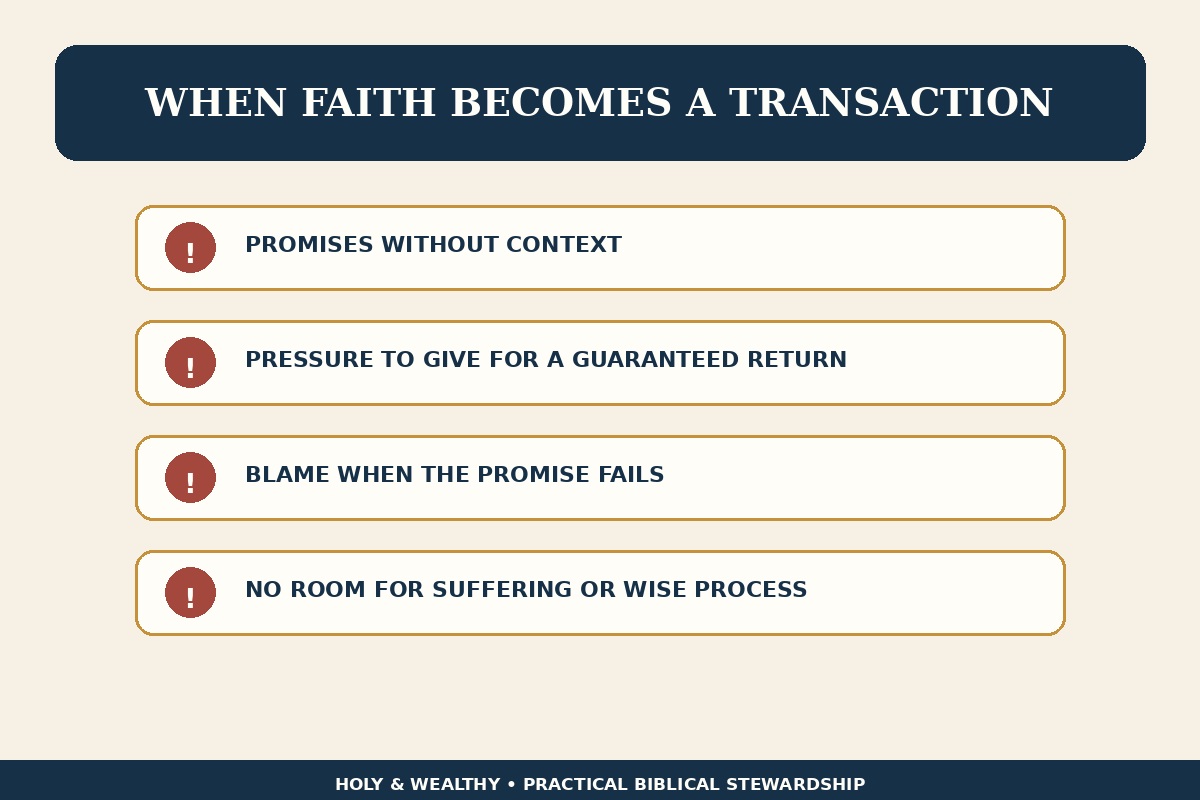
The message then becomes simple: give the correct seed, speak the correct words, honour the correct person and God will release the result. When the result does not come, the system rarely questions itself. It questions the wounded believer. Perhaps you doubted. Perhaps your seed was too small. Perhaps you dishonoured the anointing. That is how hope becomes pressure and worship becomes fear.
I want to say this clearly without mocking prayer, giving or the supernatural. The gospel is powerful enough to be defended without becoming cruel to people who are already suffering. As we examine what is wrong with the prosperity gospel, we have to look past the surface claims and examine the actual linguistic roots of how this teaching distorts the original text.
When a Financial System Replaces the Gospel
This is the first and most important thing to say. The prosperity gospel is not the gospel at all. It is a system dressed in gospel language that has replaced the actual good news with something else entirely. If you have ever wondered why prayer often feels like a commercial transaction in these spaces, I explored that dynamic in my post on praying for wealth from God, where the focus shifts away from communion toward acquisition.
To understand why this system is so deceptive, we need to look at the very root of the word we use every single day. The English word gospel comes from the Old English gōdspel, meaning good news. But when we look back to the ancient languages, the depth opens up. In Greek, the word is euangelion, composed of 'eu' meaning good and 'angelos' meaning messenger or message. In the ancient world, it was proclaimed when a king won a battle. But in Hebrew, the underlying concept connects to 'besorah', the bearer of tidings of victory and peace.
The apostles used euangelion to proclaim that Jesus Christ had conquered sin, death, and hell. Yet in modern transactional pulpits, this glorious announcement has been quietly redefined as a financial exchange rate. You invest earthly currency into a ministry platform, and heaven is forced to pay a hundredfold return.
When you move money and financial blessing to the centre of the message, you have not added to the gospel. You have replaced it. And a replaced gospel, no matter how confidently it is preached, is not the gospel at all.
"But though we, or an angel from heaven, preach any other gospel unto you than that which we have preached unto you, let him be accursed." (Galatians 1:8, KJV)
Compare the Message With the Ministry of Jesus
Ask a simple question: in the four Gospels, what did Jesus preach? He preached repentance, the kingdom of God, forgiveness of sins, healing for the broken, freedom for the captive and good news for the poor. Luke 4:18 records His own words about why He came that The Spirit of the Lord is upon me, because he hath anointed me to preach the gospel to the poor (KJV).
The Greek term used here for poor is ptochos, which describes someone who crouches or cowers like a beggar, utterly destitute and dependent on mercy. Jesus did not come to hand out real estate portfolios to the elite. He came to rescue the helpless. If you are trying to understand why so many believers carry unnecessary financial burdens, you will find real clarity in my reflection on why Christians struggle with money, which forms the bedrock of our entire discussion on financial stewardship.
Now look at the book of Acts. How did the apostles minister? They preached the resurrection, healed the sick, cast out demons and suffered for the message, were thrown in prison, beaten, and killed for it. Paul lists his credentials in 2 Corinthians 11:24-27: beaten five times, shipwrecked three times, in danger constantly, cold and hungry and naked. This is the man who carried the gospel across the known world. He was not living in abundance. He was living in faithfulness.
The euangelion announces grace; it does not sell access to God. The Latin term gratia reminds us that grace is entirely unearned, flowing from the Latin root 'gratus' meaning pleasing or thankful. You cannot buy grace with a seed offering.
Giving Cannot Purchase Belonging
One of the clearest signs that something has gone deeply wrong with prosperity teaching is the claim that if you do not pay your tithe, your salvation is compromised. To recover giving as genuine worship rather than a commercial contract, I suggest reading my thoughts on why tithing alone will not make you wealthy and how obedience differs from purchasing divine favour. And please, i invite you also to explore Tithes, Offerings and Firstfruits: What Is the Difference? ti get more understanding.
I sat in a service once where a well-known preacher stood at the pulpit and said exactly that, plainly, without softening it. I remember looking around the room and watching people who were visibly struggling financially nod along, as if their salvation genuinely depended on money they could not afford to give that month. I did not challenge it out loud that day. I have thought about that room many times since.
Think about what that claim actually says. It says that a financial payment determines your eternal destiny. It says the blood of Jesus Christ is not enough on its own. That His sacrifice at Calvary, the sacrifice that Hebrews 9:12 describes as obtaining eternal redemption for us, requires your ten percent to be complete.
John 14:6 says that I am the way, the truth, and the life: no man cometh unto the Father, but by me (KJV). The way is through Jesus, not through a tithe or any other offering. That verse has no asterisk.
Money Cannot Stand Between God and a Human Soul
Some teachers in the prosperity gospel space have gone further still, teaching that when you sow a financial seed it speaks for you. That your money becomes a voice on your behalf before God.
The Bible is clear about who speaks on your behalf. Romans 8:34 says that It is Christ that died, yea rather, that is risen again, who is even at the right hand of God, who also maketh intercession for us (KJV). Hebrews 7:25 says that He is able also to save them to the uttermost that come unto God by him, seeing he ever liveth to make intercession for them (KJV).
Jesus intercedes for you and me, not the offering envelope nor your seed. Not even your monetary gift to a ministry. The blood of Jesus, Hebrews 12:24 says, speaks a better word than the blood of Abel (KJV). Money has no voice in the courts of heaven. It never did. The teaching that it does is not a creative interpretation of scripture. It is a replacement of the gospel with a system where the seed rarely produces for the person planting it, whatever it may produce for the platform receiving it.
The Fruit of a Transactional Gospel
Set the theology aside for a moment and look simply at results. What does the prosperity gospel actually produce in the lives of ordinary believers who follow it consistently?
It produces passivity. When you believe that your financial breakthrough is tied to your seed offering and your level of confession, there is no practical reason to develop a skill, build a business, or learn how money works. You are waiting for the miracle that the seed will trigger. And while you wait, nothing gets built. If you want to understand how scripture actually views diligent work and personal responsibility, take a look at my guide on what Joseph did to succeed in the Bible.
It produces financial dependency. Believers stop budgeting, stop saving, and stop engaging in the slow, unglamorous work of faithful stewardship. When financial stress hits, many families find themselves trapped in cycles of debt because they were taught to wait for a miracle instead of managing what is in their hands. Building long-term stability requires practical wisdom, something I often discuss when exploring how to build an emergency fund on a small income without losing your faith in the process.
Why Believers Fall for the Prosperity Message
We must ask ourselves an honest question. Why does this teaching find such a massive audience across the globe? Why do sincere children of God pack stadiums to hear promises of immediate wealth?
The answer is simple, though it hurts to admit. It offers relief from pain. When inflation is rising, when jobs are scarce, when you are tired of living paycheque to paycheque, the promise of a supernatural financial shortcut is intoxicating. It whispers that your suffering is about to end if you just release a little more cash.
False teachers prey on desperation. They take the legitimate human desire for security and dignity and twist it into greed disguised as faith. But true biblical faith does not exploit the vulnerable. It walks with them through the valley, points them to Christ, and teaches them how to work with integrity.
How to Walk Away From Transactional Religion
If you have spent years caught in this system, carrying guilt because your financial harvest never matched your seed offerings, let me offer you some pastoral relief. You do not owe anyone an apology for being broke. You do not need to buy your way back into God's favour.
God loves you with an everlasting love that has nothing to do with your bank balance. Release the shame of the past. Pick up your Bible, read the text for yourself without a preacher filtering it through a fundraising campaign, and return to the simplicity of the cross.
True abundance is found in knowing Christ, walking in obedience, and stewarding whatever resources He places in your hands with diligence and peace. That is the true euangelion. And it does not require a seed offering to work.
Frequently Asked Questions
What is the core error of the prosperity gospel?
The core error is treating God, faith, and spiritual gifts as commodities in a financial transaction. It teaches that monetary giving can compel God to release material wealth, replacing the finished work of Jesus Christ with a commercial exchange system.
Does the Bible promise financial wealth to all believers?
No. While Scripture contains promises of provision, care, and the blessings of obedience, it never guarantees that every believer will become wealthy. The New Testament writers frequently experienced hardship, poverty, and persecution while remaining faithful to God.
Is it wrong for a Christian to desire financial success?
Desiring financial stability, provision for your family, and resources to bless others is entirely biblical. The danger begins when wealth becomes an idol or when the pursuit of money replaces your devotion to God.
Why do people continue to follow prosperity preachers?
Many believers are drawn to these teachings because they offer hope and emotional relief during intense financial struggle. False teachers capitalise on poverty, desperation, and the human desire for a quick solution to complex economic problems.
How can I recover from prosperity theology?
Start by returning to the uncompromised Word of God, specifically reading the Gospels and Paul's epistles without financial overlays. Focus on sound stewardship, honest work, and understanding that your righteousness comes through Christ alone, not through financial seed-sowing.
Where To Read Next
If you want to keep exploring how Scripture guides our relationship with money and guards against distorted teachings, here are a few articles you should read next:
Why Christians Struggle With Money: The Honest Truth Nobody Preaches On Sunday
Is It Biblical to Pray a Prayer That Invokes Wealth From God?
Why Tithing Alone Will Not Make You Wealthy and What the Bible Says It Actually Does
What Did Joseph Do to Succeed in the Bible? What Most Christians Refuse to Do
- How Does Money Change Relationships According to the Bible? — Another piece in this series.
- What Does the Bible Say About Your Relationship With God and Money? — Another piece in this series.
- Why Christians Struggle With Money: The Honest Truth Nobody Preaches On Sunday
- Why Is God Delaying My Financial Breakthrough Even Though I Pray Every Day?
- My Honest Story of a Christian Struggling With Money: Empty Hands and What I Finally Learned
- How to Prepare for a Financial Crisis as a Christian
- Why God Cannot Bless a Plan You Never Made
Found this helpful? Share it with someone who needs it.