
There was a period when my income was slowly dwindling. My wife said we had not been tithing and believed the enemy was attacking our finances. I was under pressure and needed an answer, so the following month I began tithing again. Looking back, I can now see two truths at the same time. I still believe the tithe belongs to God, but my motive in that moment had become transactional. I was thinking, I will pay this, and God will release my breakthrough.
Our financial habits were also scattered. We were spiritually serious, full of teaching and prayer, yet we were not applying enough order to our own household. Tithing did not create the disorder, but it could not hide it either.
That experience taught me why this conversation must be honest. Tithing can express worship, honour and trust. It cannot replace wisdom in the rest of our financial life.
If you are tired of hearing half-truths from the pulpit about money, you are not alone. As we speak, thousands of believers are stuck in a cycle of giving faithfully while drowning in debt because the church taught them tithing as an investment strategy rather than an act of worship. Let us look at what the Word of God actually says about this matter. This is why understanding why Christians struggle with money requires looking beyond a single religious habit.
Blessing Is Bigger Than an Account Balance
To understand what tithing does and does not produce, you first need to look at the linguistic roots of scripture, because the modern pulpit definition of blessing bears almost no resemblance to the biblical text. The Hebrew word for blessing is barak, which carries the physical imagery of kneeling before a ruler to receive a bestowal of life, enablement, and favour. It is relational long before it is material.
When Scripture speaks of blessing, it encompasses the Hebrew concept of berakah, representing divine empowerment to succeed, whereas the tenth itself comes from the root maaser, signifying a tenth part set apart as holy. In Latin theological tradition, this was understood as benedictio, a speaking well over a person that translates into operational capability rather than passive cash accumulation.
Deuteronomy 28:12 says that The Lord will open the heavens, the storehouse of his bounty, to send rain on your land in season and to bless all the work of your hands (Deuteronomy 28:12, KJV). Read that carefully. God promises to bless the work of your hands. Not to drop cash into your lap while you remain idle. The blessing lands on the labour. It multiplies what diligence and skill are already producing. When we isolate tithing from the broader framework of biblical stewardship versus ownership, we miss how God designed provision to function. You see what I mean, don't you?
Read Malachi as a Call Back to Covenant Faithfulness
Malachi 3:10 is the most quoted tithing verse in the global church, yet it is almost universally ripped out of its historical and covenantal context. To understand why tithing alone will not make you wealthy, you must read from where the indictment begins in verse 8.
Malachi 3:8-12 reads that Will a mere mortal rob God? Yet you rob me. But you ask, How are we robbing you? In tithes and offerings. You are under a curse, your whole nation, because you are robbing me. Bring the whole tithe into the storehouse, that there may be food in my house. Test me in this, says the Lord Almighty, and see if I will not throw open the floodgates of heaven and pour out so much blessing that there will not be room enough to store it. I will prevent pests from devouring your crops, and the vines in your fields will not drop their fruit before it is ripe, says the Lord Almighty. Then all the nations will call you blessed, for yours will be a delightful land, says the Lord Almighty (Malachi 3:8-12, KJV).
Notice the distinct agricultural framework here. The prophet was addressing an agrarian society whose physical survival depended on seasonal rain, pest control, and livestock management. When Israel withheld the tithe, they broke covenantal loyalty. When they brought it, God promised to protect their economic output from environmental ruin. He did not promise to balance their personal ledgers, bail them out of reckless consumer loans, or manage their household expenses while they slept.
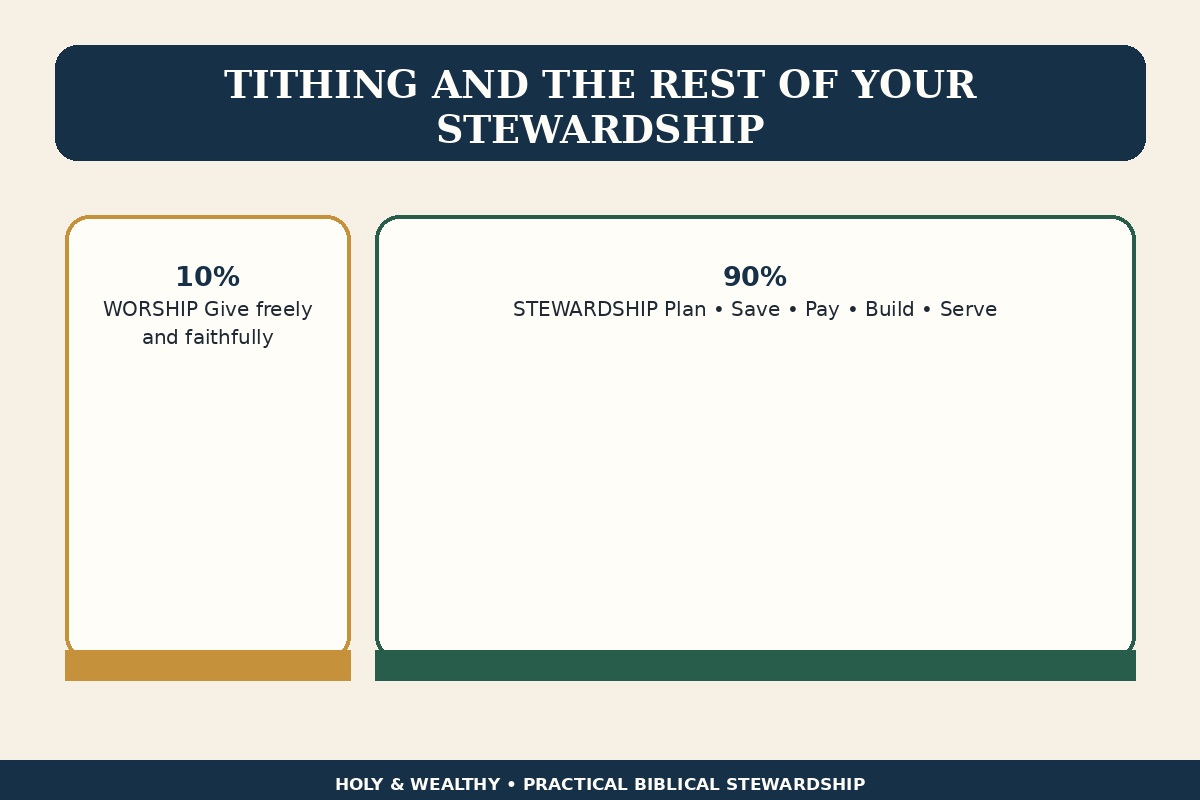
Honouring God with the maaser does not exempt you from exercising wisdom across the remaining ninety percent of your income. If your spending habits are chaotic, no religious ritual will save your bank account from collapse. When you look at why Christians pray for financial breakthrough and nothing happens, the missing link is almost always disciplined execution after the prayer ends.
Tithing Is Not an Investment Product
Is tithing a financial strategy designed to yield a guaranteed financial return? The scriptural answer is a definitive no. Treating the tithe as an investment vehicle corrupts the heart posture behind it, shifting worship into commerce.
Proverbs 3:9-10 says that Honour the Lord with your wealth, with the firstfruits of all your crops; then your barns will be filled to overflowing, and your vats will brim over with new wine (Proverbs 3:9-10, KJV). The operative word is honour. The firstfruit offering is an explicit declaration that God is the source and owner of all production. The overflowing barns are the natural byproduct of a life anchored in divine alignment, not the mechanical payout of a cosmic vending machine.
2 Corinthians 9:7 makes this motivation crystal clear that Each of you should give what you have decided in your heart to give, not reluctantly or under compulsion, for God loves a cheerful giver (2 Corinthians 9:7, KJV). Paul wrote this during a practical collection for impoverished saints, emphasizing that generosity flows from a transformed heart, not a coerced calculation.
The deeper realities explored in my honest story of a Christian struggling with money show why no single spiritual discipline can carry the weight of responsibilities that God has distributed across planning, diligence, saving, and self-control. When you treat God as your portfolio manager rather than your Lord, you miss the relational depth of the covenant.
Honour and Stewardship Belong Together
Recognising why tithing alone will not make you wealthy requires separating the act of worship from the daily mechanics of financial management. They are two distinct pillars of a faithful life, and teaching one while ignoring the other leaves believers defenseless against poverty.
Tithing is your baseline expression of worship and trust. It places your life under the covenantal covering described in Malachi and Deuteronomy. It says to God that He holds first place in your economy.
Stewardship is everything that happens after the tithe leaves your hand. It is how you handle the remaining ninety percent. It involves disciplined budgeting, intentional saving, eliminating consumer debt, and cultivating marketable skills. The parable of the talents proves that God expects us to actively manage, multiply, and deploy the resources entrusted to our care, a principle unpacked fully in the parable of the talents is a business plan.
If your prayers for financial breakthrough have felt like they are hitting the ceiling, read what I shared in why is God delaying my financial breakthrough even though I pray every day because heaven often waits for us to take practical stewardship seriously before releasing greater capacity into our hands.
The Other Ninety Percent Still Needs Wisdom
One of the most striking biblical examples of divine blessing operating alongside rigorous administrative execution is found in the life of Joseph. When Pharaoh elevated Joseph from a prison cell to second-in-command over Egypt, God's favour was undeniably upon him.
Yet Genesis 41:46 records that Joseph was thirty years old when he entered the service of Pharaoh king of Egypt and went out from Pharaoh's presence to travel throughout the nation (Genesis 41:46, KJV).
Joseph did not rely solely on spiritual revelation to save Egypt from famine. He instituted a nationwide taxation and storage policy, collecting twenty percent of the harvest during the years of abundance and locking it away in fortified granaries. God's supernatural insight empowered Joseph, but grain storage, logistical planning, and operational discipline kept a nation alive.
If Joseph had spent seven years praying without building storehouses, Egypt would have perished. Divine favour did not replace human diligence. It demanded it. As you examine what Joseph did to succeed in the Bible, you realize that administrative competence was his true vehicle of execution.
What Did the Early Church Teach About Possessions?

A common misconception in modern teaching is that the early church in Jerusalem abandoned personal property, budgeting, and financial management entirely. A careful reading of the text shatters this notion.
In Acts 4 and 5, believers sold lands and houses voluntarily to alleviate a catastrophic famine and poverty crisis among the local saints. Yet Peter addresses Ananias in Acts 5:4 with a striking affirmation of personal property rights: While it remained, was it not thine own? And after it was sold, was it not in thine power? (Acts 5:4, KJV).
Scripture never condemns private property, industrious work, or structured financial planning. It condemns greed, hoarding, and trusting in riches rather than God. Ignoring basic financial education under the guise of deep spirituality is a rejection of biblical wisdom found throughout Proverbs and the practical epistles.
How to Align Your Giving and Your Budgeting Today
If you want to experience true financial peace without falling into the trap of transactional religion, you must build an integrated financial life. Tithing anchors your soul in worship, while budgeting and diligence build the walls of your household.
Here are three practical steps you can take starting today:
First, detach your giving from mathematical manipulation. Give your tithe out of pure gratitude and covenant honour, releasing any notion that God owes you a financial return simply because your payment cleared the bank.
Second, audit the remaining ninety percent of your income. Most believers do not have a giving problem; they have an awareness problem. If you do not track your money down to the last coin, no amount of fasting will fix your deficit. Write down every expense and bring order to your ledger.
Third, hone your vocational skills. Wealth creation in scripture is consistently tied to productivity, solving real problems, and serving people with excellence. If your income cannot sustain your family and your giving, invest time in becoming more valuable through training and diligent labor.
Now that you have seen the depth of this truth, take it off the screen. Stop treating giving as a business contract and start pairing your worship with disciplined execution in your household. Sit down this evening, look at your numbers, and build a plan that honours God with both your firstfruits and your daily management.
Frequently Asked Questions
Is tithing mandatory for Christians under the New Covenant?
The New Testament does not impose a legalistic percentage tax on believers, but it passionately calls for radical, joyful, and systematic generosity. Jesus explicitly endorsed the tithe in Matthew 23:23 while rebuking the religious leaders for neglecting justice, mercy, and faith. Giving under grace is an act of love and worship, not legal compliance.
Can I stop tithing if I am in severe debt?
Many believers face intense distress when consumer debts swallow their monthly income. While some voices suggest pausing the tithe to pay creditors, tithing should remain an act of foundational faith while you simultaneously attack your debt through aggressive budgeting and lifestyle changes. Stopping your giving does not correct the underlying spending habits that caused the debt.
Does God promise financial wealth to everyone who gives?
No, teaching that God guarantees earthly riches in exchange for financial contributions contradicts the whole counsel of Scripture. God promises provision, blessing, and the capacity to produce wealth, but material wealth is never presented in the Bible as the definitive standard of spiritual maturity or divine approval.
What is the difference between a tithe, an offering, and firstfruits?
The tithe represents the baseline ten percent return dedicated as holy to God. Offerings are voluntary contributions given above and beyond the tithe to support ministry, missions, or those in need. Firstfruits involve honouring God with the initial and best portion of a new venture or income stream before utilizing the rest.
Where To Read Next
Found this helpful? Share it with someone who needs it.