Most of the chronic anxiety you feel about money is rooted in a single misunderstanding. You believe you own what you have. And legal ownership is a terrifying position to be in when the thing you own is fragile, temporary, and constantly under threat from economic shifts, inflation, or unexpected emergencies that you cannot control.
I know this fear personally. Years ago, I used to check my bank balance multiple times a day with a knot in my stomach. Every expense felt like a personal loss, and every bill felt like a threat to my security. I was treating every coin as if I had created it myself and as if its loss meant my total destruction. I was living like an owner, and it was crushing me.
The revelation that changes everything is not a new financial strategy or a quick investment trick. It is a fundamental identity shift. The moment you understand biblical stewardship versus ownership, something deep inside your heart loosens. The tight grip relaxes. The frantic panic begins to lift.
When you stop trying to own what you have, you suddenly become capable of managing it with clarity, freedom, and wisdom. You realize that you were never called to bear the heavy weight of ultimate ownership in the first place.
To really grasp this, we have to go back to the original languages of Scripture. This is not just a theological concept. It forms one of the foundational pillars in the core principles of Kingdom money management found in Scripture, because every budget, purchase, investment, and gift begins with a single question: who owns what is in your hands?
The Ancient Root of Stewardship: What the Original Languages Reveal
The word "steward" in our English Bibles comes from a rich root. In the Greek New Testament, the word used for steward is oikonomos. It is a compound of two words: oikos, which means household, and nemo, which means to arrange, manage, or distribute.
So, an oikonomos is literally a household manager. The overall responsibility itself is called oikonomia, from which we get our modern English word "economy". But notice the vast difference: modern economics is about scarcity and consumption, while biblical oikonomia is about faithful administration of another person's estate.
A steward in the ancient world was not a slave without authority. A steward held immense administrative power. He could sign contracts, manage budgets, supervise servants, and deploy capital. Yet, despite all his authority, the steward owned zero percent of the assets he managed. Not a single room, not a single coin, not a single acre belonged to him. "Moreover it is required in stewards, that a man be found faithful." (1 Corinthians 4:2, KJV)
In the Hebrew scriptures, we see a similar picture. When Joseph managed Potiphar’s house, the Hebrew phrase used is asher al-habbayith, which literally translates to "the one who is over the house". Joseph had total freedom to direct the affairs of the home, yet he never mistook Potiphar's assets for his own property. He managed with excellence because he understood his exact position.
When you understand this, your entire perspective shifts, child of God. God does not demand that you produce resources out of thin air. He asks you to manage what He has already placed in your hands with absolute faithfulness.
The Declaration That Settles God's Ownership Once and For All
Let us be completely clear about what Scripture teaches regarding property. Human beings can hold legal titles, sign land agreements, and own businesses under civil law. But before God, human ownership is strictly secondary and temporary. "The earth is the LORD'S, and the fulness thereof; the world, and they that dwell therein." (Psalm 24:1, KJV)
Notice that David did not say the earth was God's in the beginning and then handed over completely. As we speak, the earth remains the Lord's. The land, the mineral wealth beneath it, the technology you build, and the currency in your purse belong to the Sovereign Lord.
Haggai reinforces this truth when God addresses the returned exiles who were worrying about building materials and economic stability: "The silver is mine, and the gold is mine, saith the LORD of hosts." (Haggai 2:8, KJV)
You may have worked forty hours this week to earn your paycheque. You may have stayed up late building your business. But who gave you the physical health to wake up? Who gave you the mental clarity to solve problems? Who created the market in which your skills hold value?
Moses warned Israel against the dangerous myth of self-made wealth just before they entered the Promised Land. He told them to remember that it is the Lord who gives the power to get wealth (Deuteronomy 8:18). Money does not become spiritually independent simply because you worked hard for it. The strength, time, and opportunity were all received gifts.
Owner Mindset Versus Steward Mindset: The Practical Difference
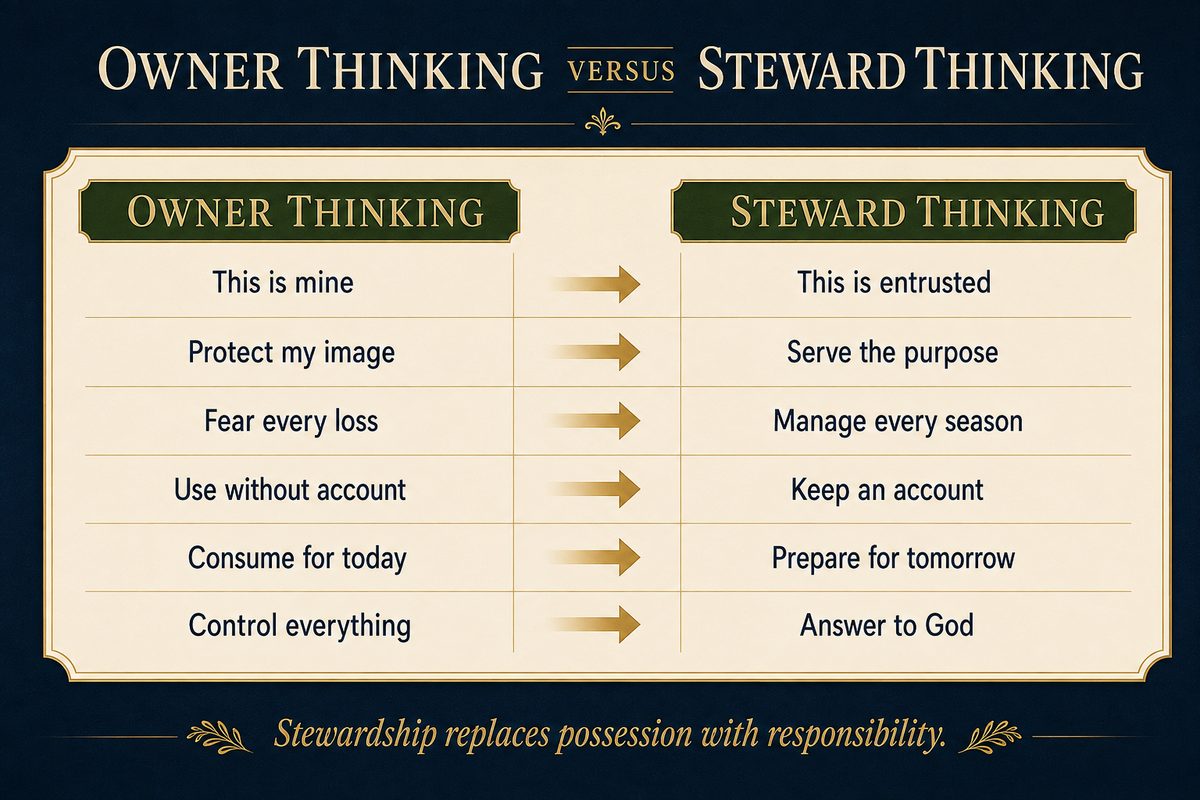
Understanding biblical stewardship versus ownership is not an academic exercise. It dictates every single micro-decision you make with your wallet. The difference between an owner mindset and a steward mindset is visible in how two different believers respond to identical financial situations.
An owner operates out of scarcity and pride. A steward operates out of abundance and accountability. When an owner receives income, the default question is: "What can I do with my money? How can this serve my comfort, my status, and my security?"
A steward asks a fundamentally different set of questions: "Lord, what is this portion for? What does the Owner intend for these funds? How can I deploy this to meet needs, build the family, and advance the Kingdom?"
When you view your salary through the lens of ownership, giving feels like a painful loss. Tithing feels like someone taking a cut of your hard-earned reward. But when you view your resources through stewardship, giving is simply transferring the Owner's money to the Owner's designated recipients.
If you have struggled with the feeling that giving limits your personal financial progress, it helps to examine the underlying reasons why so many Christians struggle with money today. Many of us were taught to budget as owners first and then give God a tip, rather than managing the whole sum on His behalf.
What Job Learned When He Lost Everything in a Single Day
We cannot discuss the fear of loss without looking closely at the life of Job. Job was the wealthiest man in the East. He possessed thousands of livestock, vast tracts of land, large numbers of servants, and a thriving family. Yet in a single afternoon, catastrophic reports arrived one after another until everything was gone.
Look at Job's immediate response when the grief hit him: "Naked came I out of my mother's womb, and naked shall I return thither: the LORD gave, and the LORD hath taken away; blessed be the name of the LORD." (Job 1:21, KJV)
Job felt profound grief, and Scripture makes it clear that he mourned deeply. But Job did not suffer an identity collapse. Why? Because he never believed that his livestock, his gold, or his property defined who he was.
Job recognized that he arrived in this world with empty hands and would depart with empty hands. Everything in between was entrusted management. When the Lord recalled a portion of those resources for a season, Job did not accuse God of robbery. You cannot rob a manager of property he never owned.
This truth brings enormous emotional healing, brethren. If your business failed recently, or if you suffered a severe financial setback, hear me clearly: your balance sheet is not your identity. The loss of a resource does not diminish your worth as a child of God. A steward can lose an asset and still stand tall, knowing that the God who entrusted the first portion is fully capable of providing the next.
What the Parable of the Talents Teaches Us About Responsibility

Jesus made stewardship central to His teaching on the Kingdom of God. In Matthew 25:14-30, He tells the famous Parable of the Talents. A wealthy master calls his three servants before traveling to a far country and delivers his goods unto them.
Notice three critical details in this parable that alter how we view work and wealth:
The resources belonged entirely to the master: The text says he delivered "his own goods" unto them. The servants were handling capital that carried his name and his purpose.
The distribution was based on capability: One received five talents, another two, and another one, "to every man according to his several ability." God does not give everyone equal amounts, but He expects equal faithfulness.
The master expected multiplication, not mere preservation: The master was absent for a long time, giving the servants freedom to invest, trade, and build.
The first two servants traded with their talents, took calculated risks, and doubled their capital. When the master returned, he greeted both with identical praise: "Well done, thou good and faithful servant... enter thou into the joy of thy lord."
If you want to read a deeper analysis of how this parable applies to modern business and career growth, I unpacked how Jesus framed practical management in the Parable of the Talents as a real framework for daily work.
The tragedy of the third servant was not just that he buried the talent. His core problem was a distorted view of the master. He told his master, "I knew thee that thou art an hard man... and I was afraid, and went and hid thy talent in the earth."
Fear turned this man into a passive hoarder. He treated stewardship as self-preservation. He was so terrified of losing what he had that he did nothing with it. And Jesus called him a "wicked and slothful servant." God does not bless financial paralysis disguised as caution.
Faithful in Another Man's House: Joseph's Secret to Promotion
Before God ever made Joseph the Prime Minister of Egypt and handed him the keys to the empire's grain reserves, He tested Joseph in a private house. Sold into slavery by his own brothers, Joseph ended up in Potiphar's home as an entry-level bondservant.
Genesis 39:2-4 tells us that the Lord was with Joseph, and he was a prosperous man. Potiphar saw that God was with him and made him overseer over his house, putting all that he had into Joseph's hands.
Think about the posture required for Joseph to excel there. He had been betrayed, stripped of his dignity, and forced into servitude in a foreign land. He could have easily said, "Why should I work hard for Potiphar? This isn’t my house. This isn’t my wealth. I am being exploited."
Instead, Joseph managed Potiphar's home with such pristine integrity and diligence that Potiphar didn't even keep track of his own affairs, except for the bread he ate. Joseph understood a key Kingdom principle that Jesus later articulated in the Gospels: "And if ye have not been faithful in that which is another man's, who shall give you that which is your own?" (Luke 16:12, KJV)
If you are currently working for an employer, managing someone else's business, or handling funds that belong to an organization, do not despise that position, fellow believers. I covered this in depth when examining what it means to be faithful in another person's house during seasons of preparation. Your current job is your training ground for future entrusted stewardship.
Practical Steps to Shift From Owner to Steward Today
Moving from the mental trap of ownership into the freedom of biblical stewardship requires deliberate, practical changes in your daily financial habits. Here is how you walk this out starting today:
Change your prayer language over your finances: Stop praying, "Lord, bless my money." Start praying, "Lord, show me how to manage your funds today." Acknowledge His ownership every time you review your bank statement.
Practice immediate firstfruits giving: The moment income enters your hands, return the tithe and set aside your offerings first. This acts as a monthly spiritual declaration that the remaining ninety percent is still under God's governance.
Budget with purpose, not just expense caps: A steward's budget does not simply list spending limits. It assigns every single pound to a specific assignment,savings, family provision, investment, debt clearance, and Kingdom advance.
Release the shame of past financial mistakes: An owner carries intense personal shame after a loss because they feel their value was destroyed. A steward accepts correction, learns the lesson, adjusts the budget, and keeps moving forward.
Evaluate purchases by return on Kingdom value: Before making major purchases, ask yourself: "Does this asset increase my capacity to serve, provide, and build, or is it merely consuming capital to boost my ego?"
If you are currently working through debt while attempting to establish these principles, it is vital to balance your obligations wisely. You can study practical steps on managing obligations while breaking free from debt biblically without shutting down your heart of generosity.
The Freedom That Stewardship Produces That Ownership Never Can
When you fully embrace biblical stewardship, a quiet confidence replaces your constant monetary panic. You realize that the Ultimate Owner is also your Heavenly Father. And He is infinitely richer, wiser, and more generous than any earthly institution.
Ownership places the whole weight of the future on your shoulders. If you are the owner, then you alone must guarantee your security, your retirement, your protection, and your children's inheritance. No wonder so many people suffer from sleep loss and high stress levels over money matters.
Stewardship invites you into a high-level partnership with Almighty God. Your role is faithful administration; His role is total provision. You bring your best effort, your sharpest planning, and your honest labour to the table, and you rest in the knowledge that He guarantees the outcome.
Jesus put it best in the Sermon on the Mount when He commanded us not to be anxious about what we shall eat, what we shall drink, or what we shall put on. He pointed out that the birds of the air do not sow or reap, yet our heavenly Father feeds them continuously.
If you want to explore more about what Christ taught regarding material possessions, take time to study the subtle teachings of Jesus regarding money and wealth that are frequently overlooked in modern pulpits.
Beloved, nothing you hold today belongs to you. And that is the best news you will hear all week. Release the tight grip. Hand the keys of your financial house back to the One who created the universe. Manage His resources with joy, integrity, and boldness, and watch how He floods your life with peace that passes all human understanding.
Where To Read Next
If this teaching has helped reset your perspective on money and ownership, I encourage you to continue building your foundation with these related studies:
Faithful in Someone Else's House: A Bible Study on God's Presence, Stewardship and Trust
How to Develop a Kingdom Financial Mindset for Successful Living
What Did Jesus Say About Money and Wealth? The Teaching Most People Miss
- Kingdom Economics Versus World Economics: The Biblical Financial System — Another piece in this series.
- What Does Nehemiah Teach About Planning and Leadership? — Another piece in this series.
- How Sabbath Rest Is a Biblical Wealth Principle That Most Believers Have Never Applied — Another piece in this series.
- Kingdom Money Principles From the Bible
- Tithes, Offerings and Firstfruits: What Is the Difference?
- What Does the Bible Say About Saving Money?
- What Does the Year of Jubilee Mean for Christians in Debt?
- When Wealth Becomes an Idol: Biblical Warnings and Protection
- Biblical Investment Principles: What Scripture Teaches and What It Does Not
- How Did Abraham, Isaac, and Jacob Build Generational Wealth? What the Bible Teaches
- Does the Bible Support Multiple Income Streams? What Scripture Says About Financial Diversification
Frequently Asked Questions
What is the main difference between biblical stewardship and ownership?
The main difference lies in control versus management. Ownership assumes that resources belong exclusively to you, placing the entire burden of security and provision on your shoulders. Biblical stewardship recognizes that God owns all resources, while you are entrusted with managing them faithfully according to His principles and purposes.
What does the Greek word oikonomos mean in the Bible?
The Greek word oikonomos combines oikos (house) and nemo (to arrange or manage). It refers to a household manager or administrator who holds full executive authority over another person's estate without holding legal title to any of the property.
How does biblical stewardship reduce financial anxiety and fear of loss?
Stewardship reduces anxiety by shifting your identity away from your bank account balance. When you recognize that assets belong to God, financial shifts or losses no longer destroy your self-worth. You trust that the Owner who entrusted the resources remains responsible for ultimate provision as you stay faithful.
Is it wrong for a Christian to hold property or buy real estate?
No, Scripture fully supports legal ownership of property and business assets within human society. However, biblical stewardship teaches that human property rights are secondary to God's prior ownership. Believers hold legal titles as managers under God rather than absolute owners independent of Him.
How can I practically apply stewardship to my monthly budget?
You can apply stewardship by dedicating the first portion of your income to God through tithes and offerings, assigning every remaining unit of currency to a clear purpose (saving, debt payoff, family care, investment), and asking God for wisdom on spending decisions rather than making them impulsively.
Found this helpful? Share it with someone who needs it.