You have probably felt that ache in your spirit when your pastor announces a new project for the church, but your bank account says you can only offer a prayer. It is a specific kind of frustration. You see the need, you have the heart to help, but you simply do not have the liquid capital to make the problem go away. I have sat in those pews myself, gripping my wallet and wishing I could be the one to sign the cheque that covers the entire roof repair or the missionary’s travel costs. That desire is not greed; it is often the first stirrings of a specific calling.
The biblical meaning of a kingdom financier is a believer who is divinely empowered and commissioned by God to generate and distribute wealth specifically for the advancement of God's purposes on earth. It is a distinct office within the body of Christ, much like a teacher or an evangelist. While every Christian is called to be a steward, not every Christian is called to the specific, high capacity role of a financier. This role is about more than just being "rich"; it is about being a conduit for the resources of heaven to find their way into the work of the ministry.
To understand this deeply, we must look at how God organises His economy. In my own walk, I have realised that God rarely drops money directly from the clouds into a church's bank account. He uses people. He finds individuals He can trust with large sums of money, knowing that when He says "give," they will not hesitate. This is the essence of Kingdom Money Principles From the Bible, where the focus shifts from what we can get to what God can flow through us.
The English word "financier" often brings to mind cold boardrooms and stock tickers, but the biblical concept is much more vibrant. The Greek word often associated with the supply of resources in the New Testament is choregeo. In ancient Greek culture, the choregos was a wealthy patron who would pay for the entire production of a play, a festival, or a public event. They didn't just give a small donation; they funded the whole vision so the public could enjoy it for free. Paul uses a form of this word in 2 Corinthians 9:10: "Now he that ministereth seed to the sower both minister bread for your food, and multiply your seed sown, and increase the fruits of your righteousness" (KJV). The word "ministereth" here is epichoregeo , God is the ultimate Patron who supplies the financier so they can supply the work.
When you understand choregeo, the role of a kingdom financier changes from a "burden of giving" to a "privilege of patronage." You are the one who ensures the "play" of the Gospel can be performed without the actors (the ministers) having to worry about who is paying for the stage. This reframe is vital. If you think you are just "giving money away," you will eventually feel a sense of loss. But if you realise you are a choregos, you understand that your wealth is the fuel for a divine production that saves souls and heals nations. You are not managing your salary; you are managing the King's treasury according to His specific instructions.
Defining the Biblical Meaning of a Kingdom Financier
The biblical meaning of a kingdom financier is found in the intersection of two things: capacity and commission. Many people have the capacity to make money, but they lack the commission to use it for God. Others have the heart for the commission, but they haven't yet developed the capacity. A financier is someone where these two worlds collide. They are the "supply lines" of the Kingdom. In a physical war, the soldiers on the front lines are essential, but if the supply lines are cut, the army starves. The financier ensures the army of God never starves.
I believe it is important to distinguish this from general tithing. Every believer is commanded to tithe , it is the floor of our financial obedience. However, a financier operates in the realm of "offerings" and "sacrificial giving" that often far exceeds the ten per cent. They are the ones who can look at a £50,000 need and say, "I will take care of that," without it crippling their personal lives. This is because they have built a life and a business structure designed for that very purpose. They have moved from being a "consumer" to being a "provider."
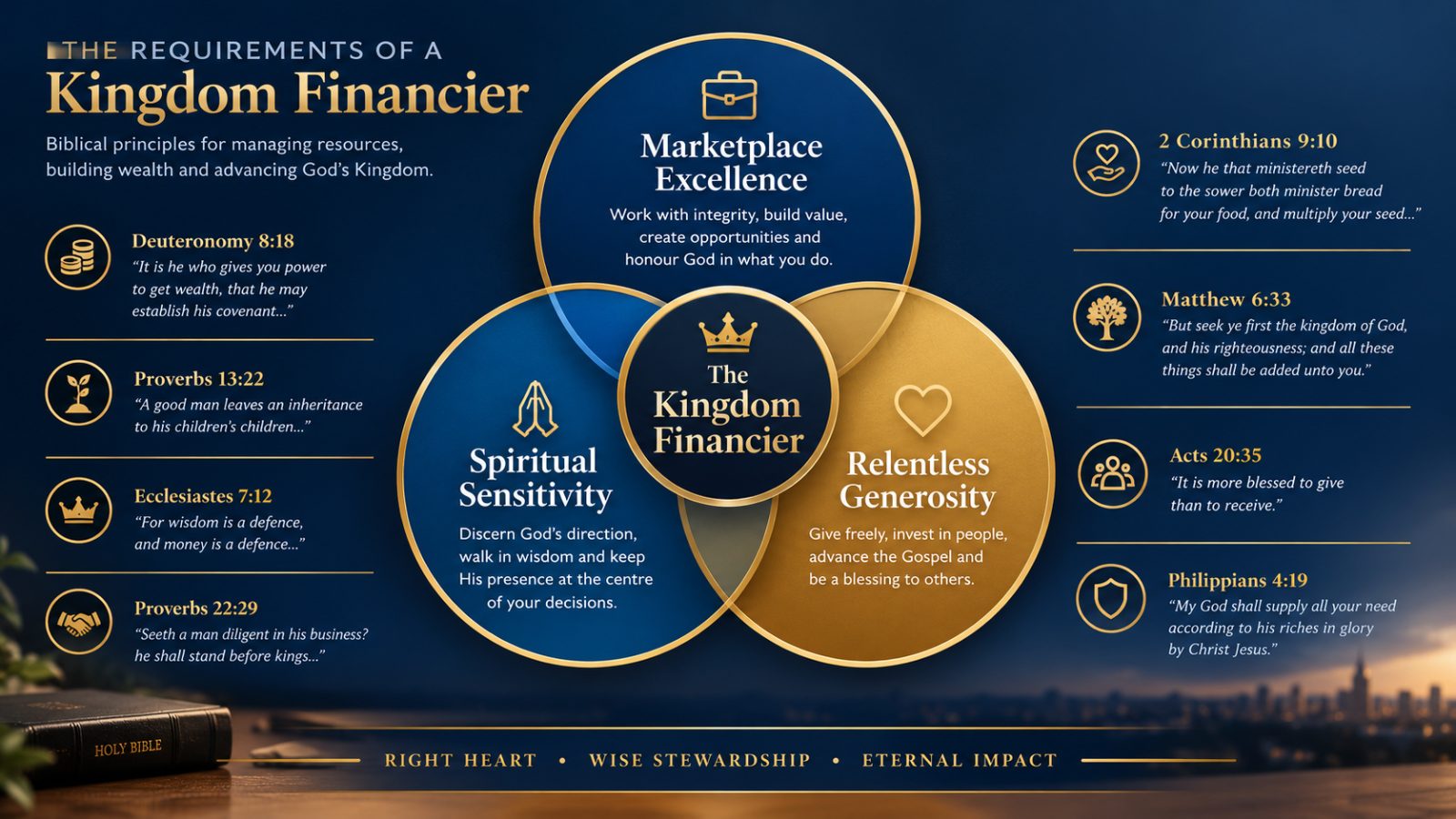
Scripture is clear that God gives some the "power to get wealth" (Deuteronomy 8:18, KJV). Why? "That he may establish his covenant." The wealth is the tool; the covenant is the goal. If you are searching for the biblical meaning of a kingdom financier, you must start there. You are a covenant enforcer. Your bank balance is a weapon of spiritual warfare used to tear down the strongholds of poverty, ignorance, and spiritual darkness by funding the light of the Gospel.
The Spiritual Requirements of the Role
God does not give this assignment to everyone, not because He is partial, but because the role requires a specific kind of spiritual "wiring." The first requirement is a total lack of ownership. You cannot be a kingdom financier if you still think the money belongs to you. I have seen many people pray for wealth, but when the money arrives, they start "owning" it. They start thinking about the bigger house or the faster car first. A true financier knows they are a manager of someone else's assets.
The second requirement is a high level of skill. God is a God of excellence, and He rarely entrusts massive resources to people who are lazy or incompetent. If you look at the who were the kingdom financiers in the Bible, you will see they were often people at the top of their professional game. They were governors, business owners, and influential traders. They understood how markets worked, how to manage people, and how to multiply what was put in their hands.
Finally, there is the requirement of "the hearing ear." A kingdom financier must be able to hear the voice of the Holy Spirit clearly. There will be times when God tells you to give to something that makes no "financial sense." You might be told to invest in a ministry that looks small or to help a person who can never repay you. If you are ruled by a spreadsheet alone, you will miss the move of God. You must be ruled by the Spirit. I’ve had moments where I felt a "nudge" to give a specific amount, only to find out later it was the exact sum the recipient had been praying for that morning.
The Financier of a Famine
Joseph is perhaps the ultimate example of a kingdom financier in the Old Testament. His story in Genesis is often taught as a lesson in forgiveness, but it is also a masterclass in kingdom economics. Joseph was not just a dreamer; he was a brilliant administrator. When he was promoted to the second in command of Egypt, his primary task was a financial and agricultural one. He had to manage the "supply" of an entire nation to survive a global crisis.
What makes Joseph a financier? He understood that the wealth he was accumulating during the seven years of plenty was not for his own luxury. He didn't build a bigger palace for himself; he built storehouses for the grain. "And Joseph gathered corn as the sand of the sea, very much, until he left numbering; for it was without number" (Genesis 41:49, KJV). He was building a reserve that would eventually fund the survival of the covenant family , the sons of Israel.
In your own career, you may be in a "season of plenty." The temptation is to increase your lifestyle to match your income. But a Joseph style financier increases their "storehouse" capacity. They save and invest during the good years so that when the "famine" hits the world, they are the ones with the resources to keep the church moving forward. If you want to dive deeper into his administrative genius, you should read the story of Joseph in the Bible and see how he positioned himself to be the world's provider.
Barnabas The Liquidator for the Gospel
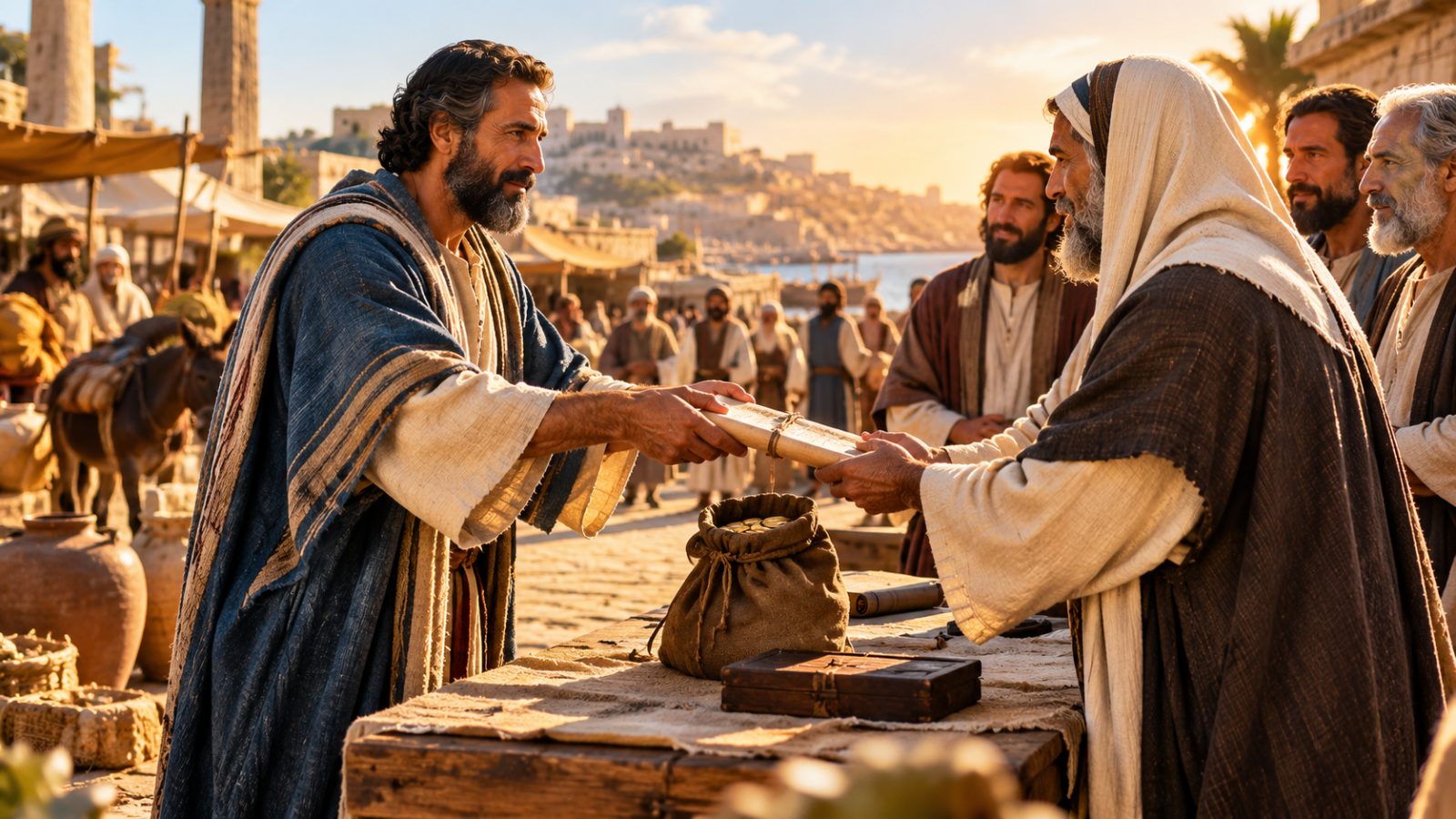
In the New Testament, we see a different kind of financier in the person of Barnabas. While Joseph managed a national economy, Barnabas managed his personal assets for the sake of the early church. "And Joses, who by the apostles was surnamed Barnabas... Having land, sold it, and brought the money, and laid it at the apostles' feet" (Acts 4:36-37, KJV). Barnabas was a "Son of Consolation," but he was also a financier who provided the initial capital for the Jerusalem church to function.
The lesson from Barnabas is about liquidity and detachment. He didn't just give out of his "extra"; he was willing to liquidate fixed assets to fund a spiritual movement. Many believers are "wealthy" on paper , they have houses, lands, and investments , but they are "kingdom poor" because they have no liquidity to give when a need arises. Barnabas understood that his land was a tool, and when the tool was more useful as cash for the apostles, he made the trade. And pleasse, understand that am not telling you to go and sale your assets so that you can give to the church and leave your family with no roof or food for tomorrow.
I have met people who have "Barnabas moments" where they sell a business or a property specifically to fund a building project or a mission's plant. This requires a level of faith that goes beyond tithing. It is the realisation that "the earth is the LORD'S, and the fulness thereof" (Psalm 24:1, KJV). If you are struggling with the fear of letting go of assets, I recommend reading about biblical stewardship versus ownership to help break that spirit of Mammon.
The Women Who Ministered to Jesus
We often overlook one of the most important groups of financiers in the Gospels. Luke 8:1-3 mentions Mary Magdalene, Joanna the wife of Chuza (Herod’s steward), and Susanna, and "many others, which ministered unto him of their substance" (KJV). Think about the reality of Jesus' ministry. He had twelve disciples who had left their businesses. They had to eat. They had to travel. They had to stay somewhere. Who paid the bills?
It was these women. They were kingdom financiers. Joanna, in particular, had access to the wealth of Herod’s court. She was using the "wealth of the Gentiles" to fund the ministry of the Messiah. These women were not the ones preaching on the hillsides, but without their "substance," the preaching would have been hindered by physical lack. This shows that the role of a financier is often behind the scenes, yet it is foundational to everything that happens in the light.
This is a powerful reminder for those of you who work in high level corporate or government positions. You might feel like you are "missing out" on ministry because you are stuck in meetings all day. But if you are like Joanna, your position in that "palace" is exactly where God wants you. Your "substance" is what keeps the "Jesus ministry" of your local church moving. You are not a second class citizen in the Kingdom; you are the fuel for the fire.
How the Financier Differs from the Average Steward
While every Christian is a steward, not every steward is a financier. This is a distinction that often causes confusion. A steward is focused on faithfulness with whatever they have. If you have £10, you steward it by tithing £1 and using the rest wisely. A financier, however, has a "multiplication mandate." They are specifically looking for ways to grow the Master’s money so they can give even more. They are like the servants in the parable of the talents who went and traded with what they were given.
The average steward asks, "How much do I have to give?" The kingdom financier asks, "How much can I possibly generate so I can give it all?" There is a different level of risk taking involved. Financiers are often entrepreneurs or investors because they understand that a fixed salary has a "ceiling" on its giving potential. To fund global missions, you often need "uncapped" income streams. They seek kingdom economics over worldly security.
In my own experience, I have noticed that financiers often have a "restless" spirit when it comes to their income. They aren't satisfied with "enough" for themselves. They feel a holy pressure to increase their capacity because they see the needs of the world so clearly. If you feel that pressure, don't suppress it. It might be the call of God to move you into a higher level of financial responsibility.
The Covenant Connection And Why God Trusts the Financier
God does not give wealth to people just so they can be comfortable. He gives it to "establish his covenant." This is the core of the biblical meaning of a kingdom financier. A covenant is a legal agreement. God has agreed to save the world, and that mission requires resources. When you align your finances with that covenant, you become a "legal partner" with heaven. You are no longer just "working for yourself"; you are a contractor for the Kingdom of God.
This partnership brings a level of divine protection that the world does not understand. When your business is the source of funding for an orphanage or a Bible translation project, God has a "vested interest" in your business succeeding. I am not talking about a "prosperity gospel" where you give to get. I am talking about a "purpose gospel" where you are supplied because you are a supplier. If you stop supplying, the supply often stops flowing.
I have seen businesses that should have failed during economic downturns stay afloat because the owner was a faithful financier. God is a righteous judge. He knows that if that business closes, the ministry it supports will suffer. Therefore, He provides "wisdom from above" to navigate the crisis. This is why you must keep your motives pure. If you start using the "kingdom money" for your own vanity, you are breaking the covenant, and you move back into the realm of human effort alone.
Practical Steps to Walking in This Calling
If you believe you are called to be a kingdom financier, you don't wait until you have a million pounds to start. You start where you are. The servants in the parable of the talents were tested with small amounts first. If you cannot be a financier with £100, you will never be one with £1,000,000. The heart posture is the same regardless of the number of zeros.
Declare your intent to God. Tell Him, "Lord, I want to be a conduit. I am not asking for wealth for my own sake, but for the sake of Your Kingdom. Use me as a financier."
Develop your "market value." High-level financiers are usually high-level experts. Whether it is in trade, technology, or management, you need to be the best at what you do. Study, train, and grow.
Live below your means. You cannot fund the kingdom if you are consuming every penny you make. Discipline is the prerequisite for distribution.
Find a "Kingdom Project" to seed into now. Even if it is a small amount, start the habit of "targeted giving." Don't just give to the general fund; find a specific need and meet it.
Study the Word. You need to know what God says about money so you aren't swayed by the world's fear. Read what Proverbs says about money and let it shape your thinking.
Being a kingdom financier is one of the most challenging but rewarding callings a believer can have. You will face spiritual warfare, you will face the temptation of greed, and you will face the pressure of responsibility. But you will also have the front-row seat to the miracles of God. You will be the one who sees a need, prays, and then realizes that you are the answer to that prayer. There is no greater joy than being the hand of God in the marketplace.
Where To Read Next
If you are ready to go deeper into the practical and spiritual side of kingdom wealth, here are the next steps for your study:
Who Were the Kingdom Financiers in the Bible and What Did They Do?
Kingdom Economics Versus World Economics: The Biblical Financial System
What Did Jesus Say About Money and Wealth? The Teaching Most People Miss
Biblical Stewardship Versus Ownership: The Truth That Frees You From the Fear of Loss
Frequently Asked Questions
What is the biblical meaning of a kingdom financier?
A kingdom financier is a believer who is divinely empowered to generate wealth for the specific purpose of funding the advancement of God's Kingdom. They act as a "choregos" or patron, ensuring that the work of the ministry is never hindered by financial lack. This role is based on the principle found in Deuteronomy 8:18 (KJV), where God gives the "power to get wealth" to establish His covenant.
Is it a sin to want to be a kingdom financier?
No, it is not a sin to desire this role as long as your motive is the glory of God and the benefit of others. Paul encourages us to "covet earnestly the best gifts" (1 Corinthians 12:31, KJV), and the gift of "giving" with simplicity is a recognized spiritual gift (Romans 12:8). The sin lies in the "love of money," not in the possession of resources for the Master's use.
How do I become a kingdom financier if I am currently broke?
You start by being faithful with the very little you have. Stewardship is the training ground for financiering; if you can manage a small budget with integrity and generosity, God can trust you with more. Focus on developing your skills and your "market value" while maintaining a heart that is fully surrendered to God's instructions.
What does the Bible say about funding the gospel?
The Bible teaches that those who preach the gospel should live of the gospel, and that the body of Christ is responsible for providing the resources for the Great Commission. In Philippians 4:15-17 (KJV), Paul commends the church for their financial support, noting that their giving is "fruit that may abound to your account." Funding the gospel is a partnership between the "goers" and the "senders."
Is a kingdom financier the same as a regular church donor?
While both are important, a kingdom financier usually operates at a higher level of strategic partnership and capacity. A donor gives out of their surplus, but a financier often builds their entire financial life, business, and investment strategy around the goal of generating kingdom capital. They are not just "giving to a cause"; they are "funding a vision."
Found this helpful? Share it with someone who needs it.