Most preachers will tell you that Jesus talked about money more than anything else in the Bible. However the question that begs as answer is that, is that true? If you actually sit down and count the verses in the four Gospels, you will find that the primary theme of Christ's earthly ministry was not currency, but the Kingdom of God. However, the reason this myth persists is that Jesus talked about money so frequently, so pointedly, and so dangerously that it feels like He never stopped. He understood that while the Kingdom was the destination, your wallet was the primary obstacle standing in the way of you getting there.
I have spent years studying the red letters of the King James Version, and I have realised that we often sanitise His words to make our bank balances feel safer. We want Him to talk about "spiritual" things like prayer and worship, yet He keeps dragging the conversation back to our possessions. In my own walk, I have found that whenever I try to get "closer to God" without addressing my spending, I am merely performing a religious dance. Jesus did not talk about money more than anything else, but He talked about it more than almost any other practical topic because He knew it was the number one rival for our devotion.
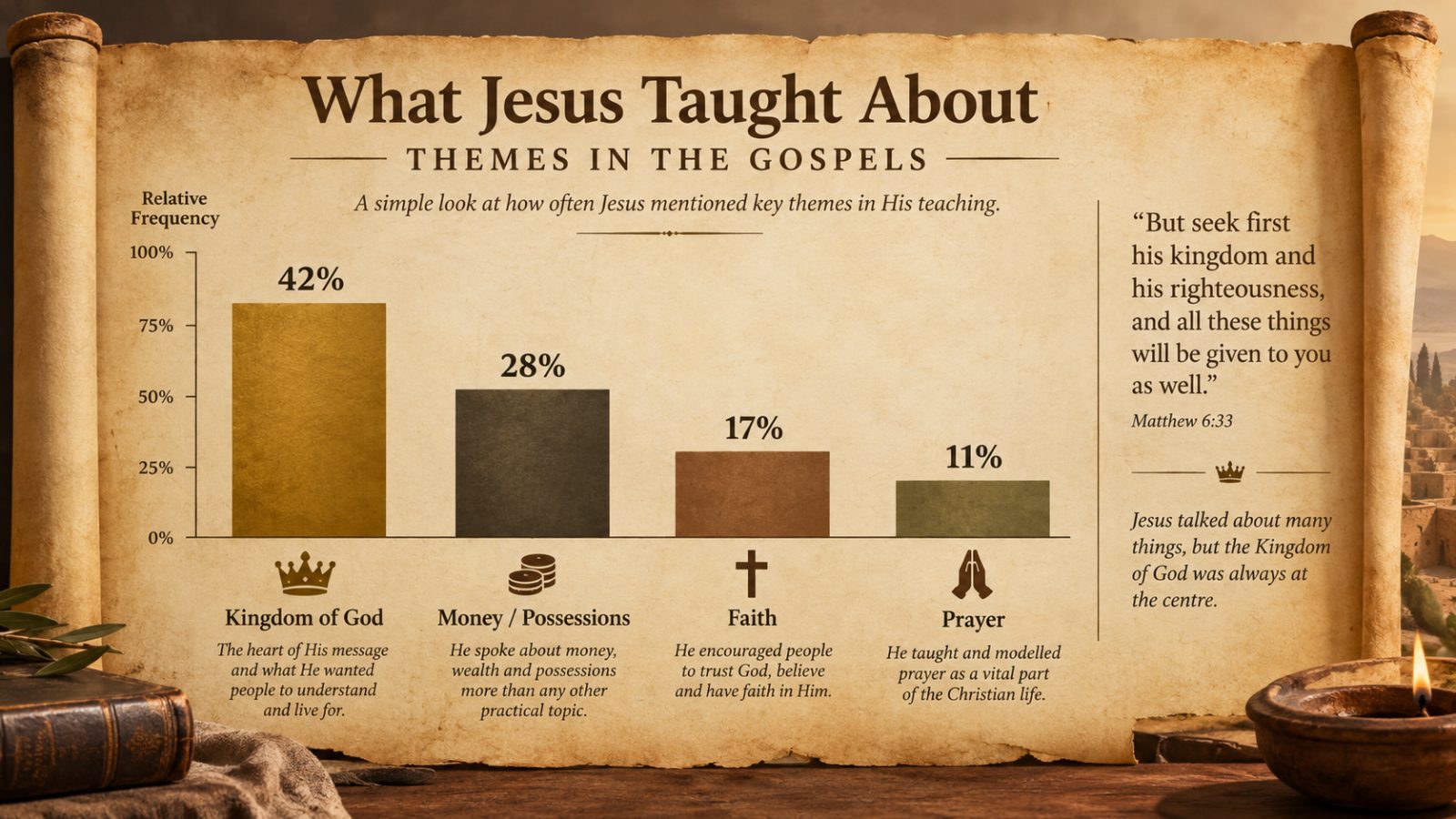
If you are searching for the truth behind the statistics, the answer is nuanced. About 11 percent of the verses in the Gospels (288 verses in total) and 16 out of His 38 parables deal directly with the theme of money and possessions. While it is not the most frequent topic,that honour belongs to the Kingdom,it is undeniably His most frequent practical application. He did not see money as a neutral tool; He saw it as a spiritual indicator. He knew that how you handle your pounds and pence is the most accurate map of where your soul is headed.
The English word "money" often feels cold and transactional, but the word Jesus frequently used in the New Testament carries a much heavier spiritual weight. In Matthew 6:24, He uses the word mammonas, transliterated as "mammon". This is not just a Greek word for coins or wealth; it is a word with Aramaic roots that suggests "that in which one trusts". By using this specific term, Jesus was personifying wealth as a rival deity. "No man can serve two masters: for either he will hate the one, and love the other; or else he will hold to the one, and despise the other. Ye cannot serve God and mammon" (Matthew 6:24, KJV).
This reframes the entire conversation. When we ask if Jesus talked about money, we are usually thinking about budgeting or tithing. But Jesus was talking about mammonas, a spiritual power that demands the same things God demands: your trust, your security, and your future. He was not giving a financial seminar; He was identifying a competitor for the throne of your heart. The word mammonas implies that money is never just a commodity; it is a system of belief. Every time you open your banking app, you are not just checking a balance; you are checking the health of your primary altar.
The Reality of the Numbers And What Jesus Actually Say?
To answer the question, "did jesus talk about money more than anything else," we have to look at the data without the hyperbole. If you count the specific mentions of the Kingdom of God, you will find it appears over 100 times in the Gospels. In comparison, money and possessions are mentioned in roughly one out of every ten verses. While "more than anything else" is a statistical stretch, "more than almost any other human behaviour" is an absolute fact. Jesus spoke about money more than He spoke about the cross, more than He spoke about heaven, and more than He spoke about hell.
Why would the Son of God spend so much breath on something as temporary as silver and gold? I believe it is because money is the only thing in the physical world that can mimic the attributes of God. It promises security, it promises power, and it promises to provide for all your needs. When Jesus saw the rich young ruler, He didn't see a man with a "budgeting problem". He saw a man who had found a different saviour. "Then Jesus beholding him loved him, and said unto him, One thing thou lackest: go thy way, sell whatsoever thou hast, and give to the poor, and thou shalt have treasure in heaven: and come, take up the cross, and follow me" (Mark 10:21, KJV).
The frequency of His teaching on this topic is a warning. If the Great Physician spends 10 percent of His time talking about one specific symptom, it is because that symptom is linked to a fatal disease. He talked about money because money is the primary way we attempt to maintain our independence from God. We think we are being responsible by building our barns bigger, but Jesus calls that "folly" when it comes at the expense of being rich toward God. He was not obsessed with your money; He was obsessed with your heart, and He knew your money was the shortest path to finding it.
The Parables: Why 16 Out of 38 Focus on Wealth
The most striking evidence of Jesus' focus on finances is found in His storytelling. Nearly half of the parables He told involved money, debts, stewardship, or possessions. Think about the most famous stories: the Parable of the Talents, the Shrewd Manager, the Rich Fool, the Hidden Treasure, and the Pearl of Great value. These are not just nice stories with a moral; they are Kingdom economics versus world economics in narrative form.
In the Parable of the Talents (Matthew 25:14-30), Jesus uses a financial metaphor to describe our entire life's work. He depicts God as a master who expects a return on his investment. This is where many believers get uncomfortable. We like to think of God as a distant grandfather who doesn't care about the details of our careers or investments. But Jesus depicts Him as a meticulous owner who audits the accounts. "After a long time the lord of those servants cometh, and reckoneth with them" (Matthew 25:19, KJV). That word "reckoneth" is a business term. It means to settle accounts.
I find it fascinating that Jesus chose the most "worldly" thing,money,to explain the most "spiritual" thing,the Kingdom. He didn't use metaphors about clouds or harps; He used metaphors about interest rates, debt forgiveness, and agricultural yields. He did this because money is the common language of humanity. We all understand what it means to owe someone. We all understand what it means to lose everything. By using money as his primary teaching tool, He ensured that His message remained grounded in the reality of our daily struggles.
Is It True That Jesus Talked About Money More Than Prayer?
This is another common claim that needs context. If you count the direct commands, Jesus certainly spent more time instructing people on how to handle their wealth than He did on the mechanics of how to pray. He gave us the Lord's Prayer as a model, but He gave us dozens of warnings about the "deceitfulness of riches". Why the disparity? Because prayer is an internal discipline, but money is an external evidence. It is very easy to lie to yourself about your prayer life; it is much harder to lie to yourself about your bank statement.
Jesus knew that our prayer lives are often hindered by our financial lives. In the Sermon on the Mount, He moves seamlessly from teaching on prayer to teaching on fasting, and then immediately into "Lay not up for yourselves treasures upon earth" (Matthew 6:19, KJV). He didn't see these as separate subjects. He understood that if your heart is buried in your investments, your prayers will never rise above the ceiling. You cannot have a vibrant relationship with the Father if you are currently in a committed relationship with your "stuff".
When people ask, "did jesus talk about money more than anything else," they are often looking for a reason to ignore the pulpit. But the reality is that Jesus' emphasis on money was meant to fuel our spiritual lives, not distract from them. He wanted us to be free from the anxiety of "what shall we eat? or, what shall we drink?" (Matthew 6:31, KJV) so that we could actually focus on the Kingdom. Money was the noise He wanted to cancel so we could hear the Father's voice. If you aren't managing your money according to His word, your prayer life will eventually become a series of requests for God to bless your disobedience.
The Warning of the Rich Young Ruler
The story of the rich young ruler is perhaps the most sobering moment in the Gospels regarding wealth. This was a man who had kept the commandments from his youth. He was "good" by every religious standard. Yet, Jesus identified that his wealth was the one thing he loved more than God. "And Jesus said unto him, Why calleest thou me good? there is none good but one, that is, God" (Mark 10:18, KJV). He then told him to sell everything. Notice that Jesus didn't tell everyone to sell everything,but He told this man because his money had become his identity.
I have often wondered how many of us would walk away "sorrowful" if Jesus sat across from us at our kitchen table today. We talk about biblical stewardship versus ownership, but the rich young ruler believed he was the owner. When you believe you own something, you are controlled by the fear of losing it. When you know God owns it, you are free to use it. Jesus talked about money so much because He wanted us to experience the freedom of being "poor in spirit" regardless of our net worth.
The tragedy of the rich young ruler wasn't that he was wealthy; it was that he was unwilling to be managed. He wanted Jesus as a consultant, not as a Lord. This is the danger for every Kingdom citizen in 2026. We have more access to wealth and financial tools than any generation in history. If we do not heed the frequency of Jesus' warnings, we will find ourselves like that young man,possessing much on earth but having no "treasure in heaven".
What the Bible Says About the "Love of Money"
While Jesus focused on the rivalry between God and Mammon, Paul later clarified this in his letter to Timothy. "For the love of money is the root of all evil: which while some coveted after, they have erred from the faith, and pierced themselves through with many sorrows" (1 Timothy 6:10, KJV). Note that the Bible does not say money is the root of all evil. It is the love of it. The Greek word here is philargyria, which literally means "affection for silver".
Jesus talked about money to prevent this affection from taking root. He knew that money is a wonderful servant but a terrible master. If you use it to feed the hungry, spread the Gospel, and provide for your family, it is a tool of the Kingdom. But the moment you start to find your "peace" in the size of your emergency fund, you have started down the path of philargyria. I have seen many believers who are not "rich" by world standards, yet they are completely consumed by the love of money because they spend all their mental energy worrying about the lack of it.
Whether you have a lot or a little, the spiritual danger is the same. This is why Jesus' teaching is universal. He wasn't just talking to the wealthy Pharisees; He was talking to the poor fishermen too. He wanted everyone to understand that their value was not determined by their "talents" or their "denarii". He wanted them to see that Kingdom money principles are about heart alignment, not just accounting. If you get the heart right, the numbers usually follow. If you get the numbers right but the heart is wrong, you have lost everything.

The Shrewd Manager: A Lesson in Eternal Investment
One of the most confusing parables Jesus ever told is the Parable of the Unjust Steward (Luke 16:1-13). In it, a manager who is about to be fired uses his master's resources to make friends for himself so that he will be taken care of after his dismissal. Surprisingly, the master commends him,not for his dishonesty, but for his shrewdness. Jesus concludes by saying, "And I say unto you, Make to yourselves friends of the mammon of unrighteousness; that, when ye fail, they may receive you into everlasting habitations" (Luke 16:9, KJV).
What is Jesus saying here? He is telling us to use temporary, "unrighteous" money to achieve eternal goals. He wants us to be just as strategic with our finances for the Kingdom as worldly people are for their own gain. If you are a Kingdom citizen, you should be the most strategic investor on the planet,not because you want to retire at 40, but because you want to see the Gospel reach the ends of the earth. You should be asking, "How can I use this currency that will one day be worthless to buy things that will be valuable forever?"
I have met people who think that being "spiritual" means being bad with money. They don't budget, they don't save, and they call their lack of discipline "living by faith". But Jesus' teaching on the shrewd manager refutes this. He expects us to have a plan. He expects us to be wise. He expects us to understand that the financial wisdom most believers never apply is actually a spiritual requirement. Stewardship is not just about not stealing; it is about active, wise management for the Master's benefit.
How to Respond to Jesus' Focus on Finances
So, if we accept that Jesus talked about money with incredible frequency and intensity, how should we live? It starts with a shift in perspective. You must stop seeing your income as "your" money and start seeing it as the Master's "talents". Every pound that passes through your hands is a test of your loyalty. Will you use it to build your own kingdom, or will you use it to advance His? This is the core of developing a Kingdom financial mindset.
Secondly, you must address the "mammon" spirit. This is done through the practice of tithing and generous giving. When you give the firstfruits of your increase, you are breaking the power of mammon over your life. You are declaring that God is your provider, not your employer or your investments. "Honour the LORD with thy substance, and with the firstfruits of all thine increase: So shall thy barns be filled with plenty, and thy presses shall burst out with new wine" (Proverbs 3:9-10, KJV). Tithing is not about God needing your money; it is about you needing to stay free from the love of it.
Finally, we must live with an eternal ledger. Jesus' primary argument against hoarding wealth was that it doesn't last. "Lay not up for yourselves treasures upon earth, where moth and rust doth corrupt, and where thieves break through and steal" (Matthew 6:19, KJV). In 2026, "moth and rust" might look like inflation, market crashes, or bank failures. But "treasure in heaven" is a guaranteed asset class. When you invest in people, in the Gospel, and in the work of God, you are moving your wealth to a jurisdiction where it can never be lost.
Where To Read Next
If this analysis of Jesus' teaching has challenged your perspective on wealth, I encourage you to dive deeper into these specific biblical studies on stewardship and Kingdom finance.
What Did Jesus Say About Money and Wealth? The Teaching Most People Miss
Kingdom Economics Versus World Economics: The Biblical Financial System
Frequently Asked Questions
Did Jesus talk about money more than anything else?
No, Jesus talked about the Kingdom of God more than any other topic, but money was His most frequent practical application. Approximately 11% of the verses in the Gospels and nearly half of His parables deal with money and possessions. "Ye cannot serve God and mammon" (Matthew 6:24, KJV).
Is it a sin to be wealthy according to Jesus?
Wealth itself is not a sin, but the love of money and the trust in riches are significant spiritual dangers. Jesus warned that it is difficult for a rich man to enter the Kingdom of Heaven because wealth often becomes a rival god. "For where your treasure is, there will your heart be also" (Matthew 6:21, KJV).
What does the Bible say about the love of money?
The Bible teaches that the love of money is the root of all kinds of evil, leading people away from the faith and into many sorrows. It is the affection for and trust in wealth,rather than the currency itself,that causes spiritual ruin. "For the love of money is the root of all evil" (1 Timothy 6:10, KJV).
How many of Jesus' parables are about money?
Out of the 38 parables recorded in the Gospels, 16 of them deal directly with money, stewardship, or possessions. This high frequency shows that Jesus considered our handling of material resources to be a primary indicator of our spiritual condition.
Should Christians strive to be rich?
Christians should strive to be "rich toward God" and faithful stewards of whatever resources He provides. While God may bless some with great wealth for the purpose of Kingdom advancement, our primary focus should be seeking His Kingdom and righteousness first. "But seek ye first the kingdom of God, and his righteousness; and all these things shall be added unto you" (Matthew 6:33, KJV).
Found this helpful? Share it with someone who needs it.