I once watched a brother in Christ stand at the pulpit, wave a glossy brochure, and promise a thirty-fold return on a real estate project because "God had anointed the soil." I lost three thousand pounds on that "anointed" soil, and it took me two years of hard work to recover. That painful experience forced me to sit down with my Bible and study what biblical investment principles actually look like when we strip away the emotional hype. The Bible does not tell you which shares, fund, property, business, or digital asset to buy.
It was not written as a modern investment handbook, and anyone who claims that one verse guarantees a particular return is asking Scripture to say what it does not say. Yet the Bible speaks deeply about stewardship, knowledge, risk, patience, honest gain, and responsibility. Those truths should shape the way a Christian approaches investment.
I have learned to be cautious when an opportunity becomes more exciting than my understanding. Christian language can make a weak investment sound safe: somebody says God opened the door, calls the profit a harvest, and treats questions as unbelief. But prayer does not turn hidden fees into honest fees or remove market risk. Wisdom requires both spiritual discernment and factual due diligence. If you want to understand how kingdom money principles from the bible operate in practice, you have to start by aligning your heart with God's definition of stewardship. True wealth is built slowly, under the guidance of the Holy Spirit, through disciplined and righteous decisions.
The Latin Root of Investment and What It Teaches Us About Stewardship
To truly understand what it means to invest as a believer, we need to look at where the word itself comes from. The word "invest" comes from the Latin root investire, which literally means "to clothe, cover, or surround." Think about that for a moment. When you invest your money, you are not just throwing numbers into a screen. You are clothing a productive enterprise with your capital. You are covering its expenses so it can produce fruit. This is a beautiful picture of biblical stewardship. When God created the world, He clothed the earth with beauty and purpose. Jesus reminded us of this care when He spoke of the lilies of the field.
"Wherefore, if God so clothe the grass of the field, which to day is, and to morrow is cast into the oven, shall he not much more clothe you, O ye of little faith?" (Matthew 6:30, KJV)
Our investment decisions should reflect this divine pattern. We are not called to throw our money into naked, speculative schemes that produce nothing of real value. We are called to clothe businesses, properties, and ideas that build up communities, create honest jobs, and provide genuine services. When you view your capital as a garment of provision, you stop chasing phantom returns. You start looking for real, productive operations that deserve to be clothed. It changes your entire perspective. You transition from a gambler looking for a quick payout to a faithful manager who is actively covering productive work.
What Biblical Investment Principles Can and Cannot Do for Your Wallet
Biblical principles can test character and process. They can ask whether the money was earned honestly, whether the opportunity is understood, whether another person is being exploited, and whether a loss would destroy responsibilities that should have been protected. They cannot remove uncertainty, predict a price, or promise profit. Let us be completely real about this. God is not a financial broker. He does not guarantee that your portfolio will beat the index next quarter just because you read your Bible. Faith is not a financial hedge. It is a living relationship.
Stewardship is not proved by taking every opportunity. Sometimes faithfulness means investing; sometimes it means waiting, learning, reducing debt, or keeping money accessible for a nearer responsibility. I have met many believers who felt guilty for leaving money in a simple savings account because they thought they were burying their talent. But if you do not understand the market, keeping your cash safe is actually a form of wisdom. Do not let guilt drive your financial choices. If you find yourself struggling to separate spiritual conviction from emotional hype, I encourage you to read what I wrote on how to tell wise investing from greed when evaluating opportunities before making your next move.
Why You Must Never Invest in Something You Cannot Explain to a Child
Proverbs values knowledge, counsel, and prudent foresight. Proverbs 14:15 says the simple believe every word, while the prudent look carefully at their steps. In financial language, that means you should be able to explain how the investment creates value, how returns may be produced, who holds the asset, what fees are charged, how you can withdraw, and what could cause loss. If you cannot explain these details in simple terms, do not touch it. It is that simple. I do not care how many of your friends from church are making money from it. Walk away.
If the answer is mainly that more people will arrive later and pay a higher price, you need to understand that dependence. That is not an investment; it is a transfer of risk. If somebody promises a fixed high return while hiding the underlying activity, step back. If the seller becomes angry when you request documents, regulation details, or audited records, the anger is information. It tells you all you need to know. The Securities and Exchange Commission's investor education guidance stresses understanding risk, diversification, and fraud warning signs. Local laws and products differ, so verify any adviser, platform, or security with the appropriate regulator in your own country.
Understanding That Risk Is Real, Even When Your Intentions Are Holy
Ecclesiastes 11:1-2 uses trading and uncertainty imagery: send out portions and give a portion to seven or eight because you do not know what disaster may come. The passage in Ecclesiastes is wisdom poetry, not a rigid mathematical command to construct a modern portfolio with exactly eight assets. It is about wisdom. It recognises that our world is fragile, full of sudden shifts, and it warns us against placing our entire household future into one vulnerable basket. Diversification spreads your exposure. But let us be completely honest here: it does not guarantee a profit, nor does it prevent every single market loss. Ten versions of the exact same risky, unproven idea are not true diversification. That is just foolishness.
"Give a portion to seven, and also to eight; for thou knowest not what evil shall be upon the earth." (Ecclesiastes 11:2, KJV)
A Christian should ask whether one business, property, employer, customer, platform, or asset controls too much of the household's future. If that one thing fails, will you still be standing? If the answer is no, you are over-exposed. We must learn to manage risk with sober minds. I covered this depth of risk management in my breakdown of what scripture teaches about financial diversification and managing risk across different asset classes. Diversification is not a lack of faith. It is a humble acknowledgement that we do not control the future.
Why True Kingdom Investment Is Far Larger Than Buying Shares
In ordinary language, investment includes committing resources now in expectation of future benefit. A course that develops a marketable skill, reliable tools that improve productive work, systems that reduce waste, and retained earnings used to strengthen a sound business can all function as investments. Their returns are still uncertain, but the value-creating activity is easier to see than in an opportunity built only on price excitement. Do not limit your understanding of investment to the stock market or digital currencies. Sometimes the best investment you can make is in your own ability to produce value.
The Proverbs 31 woman considers a field and buys it; from her earnings she plants a vineyard. The poem celebrates wisdom expressed through work, household care, trade, and foresight. It does not prove that every property purchase is wise. It shows that productive decisions can be examined, funded, and connected to labour rather than treated as magic. If you want to build an actionable blueprint for multiplying your resources, I recommend treating the parable of the talents as a business plan for active stewardship. Matthew 25 shows us that God expects us to use our creative abilities to multiply what He has put in our hands. But remember, the servants in that parable did not gamble on price movements. They traded. They worked.
What Does the Bible Say About Speculation Versus True Investing?
Speculation is the attempt to profit from short-term price fluctuations without adding any real value to the underlying asset. It is driven by the desire to get rich quick, and it is a dangerous path for any child of God. True investing, on the other hand, is the slow allocation of capital into productive enterprises that generate real value over time. Speculation depends on luck and timing. Investing depends on patience and diligence. The difference is not just financial; it is spiritual. One feeds greed; the other builds stewardship.
"He that hasteth to be rich hath an evil eye, and considereth not that poverty shall come upon him." (Proverbs 28:22, KJV)
When you speculate, you are constantly anxious. You are checking charts, watching prices, and riding an emotional roller coaster. This is not the life of peace that God has promised us. If you have been caught in this cycle, you need to step back and examine your heart. I have seen many believers lose their life savings on speculative bubbles because they were chasing excitement instead of wisdom. If you have experienced a major loss, do not lose heart. God is able to restore you. You can read my personal guide on rebuilding your finances after a painful financial setback or loss to help you get back on your feet with peace and biblical direction.
How to Protect Your Household Before You Start Chasing Returns
Money needed for rent, food, school fees, important transport, agreed debt payments, or a near emergency should not be exposed as though it were spare capital. A possible high return does not cancel the certainty of those responsibilities. An investment may take longer than expected to sell, fall in value, or fail completely. You must protect the foundation before you try to build the upper floors. This is where many believers get into trouble. They invest money they cannot afford to lose, and when things go wrong, their families pay the price.
This is why saving and investing have completely different jobs in your financial journey. I wrote a complete study on the biblical foundational view on saving money for future needs to show how a secure reserve protects your peace. Saving is about safety and liquidity. Investing is about growth and risk. Never mix the two. However, if you do not have reserves set aside yet, take time to focus on building a cash emergency fund on a small income without fear before placing capital into assets that fluctuate. Build your fortress first. Then, and only then, can you look at allocating capital for long-term growth.

Why Your Honest Profit Must Come From Righteous Operations
Productive investment connects your money to accountable operations, real people, and actual capacity. It is not magic. Honest profit must still be honest. A profitable opportunity can be morally bankrupt. James condemns withheld wages. He does not mince words. And the Proverbs writer repeatedly rejects dishonest scales. Before you put your money into any company or project, you must ask hard questions about how that company actually makes its money. Does it exploit its workers? Does it deceive its customers? Does it profit from harm?
"A false balance is abomination to the LORD: but a just weight is his delight." (Proverbs 11:1, KJV)
Ethical questions are not always simple. Large companies operate across complicated supply chains, and investors may disagree about particular industries. The goal is not to pretend perfect knowledge. It is to refuse deliberate blindness and to make the best informed decision your conscience and evidence allow.
We cannot separate our faith from our finances. If you are investing in companies that destroy families or exploit the poor, you are sharing in their deeds. Your profits are stained. Choose instead to clothe enterprises that bring light, dignity, and genuine value to the world.
Why Patience Will Always Outperform Financial Excitement
Proverbs 13:11 warns that wealth gained hastily dwindles, while wealth gathered gradually increases. The verse does not outlaw every fast return, but it exposes the appetite that wants growth without time, skill, or value. Scams understand that appetite. They create urgency, secrecy, and social proof so that fear of missing out becomes stronger than judgement. When you feel rushed to make a financial decision, that rush is your warning sign. Slow down. A sound process is a slow process.
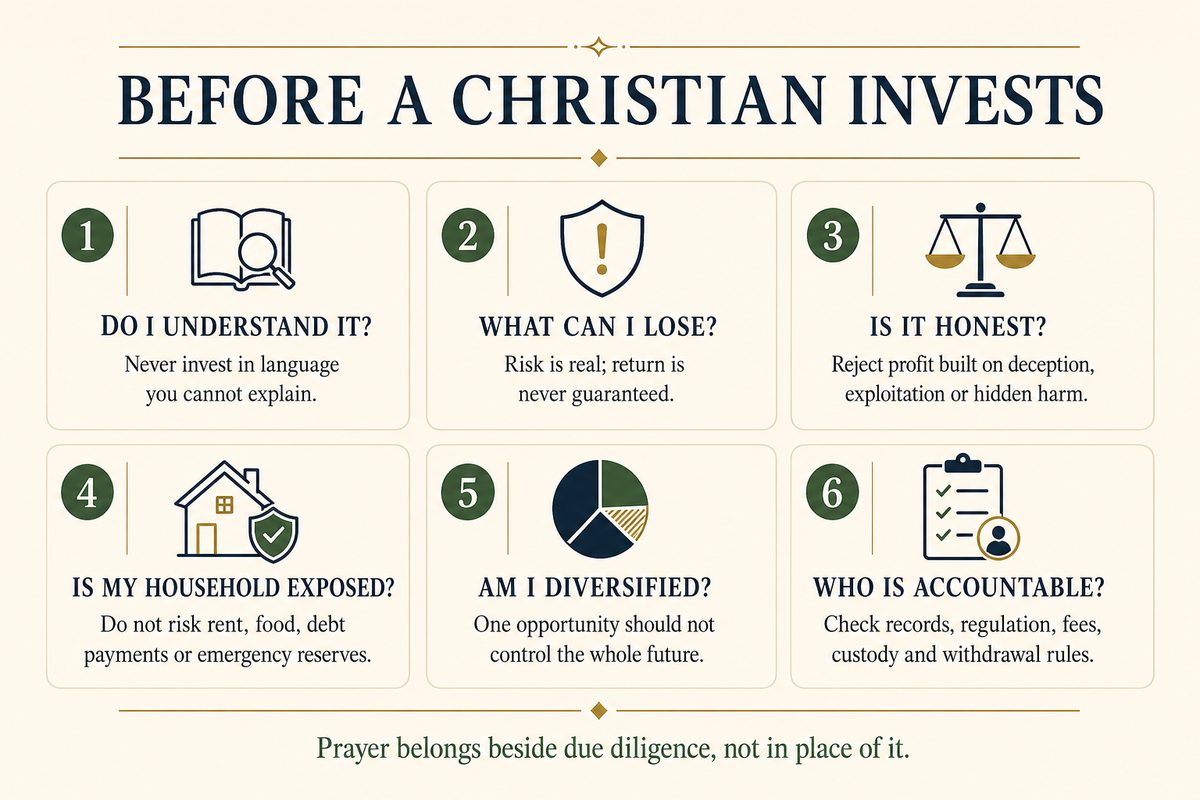
Read the documents. Calculate fees. Ask how losses are handled. Compare alternatives. Seek counsel from somebody who is competent and is not being paid to recruit you. Pray before and during this work, but do not call the work itself a lack of faith. Diligence is a form of worship. When you take the time to investigate an opportunity thoroughly, you are showing respect for the resources God has entrusted to you. Patience is not just a virtue; it is your best financial defence.
How Small Fees and Long Time Horizons Quietly Build Wealth
Compound growth means returns may themselves earn returns over time, but costs can compound in the opposite direction. Management fees, transaction charges, platform costs, and taxes can quietly eat away a massive portion of your long-term wealth. Many investors spend all their time trying to pick the perfect asset while ignoring the fees that are draining their accounts. A Christian steward must pay attention to these details. We must be faithful in the small things.
Over a thirty year horizon, a difference of just one percent in annual fees can cost you tens of thousands of pounds. That is money that could have been used to support your family, fund Kingdom work, or bless those in need. Do not let financial institutions quietly siphon off your stewardship. Look for low-cost, transparent options. Keep your investment strategy simple, consistent, and long-term. Let time and patience do the heavy lifting, rather than trying to beat the market through constant, expensive trading.
Where To Read Next
Managing God's money is a lifelong process of learning and growth. If you want to dive deeper into what Scripture teaches about wealth, stewardship, and practical financial management, I highly recommend checking out these articles next:
Does the Bible Support Multiple Income Streams? What Scripture Says About Financial Diversification
Is Investing Biblical for Christians? How to Tell Wise Investing From Greed
- How to Develop a Kingdom Financial Mindset for Successful Living
- When Wealth Becomes an Idol: Biblical Warnings and Protection
- Tithes, Offerings and Firstfruits: What Is the Difference?
- What Does the Year of Jubilee Mean for Christians in Debt?
- Kingdom Economics Versus World Economics: The Biblical Financial System
- What Does Nehemiah Teach About Planning and Leadership?
Frequently Asked Questions
Is it a sin for a Christian to invest in the stock market?
No, it is not a sin to invest in the stock market, provided you are doing so with wisdom, honesty, and a clear conscience. The stock market is simply a marketplace where you can buy fractional ownership in real, productive businesses. When you buy shares, you are clothing those businesses with your capital so they can grow, employ people, and provide valuable services. However, you must avoid speculative trading, which is essentially gambling, and ensure you are not investing in companies that profit from unrighteous operations.
What does the Bible say about high-risk investments?
The Bible does not explicitly forbid high-risk investments, but it strongly warns against speculation, greed, and putting your household's security at risk. Ecclesiastes 11:2 advises us to diversify our resources because we do not know what disasters may come upon the earth. If a high-risk investment fails and causes your household to fall into financial crisis, you have failed in your primary responsibility to provide for your family, which Scripture warns is a serious matter.
How can a Christian practice ethical investing?
A Christian can practice ethical investing by performing thorough due diligence on the companies, funds, or properties they choose to fund. This means looking beyond the potential financial returns and examining the actual operations of the enterprise. Ask yourself: does this business treat its workers fairly, speak truthfully to its customers, and produce goods or services that align with biblical values? While perfect knowledge is impossible in a complex global economy, we must refuse deliberate blindness and make the most righteous decisions our conscience and evidence allow.
Should I pay off my debt before I start investing?
In most cases, yes, you should focus on paying off high interest debt before you start investing. The Bible describes debt as a form of bondage, and the guaranteed return of paying off a debt with a high interest rate is almost always better than the uncertain return of an investment. Protecting your household and reclaiming your financial freedom should always take priority over chasing market returns. Once your debts are cleared and you have a solid emergency fund, you can begin investing with a peaceful and clear mind.
May God grant you deep wisdom, discernment, and peace as you walk out these biblical investment principles in your daily life. Remember, the Lord is your ultimate provider,not your portfolio, not your savings account, and not your career. Walk in faith, steward His resources with absolute integrity, and trust the One who owns it all.
Found this helpful? Share it with someone who needs it.