I spent three years tithing wrong. Not wrong in amount, but wrong in heart. Around that same time, I realised my bank account had become my temple. I was sitting in my car, staring at a spreadsheet, feeling a deep, suffocating panic even though I had more money than I had ever owned in my life. It was a strange, hollow feeling. Wealth rarely announces that it wants to become an idol; it first presents itself as relief, opportunity, or protection. The danger begins when money quietly takes over work that belongs to God, giving identity, commanding obedience, defining worth, and promising that enough possessions can make life untouchable.
As believers, we need to understand that we do not need to hate money in order to resist idolatry. Money is useful. It can feed a household, build a business, pay workers, repair damage, and support ministry. The issue is mastery. Jesus did not say money cannot serve; He said we cannot serve both God and mammon. When we study the foundational Kingdom money principles from the Bible, we see that wealth is always meant to be a tool under our feet, never a master over our heads.
What the Bible Means by Idolatry
Idolatry is more than bowing before a carved object. It gives created things the trust, love, fear, or obedience that belongs to the Creator. Colossians 3:5 identifies covetousness as idolatry because desire can place acquisition at the centre of the life. The idol is not only what sits on an altar. It is what receives final authority in the heart.
To fully grasp this, we must look at the origin of the word itself. The word "idol" comes from the Greek word "eidolon", which refers to an image, a phantom, or a mere shadow of reality. It is a representation that lacks true substance. When we turn wealth into an idol, we are worshiping a shadow instead of the Substance. In the Old Testament, the Hebrew word often used for idols is "elil", meaning weak, empty, or of no value. Isaiah knew this trap well. He described how people manufacture their own gods: "Their land also is full of idols; they worship the work of their own hands, that which their own fingers have made." (Isaiah 2:8, KJV)
This is the tragedy of financial idolatry. We bow down to what we ourselves have built, expecting a bank balance to provide the peace that only the Holy Spirit can guarantee. That is why this warning belongs within our understanding of stewardship. I wrote about this shift in my post on biblical stewardship versus ownership, and honestly, it changed how I think about my possessions. Stewardship asks what money is for and who owns it. Idolatry reverses the order: money becomes owner, and the person becomes steward of its demands.
Jesus Called Money a Rival Master
How do we know when money has crossed the line from a useful resource to a rival master? Matthew 6:24 says:
"No man can serve two masters: for either he will hate the one, and love the other; or else he will hold to the one, and despise the other. Ye cannot serve God and mammon." (Matthew 6:24, KJV)
Mammon refers to wealth or possessions treated as a power in which people trust. Jesus frames the conflict as service because money does more than sit quietly. Once it becomes master, it gives commands: work without rest, hide the truth, keep more, compare constantly, and postpone obedience until the balance feels safe.
If you are struggling with this, you will want to read what I wrote about what Jesus said about money and wealth. His teaching does not condemn productive work or responsible provision. It refuses to allow possessions to define life.
Look, the master you serve determines your peace. When God is your Master, your security is anchored in His unchanging character. When mammon is your master, your peace is at the mercy of inflation, market crashes, and job security. We must choose which master we will trust to sustain us.
The Rich Fool Had Storage but No Accountability
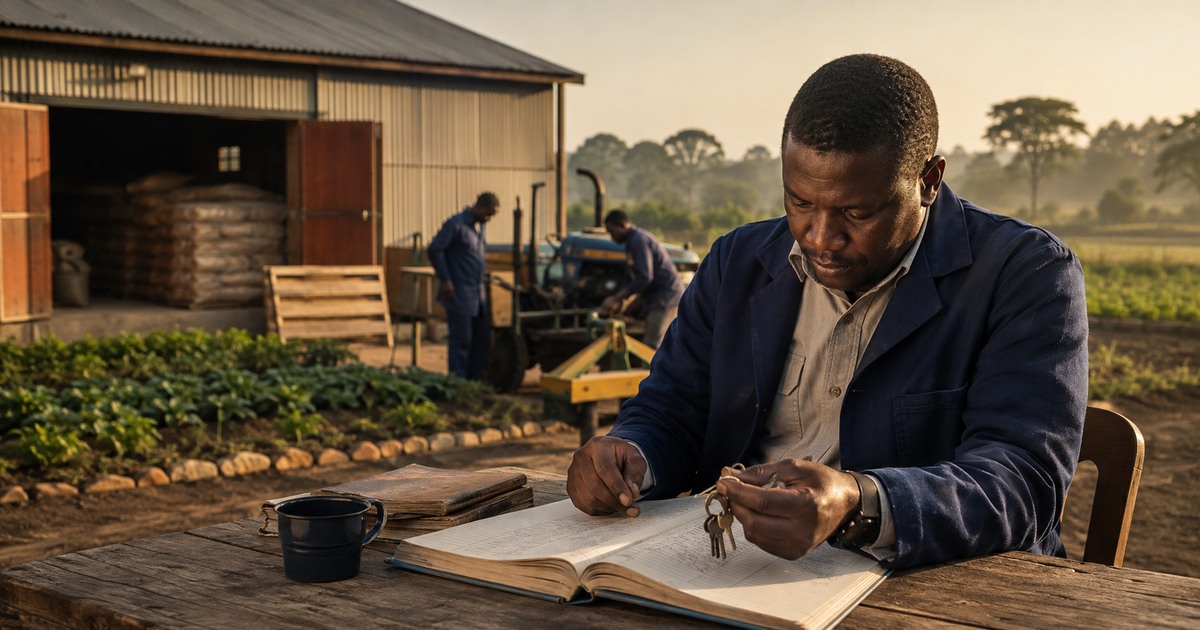
In Luke 12, a successful farmer decided to replace his barns with larger ones. Jesus did not criticise the land for producing or the man for noticing a storage problem. The spiritual failure appears in the conversation the man has with himself. He says my fruits, my goods, my barns, and my soul. Nobody else enters the plan, and God’s ownership disappears.
The man then promises his soul many secure years. That is where stored goods are asked to perform a divine task. A reserve can prepare for a known responsibility; it cannot guarantee life. An investment can grow; it cannot make death negotiate. The farmer was rich in possessions and poor in the direction of those possessions.
Let us look closely at the language this man used. In just three verses, he uses the words "I" and "my" more than a dozen times. "I will pull down my barns... there will I bestow all my fruits and my goods... I will say to my soul..." This is a complete monologue of self-sufficiency. He had no prayers, no thanksgiving, and no consultation with the community. He was completely isolated in his abundance.
This teaches us a profound lesson about the danger of planning without God. I spent years making financial projections without ever asking the Lord what He wanted me to do with the increase. I was behaving exactly like this farmer. If you want to avoid this trap, you must learn why God cannot bless a plan you never made, because a plan without God is simply a monument to your own control.
To protect your heart, you must perform a regular audit of your financial planning. Here is how you can do it. First, look at the pronouns in your goals. Are you planning for "my retirement" and "my comfort", or are you asking how "God's resources" can build His Kingdom? Second, look at your surplus. When God increases your income, is your first instinct to build bigger barns of savings, or is it to increase your capacity for generosity?
If you want to understand how this plays out in modern life, we must look at why Christians struggle with money so often. We frequently build barns of security without building a relationship with the Provider. We assume that having a large reserve means we no longer need to walk by faith. But true security is never found in the abundance of things; it is found in the presence of God.
Paul Warned the Rich Without Pretending Resources Have No Use

First Timothy 6:17,19 tells those who are rich not to be high-minded or to trust uncertain riches. Paul does not instruct Timothy to declare every possession evil. He redirects trust towards the living God and tells the wealthy to become rich in good works, ready to distribute, and willing to communicate.
The passage holds two truths together. Riches are uncertain, so they cannot carry final hope. Riches are also usable, so they can become generosity and shared good. The protection is not merely owning less; it is refusing pride, practising release, and remembering that enjoyment itself is received from God rather than seized as proof of superiority.
Paul’s word to those who want to be rich is sharper. The desire can lead people into temptation, harmful lusts, and ruin. He says: "For the love of money is the root of all evil: which while some coveted after, they have erred from the faith, and pierced themselves through with many sorrows." (1 Timothy 6:10, KJV)
The love of money, not money itself, is the root of all kinds of evil. Desire must therefore be examined before the result arrives, because wealth usually magnifies the direction already present in the heart. If we do not master our desires, our desires will master us. This is why learning how to develop a Kingdom financial mindset is so important. It helps us see wealth as a responsibility to manage, rather than a prize to hoard.
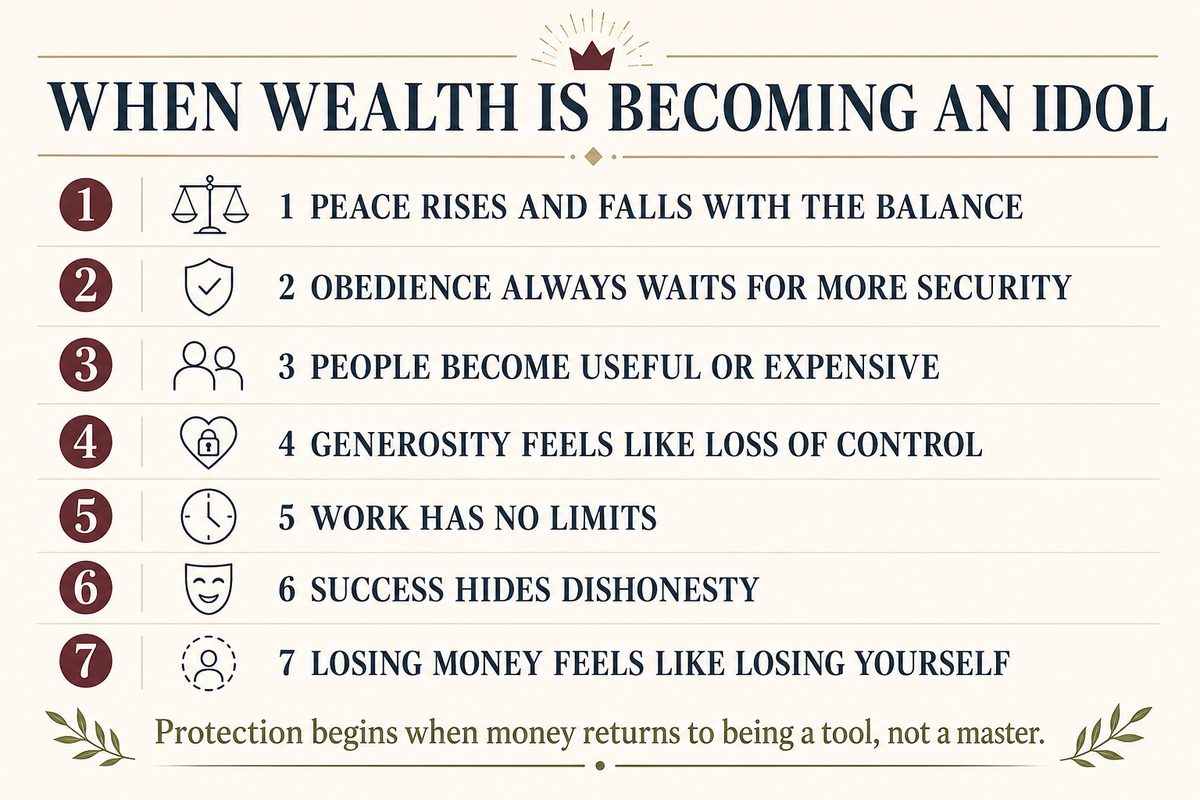
Seven Signs Wealth Is Becoming an Idol
How do we know if we have crossed the line? Let us look at three primary indicators. First, your peace rises and falls entirely with the balance. Second, you delay obedience, telling God you will give once you hit a certain target. Third, you view people as either useful or expensive, measuring relationships by financial status.

The Rich Young Ruler and the Bondage of Possessions
The rich ruler in Mark 10 wanted eternal life and appeared morally serious. Jesus looked at him with love, then touched the possession that held final authority. The command to sell and give exposed a particular bondage. The man went away sorrowful because he had great possessions; and, more painfully, the possessions had him.
We should not turn that encounter into a mechanical command that every Christian must sell everything in the same way. Wealth becomes an idol when obedience is always negotiable but possession is not. If you have ever experienced this struggle, I shared my honest story of a Christian struggling with money, and the deep lessons God taught me when my hands were completely empty.
Where To Read Next
If you want to deepen your understanding of how to manage resources without letting them manage you, here are a few articles I highly recommend:
What Did Jesus Say About Money and Wealth? The Teaching Most People Miss
Biblical Stewardship Versus Ownership: The Truth That Frees You From the Fear of Loss
How to Develop a Kingdom Financial Mindset for Successful Living
- Biblical Investment Principles: What Scripture Teaches and What It Does Not
- Tithes, Offerings and Firstfruits: What Is the Difference?
- What Does the Bible Say About Saving Money?
- What Does the Year of Jubilee Mean for Christians in Debt?
- Kingdom Economics Versus World Economics: The Biblical Financial System
- What Does Nehemiah Teach About Planning and Leadership?
Frequently Asked Questions
Is it a sin to be wealthy as a Christian?
No, wealth is not a sin. Abraham and Job used their resources to honour God. The sin occurs when wealth becomes an idol, taking the living God's place as your source of security, confidence, and ultimate trust. God desires faithful stewards who will manage resources to expand His Kingdom.
How do I know if money has become an idol?
It is an idol if your peace is tied to your balance, if you delay obedience to God, or if you compromise your integrity to make a profit. Generosity will also feel like a painful loss of control. You will find yourself constantly worrying about keeping what you have.
What did Jesus mean by serving mammon?
Jesus meant that wealth demands ultimate allegiance. You cannot trust in material riches for security and trust in God. One will always have final authority over your daily decisions, your values, and your heart. Mammon acts as a direct rival to God's authority.
How can I protect my heart from the love of money?
You can protect your heart by actively practising biblical stewardship. Acknowledge that God owns everything. Regularly practice generous giving, maintain a strict Sabbath rest, and hold your possessions with open hands. This breaks the grip of greed on your soul.
Does God want us to live in poverty?
No, God does not require poverty. The biblical solution is stewardship, where you manage whatever resources God has entrusted to you with gratitude, generosity, and complete trust in Him. This keeps your heart safe always.
Can a financial loss help break the power of wealth idolatry?
Yes. A financial crisis or loss can expose where our true security was built. While painful, it is often a season where we learn to lean entirely on God's grace and provision, discovering that He alone is our ultimate shield and protector.
Found this helpful? Share it with someone who needs it.