
For a long time I carried spiritual knowledge without enough financial order. I prayed, served, gave and believed God, yet there were seasons when my income weakened and our household habits were scattered. I was not pretending to be spiritual. My faith was real. But sincerity did not automatically teach me how money worked. If you are trying to understand why Christians struggle with money so often despite deep devotion, you need to know that you are not alone in this quiet frustration.
One of the clearest moments came when my wife connected our financial pressure to the fact that we had not been tithing. I returned to tithing because I urgently needed change. Years later I could see that I had quietly turned worship into a transaction: I give, then God releases the breakthrough. At the same time, we still needed to face the way we were managing what remained.
This story is not about blaming the Church or dismissing prayer. It is about what happened when I allowed the Word of God to confront both my spiritual expectations and my practical habits.
Faithful, Busy and Still Without Direction
Right after I completed school, I entered one of the most confusing seasons of my life. I had a genuine vision for doing something meaningful with my life. I believed in God sincerely. I was praying, attending church, giving offerings, and working hard at whatever was in front of me. By every visible measure I was doing what a faithful believer was supposed to do.
But there was a hollowness underneath all of it that I could not shake. Other people my age were choosing careers deliberately, going after the highest-paying professions, finding their way into stable employment, building something clear and directional with their lives. I was not. Not because I lacked ambition. Because I genuinely did not know who I was or what I was here to do. My gifts and abilities were sitting dormant inside me, and I did not yet know how to identify them, let alone deploy them. When you find yourself in this kind of fog, you might also want to look at how to know what God has called you to do with your work so you can stop wandering.
Proverbs 19:2 says that Desire without knowledge is not good, and whoever is in a hurry makes mistakes. That verse describes exactly where I was. The desire was real and the faith was genuine.
I have placed the wider lessons from this journey in Why Christians Struggle With Money, where prayer, mindset, work and stewardship are examined together rather than separated.
I Looked for Blessing Before Building Capacity
One of the things I did consistently during that period was seek out the most anointed men of God I could find. I believed deeply that if the right person laid hands on me and declared God's blessing over my life, the doors would open and everything would change. Church after church. Man of God after man of God. Seeking favour, seeking breakthrough, seeking the prophetic word that would unlock what I was waiting for. The tension between prayer and avoided responsibility is examined in Why Do Christians Pray for Financial Breakthrough and Nothing Happens?.
What I did not understand then is something I understand very clearly now. God cannot bless a plan you never made, and He cannot multiply what is not yet in your hands. I was asking for doors to open to somewhere I had not yet built anything worth walking into. The blessing I was seeking had nothing to land on. Acts 3:6 records Peter saying to the lame man: silver and gold I do not have, but what I do have I give you. Peter offered what was actually in his hands. I was asking God to give me the result of work I had not yet done.
"Silver and gold have I none; but such as I have give I thee..." (Acts 3:6, KJV)
We often forget that miracles in Scripture usually intercepted action. Moses had a rod. The widow had a jar of oil. The boy had five loaves. God asks what is in your hands before He multiplies anything. If your hands are entirely empty of skill, discipline, or practical service, even heaven has nothing to work with.
Training Could Not Replace Self-Knowledge
I enrolled in a theological university hoping that formal ministry training would fill what I was feeling. It did not. Not because theological education is without value, but because I was using an institution to try to resolve something that only genuine self-knowledge could address. I sat in classes that did not make me come alive, studied subjects I did not love, and left most days feeling more distant from the thing I was searching for, not closer to it.
I also tried to start businesses during that period. Twice. Both times they failed, and the reasons are ones I am not proud of but I will name honestly because someone reading this needs to hear them. I started those businesses for money, not for service. I did not do market research.
I did not analyse what my potential customers actually needed or wanted. I did not study what competitors were doing well or what gap in the market genuinely needed filling. I had no proper plan. When we talk about building income, I always tell people that your God-given gift still needs training before it can support you. Proverbs 14:15 says that A simple man believes anything, but a prudent man gives thought to his steps.
I Had to Listen Beneath the Noise

There came a season where I was standing at what felt like an intersection. On one side, the pressure of what my environment said a successful man should look like, a prestigious career, a title, a respectable profession with a reliable income. On the other side, the quiet consistent pull of the Holy Spirit toward something I could not yet fully see or describe but that felt more genuinely mine than anything else I had considered.
John 16:13 says that When he, the Spirit of truth, comes, he will guide you into all the truth. The Spirit guides into truth, including the truth about who you are and what you were made to do. But that guidance is often quiet, and it competes with a great deal of noise. The noise of comparison. The noise of what other people are doing. The noise of what the church says your life should look like. The noise of financial pressure that makes the highest-paying option feel like the most responsible one, even when it leads somewhere that will never feel like home.

Knowledge and Purpose Changed the Question
The hollow feeling I carried for so long was not spiritual weakness. It was the signal of a person whose abilities had not yet been identified, developed, and directed toward anything of genuine use to anyone else. Ecclesiastes 3:11 says God has set eternity in the human heart. There is something in every person that knows they were made for more than they are currently living. That restlessness is not ingratitude. It is the created nature pressing toward its purpose.
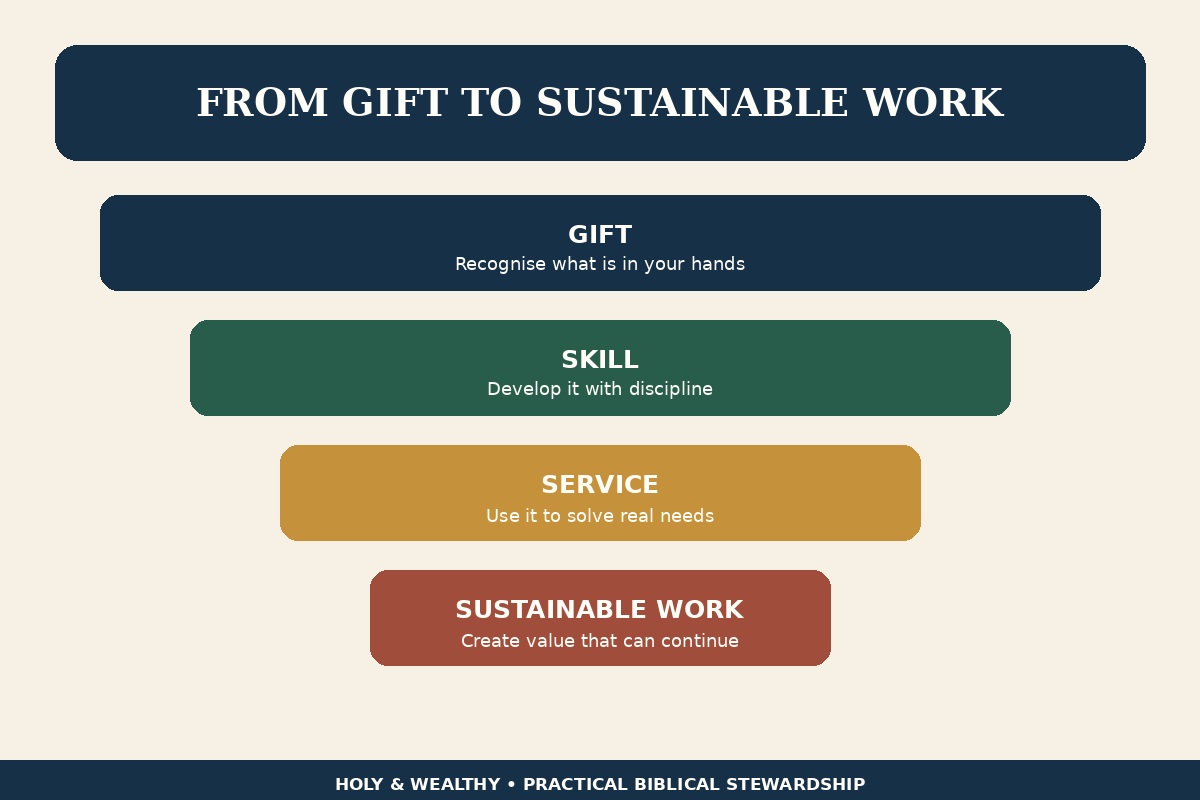
What I learned, slowly and through enough failure to take it seriously, is that the Christian financial struggle most believers face is almost never primarily a spiritual problem. It is a purpose and stewardship problem. A person who does not know what they are gifted to do cannot steward that gift. A person who has not identified the problem they were designed to solve cannot build the service that solves it.
And a person who is chasing money rather than serving people will always find that the money stays one step ahead of them, because money follows value. If you want to dive deeper into practical household stability while sorting out your calling, my post on how to save money on a small income offers a grounded starting point.
Frequently Asked Questions
Why do so many faithful Christians struggle with money?
Many sincere believers struggle financially because they separate spiritual devotion from practical stewardship, skill development, and market value. Faith is essential, but God designed economic systems to reward solved problems and added value, not just religious activity.
Is it wrong for a Christian to want financial stability?
It is not wrong at all. Financial stability gives you the breathing room to care for your family, support your local community, and fund Kingdom initiatives without constant anxiety.
How do I find out what God has called me to do?
Your calling usually lives at the intersection of your natural abilities, the burdens God has placed on your heart, and the real problems in the world that you feel uniquely equipped to solve.
What should I do if my business or career has failed multiple times?
Take a step back to evaluate your strategy, acquire missing skills, and ensure you are building a genuine service that solves a real market need rather than just chasing quick cash.
Where To Read Next
Why Christians Struggle With Money: The Honest Truth Nobody Preaches On Sunday
Why Do Christians Pray for Financial Breakthrough and Nothing Happens?
How to Choose an Income Producing Skill That Fits Your God Given Abilities
How to Save Money on a Small Income as a Christian Without Living in Fear
- How Does Money Change Relationships According to the Bible? — Another piece in this series.
- What Does the Bible Say About Your Relationship With God and Money? — Another piece in this series.
- Is It Biblical to Pray a Prayer That Invokes Wealth From God? — Another piece in this series.
Found this helpful? Share it with someone who needs it.