
You have prayed the prayers. You have quoted the verses and have told everyone you are "trusting God" for a breakthrough. But the bank balance and the living conditions hasn't moved an inch or changed, and the bills aren't waiting for your faith to manifest.
I know that sinking feeling in the pit of your stomach when you check your account and your family needs as well as the need to provide for them. It is a mixture of confusion and a quiet, desperate kind of shame. You wonder if your faith is too small, or worse, if God is simply not listening to you anymore.
The truth is that many believers find themselves struggling financially if I trust God becomes their daily lament. They are doing the "spiritual" work but seeing zero material results. This happens because we have been taught that trust is a passive state of mind, rather than an active partnership with the Creator.
If you are tired of spiritualising your shortage and want to understand why your trust isn't translating into provision, we need to look at the hard reality of stewardship. As I discuss in my core teaching on Why Christians Struggle With Money: The Honest Truth Nobody Preaches On Sunday, God rarely blesses a mess, no matter how much you pray over it. Trusting God is the foundation, but it was never intended to be the finished building.
The English word "trust" often feels like a soft, emotional leaning. It suggests a child waiting for a parent to do everything. But the Hebrew concept of trust is far more rugged and structural than our modern sentimentality allows.
In the Old Testament, one of the primary words for trust is aman. You might recognise it as the root of our word "Amen." In its original context, aman does not mean to sit back and hope for the best. It means to build, to support, or to be firm. It is the image of a pillar holding up a roof or a nurse carrying a child. It implies a solid, reliable foundation that can bear weight.
When Isaiah 28:16 says, "he that believeth shall not make haste" (KJV), the word for believeth is aman. This isn't just about "believing" in your head. It is about being so firmly planted in God's principles that you don't panic or rush into foolish debt. If you are struggling financially if I trust God is your concern, you must ask: Is my trust a pillar that supports my actions, or is it just a wish I've renamed "faith"?
To aman God is to build your financial life upon His specific instructions. It is the difference between a house built on sand and one built on a rock. You aren't just waiting for God to move; you are moving because you trust that His Word is solid ground. Trusting Him means you act on His laws of sowing, reaping, and stewardship with the absolute certainty that they work.
The Trap of Passive Faith
I have seen so many brethren treat trust like a spiritual lottery ticket. They think that if they just "believe hard enough," God is obligated to bypass the natural laws of money and drop a blessing in their lap. This is not faith. This is presumption.
Presumption is expecting God to do for you what He has already given you the power to do for yourself. He gave you the ability to get wealth, but He didn't promise to manage your bank account for you. "But thou shalt remember the LORD thy God: for it is he that giveth thee power to get wealth" (Deuteronomy 8:18, KJV).
Notice that He gives the power, not necessarily the finished product. If you are trusting God but refusing to look at your spending, you are asking Him to bless your disobedience. I used to think that "living by faith" meant I didn't need a budget. I thought a budget was for people who didn't trust God.
I eventually realised that a budget is actually an act of worship. It is telling God, "I trust Your provision so much that I am going to honour every penny of it by giving it a name and a purpose." When you refuse to manage what He gives, you are telling Him you don't value the "power" He has already provided.
Why Your Prayers Aren't Paying Your Rent
Prayer is the engine room of the Christian life, but an engine doesn't move the car if you haven't put it in gear. Many Kingdom citizens are struggling financially if I trust God because they are using prayer as a substitute for obedience. You cannot pray your way out of a problem that you behaved your way into.
If you are spending more than you earn, no amount of fasting will fix your balance sheet. God is a Father, but He is also a Judge and a King. He governs the universe by laws. One of those laws is that "the borrower is servant to the lender" (Proverbs 22:7, KJV).
When you violate that law by taking on high interest debt for things you don't need, you are entering into a form of servitude. You can pray for "liberty," but God's way to liberty is usually the long, narrow path of repayment and discipline. He will give you the strength to walk it, but He rarely just "cancels" the debt while you keep the same habits.
I often tell people that God's answer to a financial prayer is frequently a job offer, a business idea, or a conviction to stop eating out. If you are looking for a miracle but ignoring the instruction, you will stay stuck. Trusting God means listening for the "still small voice" that tells you to sell the car you can't afford.
The Stewardship Mandate You Might Be Ignoring
We often forget that the very first command God gave man was about management. Before the fall, before sin, there was stewardship. We were put in the garden to "dress it and to keep it" (Genesis 2:15, KJV). Management is a holy calling.
If you are struggling, it might be because you have a "consumer" spirit rather than a "steward" spirit. A consumer looks at money and asks, "What can this buy for me?" A steward looks at money and asks, "What does the Owner want me to do with this?"
This shift in perspective changes everything. When you realise you are managing God's money, you become much more careful with it. You wouldn't be reckless with your boss's corporate credit card, would you? Yet we are often reckless with the resources the King of Kings has entrusted to us.
I have found that God doesn't increase what we cannot manage. In the Parable of the Talents, the master gave to each "according to his several ability" (Matthew 25:15, KJV). The increase followed the demonstration of management ability. If you want more, you must show God you can handle the little you have right now.

Faith Without a Spreadsheet is Often Presumption
James tells us clearly that "faith, if it hath not works, is dead, being alone" (James 2:17, KJV). In the realm of finance, those "works" look like spreadsheets, savings accounts, and skill development. You cannot say you trust God for a better job if you haven't updated your CV in five years.
I believe that real faith is evidenced by preparation. If you ask yourself: Am I prepared for the blessing I'm praying for? If God dropped ten thousand pounds into your lap today, would it be gone in a month because you have no system to catch it? This is what a lot of Christians are lacking today and at the end of the day blame God for not receiving answers to their prayers.
Look at how Joseph handled the famine in Egypt. He didn't just "trust God" and hope the grain appeared. He built storehouses. He measured the harvest. He created a twenty percent tax system during the years of plenty to survive the years of lack. You can read more about this in my study on What Did Joseph Do to Succeed in the Bible?.
Joseph's faith was not passive. It was administrative. He trusted God's word about the coming famine, and he moved into action. True trust results in a plan. If you don't have a plan, you might be surprised to learn that Why God Cannot Bless a Plan You Never Made is a reality many of us face.
The Difference Between Waiting on God and Being Lazy
There is a very fine line between "waiting on the Lord" and just being idle. We often use spiritual language to mask our fear of failure or our lack of discipline. We say we are "waiting for a door to open," but God says He will bless the "work of thine hand" (Deuteronomy 28:12, KJV).
If your hands are empty and folded in your lap, there is nothing for Him to bless. I have met many believers who are struggling financially because they are waiting for a supernatural "shift" while ignoring natural opportunities. They want the "windows of heaven" to open, but they won't even open a laptop to learn a new skill.
The Bible is very blunt about this. "He becomes poor that dealeth with a slack hand: but the hand of the diligent maketh rich" (Proverbs 10:4, KJV). Diligence is a form of trust. It is trusting that if you do your part with excellence, God will do His part with favour. It is not one or the other; it is both.
In 2026, the "work of your hand" might look like taking an online course, starting a side business, or finally asking for that promotion. Trusting God gives you the courage to take the risk, but it doesn't do the work for you. You have to show up to the field if you want to see the harvest.
How to Start Moving While You Are Still Praying
If you find yourself struggling financially, the first step is to stop looking for a miracle and start looking for a mandate. What has God already told you to do that you are ignoring? For many of us, the "breakthrough" is hidden in the thing we are avoiding.
Start by getting honest about your consumer habits and numbers. You cannot manage what you do not measure. I know it's painful to look at the debt. I know it's scary to see how much you've been wasting. But "the truth shall make you free" (John 8:32, KJV). You cannot be free from a financial prison if you refuse to admit you are in one.
Audit your spending for the last 90 days. Every single penny.
Create a "Zero-Based" budget where every pound has a job before the month starts.
Identify one skill you can improve to increase your value in the marketplace.
Set up a small, automatic saving plan, even if it is only five pounds a week.
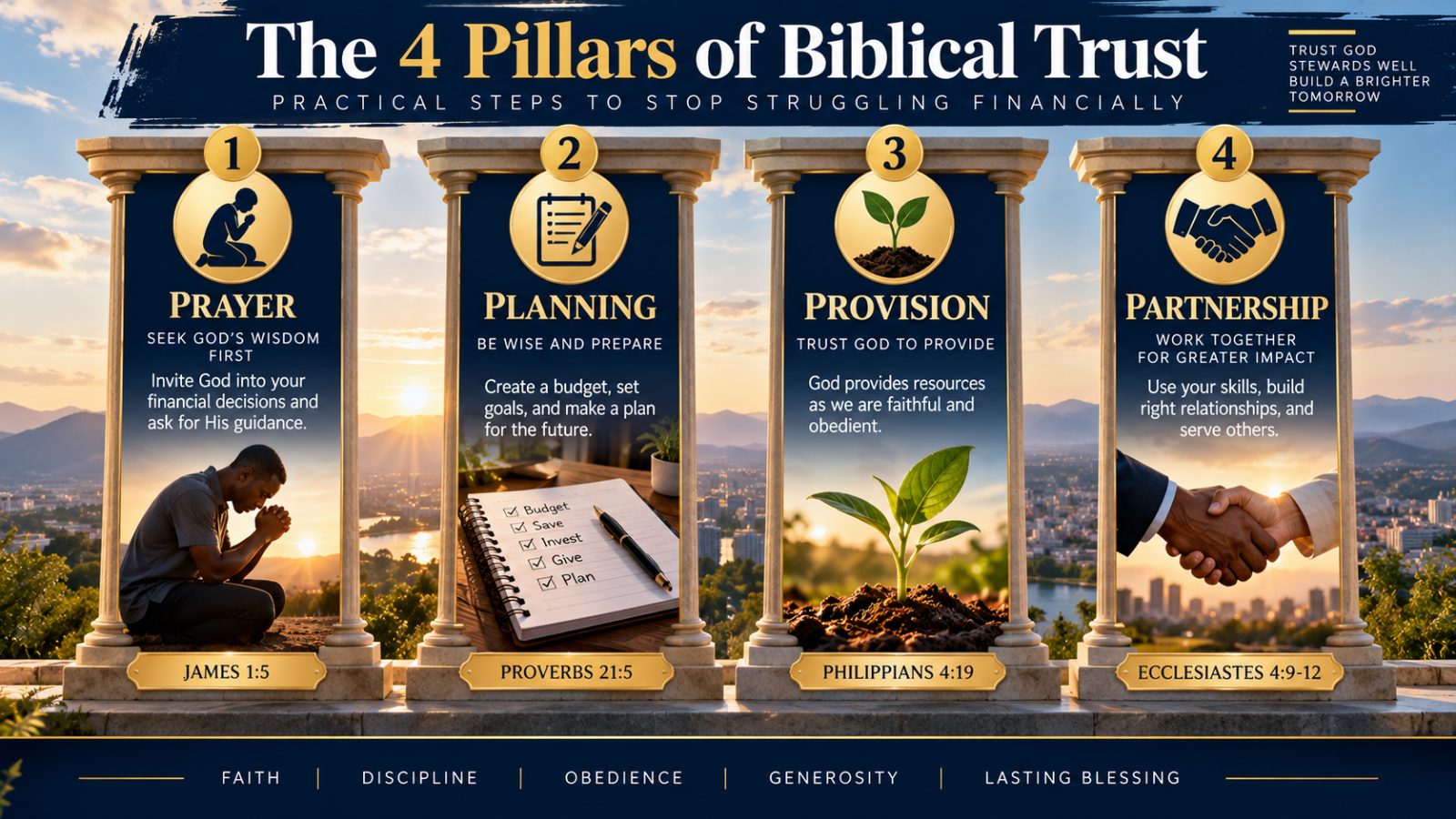
These small acts of stewardship are signals to heaven that you are ready to be a faithful oikonomos (manager). You are moving from a passive victim of circumstances to an active participant in God's provision. This is what it looks like to truly trust Him with your money.
If a big number of kingdom citizens can understand this and take action we can build a community of kingdom believers who not only understand finanances but also represents the king in their territories.
Where To Read Next
If you want to go deeper into why the spiritual and the practical must work together, here are several resources to help you walk this out:
Why Christians Struggle With Money: The Honest Truth Nobody Preaches On Sunday
Why Do Christians Pray for Financial Breakthrough and Nothing Happens?
What Proverbs Says About Money And The Financial Wisdom Most Believers Never Apply?
How to Save Money on a Small Income as a Christian Without Living in Fear
My Honest Story of a Christian Struggling With Money: Empty Hands and What I Finally Learned
How to Get Out of Debt as a Christian Without Stopping Giving: A Biblical Approach
Frequently Asked Questions
Why am I struggling financially if I trust God?
You may be treating trust as a passive emotion rather than an active commitment to biblical stewardship. Trusting God requires you to obey His financial laws, such as budgeting, avoiding debt, and working with diligence. "Faith without works is dead" (James 2:20, KJV), so ensure your spiritual trust is matched by practical management.
Is it a sin to be struggling financially as a Christian?
Struggling financially is not inherently a sin, but the habits leading to it might be, such as slothfulness or greed. Many faithful people in the Bible, including Paul, experienced times of "want" and "necessity" (Philippians 4:12, KJV). However, God calls us to move toward wisdom and stewardship so we can be a blessing to others.
How do I trust God when I can't pay my bills?
Trusting God in a crisis means choosing peace over panic while taking every practical step available to you. Start by bringing your needs to Him in prayer, then look for the "power to get wealth" He has already provided through your skills or resources. "But my God shall supply all your need according to his riches in glory by Christ Jesus" (Philippians 4:19, KJV).
What does the Bible say about struggling with money?
The Bible acknowledges that life involves seasons of hardship, but it consistently points toward wisdom and diligence as the way out. It warns against the "slack hand" that leads to poverty and encourages the "diligent" who will bear rule. Scripture teaches us to seek first the Kingdom of God, which includes following His rules for money management.
Should I stop tithing if I am struggling financially?
I believe that tithing is a test of our first-fruits priority and should be the last thing we cut, not the first. Many believers find that when they honour God first, He gives them the wisdom to manage the remaining 90% more effectively. "Honour the LORD with thy substance, and with the firstfruits of all thine increase" (Proverbs 3:9, KJV).
Found this helpful? Share it with someone who needs it.