
Anointing will never exempt you from an economic storm. I have sat across from faithful believers who prayed every morning, paid their tithes without fail, and served passionately in church, yet found themselves completely shattered by a sudden layoff or business collapse. They believed their spiritual devotion was an invisible insurance policy against hardship in this broken world. When the storm arrived, they were caught off guard, overwhelmed, and completely unprepared.
Look around you today. Whenever the word crisis appears in the headlines, faces tighten and anxiety spreads like wildfire through Christian households. Economic downturns, health emergencies, and unexpected layoffs do not stop to check your church attendance before they strike.
Admitting that trouble will come is not weak faith. It is mature biblical wisdom so you never get caught sleeping when the season shifts.
The Biblical Meaning of a Crisis
To learn how to prepare for a financial crisis, you must first understand what the word actually means in Scripture. In our modern vocabulary, crisis sounds like total destruction and hopeless ruin. We treat it as an unmitigated disaster that leaves us completely helpless and terrified. Yet the original word tells a radically different story.
The English word comes from the Greek noun krisis. It does not mean ruin or catastrophe. In ancient Greek, krisis means an evaluation, a turning point, a decisive moment, or a process of separating what is authentic from what is counterfeit. It is the exact moment where truth is revealed.
When you walk through sudden pressure, God is not abandoning you to chance. That trial is exposing the structural integrity of your life. This reveals why so many faithful believers struggle with money when unexpected hardship knocks at their door.
The Apostle Peter used this exact concept when writing to believers who were facing intense uncertainty: "Beloved, think it not strange concerning the fiery trial which is to try you, as though some strange thing happened unto you:" (1 Peter 4:12, KJV)
Peter tells us that testing is not an accident that catches God by surprise. A financial crisis does not create your financial foundation; it simply reveals what your household was built on all along. A crisis simply forces you to make decisions you should have made during the good years.
Anointing Is Not Insurance Against the Wind
I want to speak plainly to you, Kingdom citizens. There is a dangerous idea floating around modern pulpits suggesting that if you have enough faith, you will never face a lean year.
That is not what Jesus taught. In the Sermon on the Mount, Jesus shared the familiar parable of two men who set out to build homes. "And the rain descended, and the floods came, and the winds blew, and beat upon that house; and it fell not: for it was founded upon a rock." (Matthew 7:25, KJV)
Look carefully at that verse. The rain descended on the wise builder's house. The floods rushed against the wise builder's foundation. The wind battered the wise builder's walls.
Wisdom did not stop the weather from turning violent. Being founded on the rock simply kept the house standing upright when the squall struck. You can be deeply spiritual, pray without ceasing, and love God with all your heart, yet still face rising grocery costs, unexpected illness, or redundant contracts.
The difference between those who survive a crisis and those who collapse is not the presence of faith alone. It is whether that faith was paired with practical obedience and disciplined preparation.

Why Anticipating Trouble Is Spiritual Leadership
Many believers hesitate to prepare for hard times because they mistakenly think preparation shows a lack of trust. They assume that storing away provision means you are inviting evil into your life.
That is superstitious religion, not biblical truth. Solomon shattered that flawed assumption in the Book of Proverbs: "A prudent man foreseeth the evil, and hideth himself; but the simple pass on, and are punished." (Proverbs 27:12, KJV)
The prudent person looks down the road, spots the trouble coming, and takes cover. The simple person closes their eyes, claims they are trusting God, walks right into the ditch, and suffers the penalty. Foresight is an act of spiritual stewardship.
Jesus Himself never sugarcoated the future for His followers. Before the cross, He told them plainly: "In the world ye shall have tribulation: but be of good cheer; I have overcome the world" (John 16:33, KJV). He prepared their minds before the crisis hit so their faith would not shatter under pressure.
A spiritual leader anticipates shifting seasons. If you fail to prepare your family budget, you are not displaying holy courage; you are being careless with God's resources. When you build a defence before the storm arrives, you are honouring God with the harvest He placed in your care.
The Danger of Consuming Your Seed in Harvest Seasons
The easiest time to prepare for an economic downturn is when you do not feel any pressure at all. When money flows easily, salaries arrive on time, and clients pay upfront, human nature becomes complacent.
We tell ourselves that the sunny harvest will continue forever. If you spend one hundred per cent of what comes into your hands each month, you are living on the edge of a cliff. One late cheque or one medical emergency pushes your whole household over the brink.
Scripture commands us to study one of the smallest creatures on earth to learn basic survival: "Go to the ant, thou sluggard; consider her ways, and be wise: Which having no guide, overseer, or ruler, Provideth her meat in the summer, and gathereth her food in the harvest." (Proverbs 6:6-8, KJV)
The ant does not collect grain in the summer because it is depressed. It works hard because it understands that summer never lasts. Winter always follows harvest.
If you consume every crumb today, you will beg tomorrow. Years ago, I lived through this bitter reality because I confused my seed with my bread. I talk candidly about that season in my personal story of learning stewardship through empty hands, and it taught me that God will never manage for you what He told you to manage yourself.
You cannot spend every penny on luxury during harvest and then blame spiritual warfare when the winter leaves your cupboard empty.
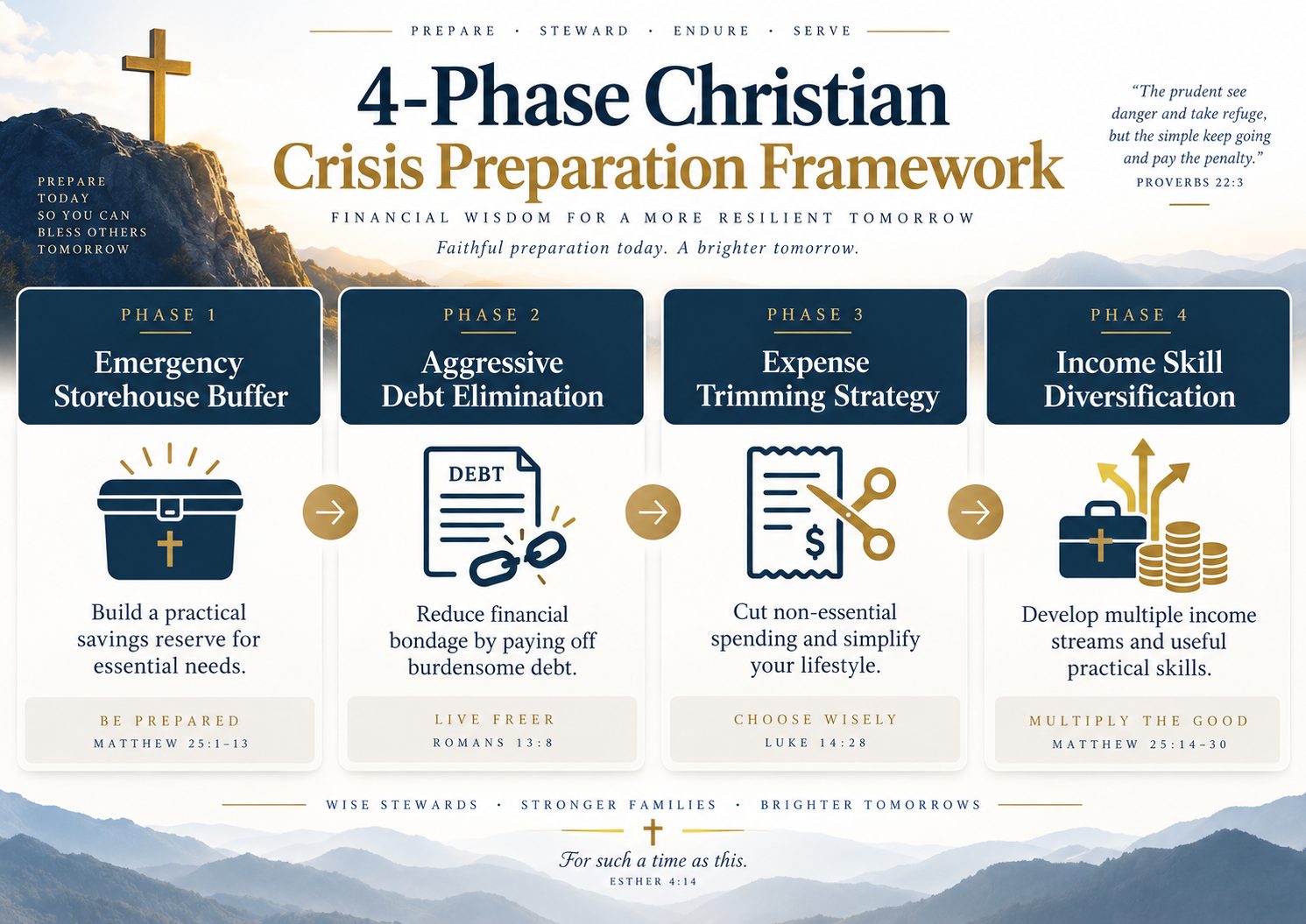
Practical Steps to Prepare for a Financial Crisis as a Christian
So how do you construct a practical defence before economic trouble arrives? Here are the five biblical actions every believer should take immediately.
1. Build Your Storehouse Buffer
Look at what Joseph did in Egypt when God warned Pharaoh about an approaching famine. Joseph did not tell the nation to fast and pray that the famine would vanish.
Instead, he instituted a rigorous, national savings policy. During seven years of supernatural abundance, he gathered twenty per cent of the harvest every single year.
"And let them gather all the food of those good years that come, and lay up corn under the hand of Pharaoh, and let them keep food in the cities." (Genesis 41:35, KJV)
When the seven years of famine swept across the ancient world, Egypt had bread to spare. Joseph understood what most modern Christians ignore, as I pointed out when examining what Joseph actually did to secure biblical success during a national crisis.
You must establish your own storehouse buffer. That means building a dedicated emergency fund holding three to six months of basic living expenses. Keep this money in an accessible, separate savings account that you do not touch for holidays or spontaneous shopping.
If saving three months of living expenses feels impossible right now, do not despair. Start by setting aside your first five hundred pounds. Even a small financial buffer gives you room to breathe when the unexpected happens.
2. Perform a Ruthless Spending Audit
You cannot defend what you do not measure. Most households bleed money through small, unnoticed leaks rather than massive splurges.
Print out your last three bank statements. Go through every single line item with a red pen. Divide your spending into absolute necessities, which are food, shelter, utilities, and transport, and discretionary lifestyle choices.
Cancel subscriptions you barely watch. Stop dining out four nights a week. Bring your lunch to work. If you need help structuring this, you can follow our practical step-by-step biblical budgeting system to regain total clarity over your cash flow.
Cutting expenses before a crisis hits is an act of wisdom; cutting expenses during a crisis is an act of desperation. Give yourself the advantage of making calm decisions today.
3. Kill Consumer Debt With Holy Aggression
Debt is financial bondage that leaves you completely vulnerable during lean times. When the economy contracts, loan payments remain completely fixed.
The Proverbs writer made this crystal clear thousands of years ago: "The rich ruleth over the poor, and the borrower is servant to the lender." (Proverbs 22:7, KJV)
If you carry credit card balances, hire purchase contracts, and store card debts, you are handing your peace over to lenders. In a crisis, that monthly debt payment turns from an annoyance into an unbearable weight. It robs you of options when income drops.
Stop borrowing money to finance an image you cannot afford. List your debts from smallest balance to largest. Throw every spare penny at the smallest balance until it is destroyed, then roll that payment into the next one.
Attacking your obligations requires serious determination. For a complete strategy, read our guide on getting completely free from debt while keeping your giving intact so you can protect your household from future shocks.
4. Diversify Your Skills and Work
Depending on one employer for your total financial survival is a dangerous strategy. Companies downsize, sectors change, and technologies eliminate jobs overnight.
The Preacher in Ecclesiastes gave wise counsel concerning financial diversification: "Give a portion to seven, and also to eight; for thou knowest not what evil shall be upon the earth." (Ecclesiastes 11:2, KJV)
Do not wait until a dismissal letter arrives on your desk to learn a new skill. What can you do with your hands? What expertise, trade, or knowledge do you possess that can solve a tangible problem for your community?
Begin sharpening that skill during your evenings and weekends. Learn how to offer that service honourably to others. You are not dividing your loyalty; you are being a responsible manager of your God-given abilities.
5. Anchor Your Giving in Scripture, Not Emotion
When panic sweeps across an economy, the first thing people often do is stop giving. They hoard whatever they hold in their hands out of terrifying fear.
Scripture presents a completely different economic reality. In 1 Kings 17, the widow of Zarephath had only a handful of meal and a little oil in a cruse. She was preparing one last meal for herself and her son before facing starvation.
Yet God sent the prophet Elijah to ask for her obedience first. When she released that small portion in faith, her jar never ran dry throughout the entire famine. Generosity during a crisis breaks the spirit of fear over your life.
Giving keeps your heart soft toward others and reminds you that your true security comes from Jehovah Jireh, not the bank. Never let financial uncertainty steal your generous heart.

What to Do If the Crisis Has Already Arrived
Perhaps you are reading this while the storm is already raging around you. Your income has already dropped, the bills are piling up, and you do not have three months of savings in reserve.
First, breathe. Do not let shame paralyse you. As I explored when dealing with the heavy shame of financial mistakes as a Christian, condemnation never comes from God. Guilt will not pay your rent, and regret will not restore your savings account.
Second, face the numbers without hiding. Speak to your creditors immediately before they chase you. Explain your circumstances calmly, request hardship arrangements, and protect your four walls: food, housing, electricity, and basic transport.
Third, bring your honest situation before the Lord. King David was surrounded by enemies and financial stress in the wilderness, yet he prayed with confidence:
"The young lions do lack, and suffer hunger: but they that seek the LORD shall not want any good thing." (Psalm 34:10, KJV)
Cry out to Him for practical wisdom. Ask Him to open your eyes to hidden opportunities, to give you favour with employers, and to show you where you can serve others. God is the God of the valley just as much as He is the God of the mountain.
Where To Read Next
If you want to build a truly resilient financial foundation grounded in biblical wisdom, continue with these guides:
Why Christians Struggle With Money: The Honest Truth Nobody Preaches On Sunday
What Did Joseph Do to Succeed in the Bible? What Most Christians Refuse to Do
My Honest Story of a Christian Struggling With Money: Empty Hands and What I Finally Learned
How to Create a Christian Budget When Money Is Tight: A Biblical Step by Step Guide
Shame and Financial Failure as a Christian: What the Bible Says About the Weight You Are Carrying
- How Does Money Change Relationships According to the Bible?
- What Does the Bible Say About Your Relationship With God and Money?
- Is It Biblical to Pray a Prayer That Invokes Wealth From God?
Frequently Asked Questions
Is saving money during good times a sign of weak faith?
No, saving money is a direct biblical command, not a lack of faith. In Proverbs 6:6-8, God commends the ant for storing provision in the summer to survive the winter. Wise stewardship means gathering resources during seasons of abundance so your household does not become a burden during lean times.
How much money should a Christian keep in an emergency fund?
A wise target for most Christian households is three to six months of essential living expenses. This covers baseline needs like housing, food, and utilities. If you are starting from zero, aim for an initial buffer of five hundred to one thousand pounds before building toward your full storehouse.
Should I continue tithing if I am in a severe financial crisis?
Yes, your posture of honouring God should not vanish when money becomes tight. While God desires your heart and not your legalistic misery, continuing to give faithfully reminds your soul that the Lord remains your provider. If income is drastically reduced, give proportionately according to what you have, trusting His sustaining grace.
What does the Bible say about surviving an economic collapse?
The Bible shows throughout Genesis, Psalms, and Acts that God preserves His people during famine and hardship. In Genesis 41, God gave Joseph a strategic management plan to store twenty per cent of the harvest before famine struck. Scripture teaches diligent preparation, debt avoidance, and unwavering trust in God's daily bread.
Found this helpful? Share it with someone who needs it.