I used to believe that having a savings account was a silent confession of unbelief. I thought that if I truly trusted God for my daily bread, my bank account should remain close to empty, proving my complete reliance on His hand. But after years of living in a constant cycle of financial panic, crying out for miracles to cover predictable bills, I realized I was confusing spiritual faith with physical carelessness. If you are asking yourself, what does the Bible say about saving money, you need to know that God does not command us to live in perpetual crisis.
Saving is simply income kept for a future purpose. It may be for school fees, rent during an uncertain month, medical costs, tools for work, or an emergency that has not happened yet. Whether that saving is wise or fearful depends entirely on what it serves, how it was gathered, and what place it occupies in your heart. When we understand how to manage our resources, we can begin applying kingdom money principles from the Bible to our daily decisions without feeling guilty about preparing for tomorrow.
We must realize that the Lord wants us to be channels of His blessing, not just consumers of His provision. If we spend every single coin that enters our hands, we leave ourselves vulnerable to the storms of life. Let us look closely at what the Scriptures actually teach about building a reserve, separating our funds, and protecting our hearts from the trap of false security.
What Does the Bible Say About Saving Money?
To understand what the Bible says about saving money, we must look at the natural patterns God established in creation. Proverbs 21:20 says, "There is treasure to be desired and oil in the dwelling of the wise; but a foolish man spendeth it up" (Proverbs 21:20, KJV). Proverbs is wisdom literature. It describes patterns that ordinarily protect life; it does not promise that every person who saves will avoid loss, or that every person without savings has been foolish. Poverty, illness, injustice, and crisis can consume even the most careful household.
To understand the depth of this verse, we must look at the Hebrew language. The word translated as "treasure" in this passage is otsar, which comes from the root verb atsar, meaning to store up, lay up, or gather thoughtfully. It does not refer to a pile of gold hoarded out of greed. It refers to a well-managed storehouse of important provisions. Solomon is teaching us that a wise steward keeps a reserve of resources in his home, while a foolish person consumes everything immediately.
Still, the verse refuses to praise the habit of consuming everything available. Oil and stored goods had practical value in an agricultural household. Keeping part of them meant that tomorrow’s needs did not have to be treated as tomorrow’s surprise. If you want to study this wisdom further, you can read my guide on what Proverbs says about money and financial wisdom to see how these principles work in real life.
Proverbs 6:6-8 points to the ant, which prepares food in summer and gathers during harvest. The lesson is not that we should live in panic. It is that seasons matter. Harvest and shortage do not arrive at the same time, so wisdom acts while opportunity is present. The ant does not wait for the winter to start thinking about food; it uses the abundance of summer to prepare for the cold season ahead. If the ant can practice such foresight without a guide or ruler, how much more should we, as children of God, steward our resources with diligence?
Preparation Can Be an Act of Faith
This brings us to an important truth: preparation is not the opposite of faith. In fact, preparing for the future is often one of the highest expressions of biblical stewardship. To see this clearly, we must look at the origin of the word provision. It comes from the Latin word provisio, which is derived from providere. This word is made of two parts: pro, meaning forward or ahead, and videre, meaning to see. Literally, provision means to look ahead and prepare for what is coming.
This is the exact concept Paul uses when writing to Timothy. In the Greek text of 1 Timothy 5:8, the word translated as "provide" is pronoeo. This comes from pro, meaning before, and noeo, meaning to think or perceive. It literally means to think beforehand, to practice foresight, or to take thought for ahead of time. Paul writes: "But if any provide not for his own, and specially for those of his own house, he hath denied the faith, and is worse than an infidel." (1 Timothy 5:8, KJV)
Look at the strength of that language, child of God. Paul does not say that planning for your family is a sign of weak faith. He says that a refusal to practice pronoeo, a refusal to think ahead and prepare for your household's needs, is a denial of the Christian faith itself. If we do not save or plan for the predictable needs of our children, spouses, and elderly relatives, we are failing in our basic duties as believers.
Saving money is simply the practical application of this foresight. It is setting aside a portion of today's harvest to ensure that the people God has placed under our care are protected tomorrow. When we save with this heart, we are not trusting in our bank accounts. We are obeying God's command to care for our households with wisdom and diligence. It is about being a faithful manager of what belongs to the Master, which is why understanding biblical stewardship versus ownership is so important to our peace of mind.
Joseph Saved for a National Crisis, but His Story Needs Care
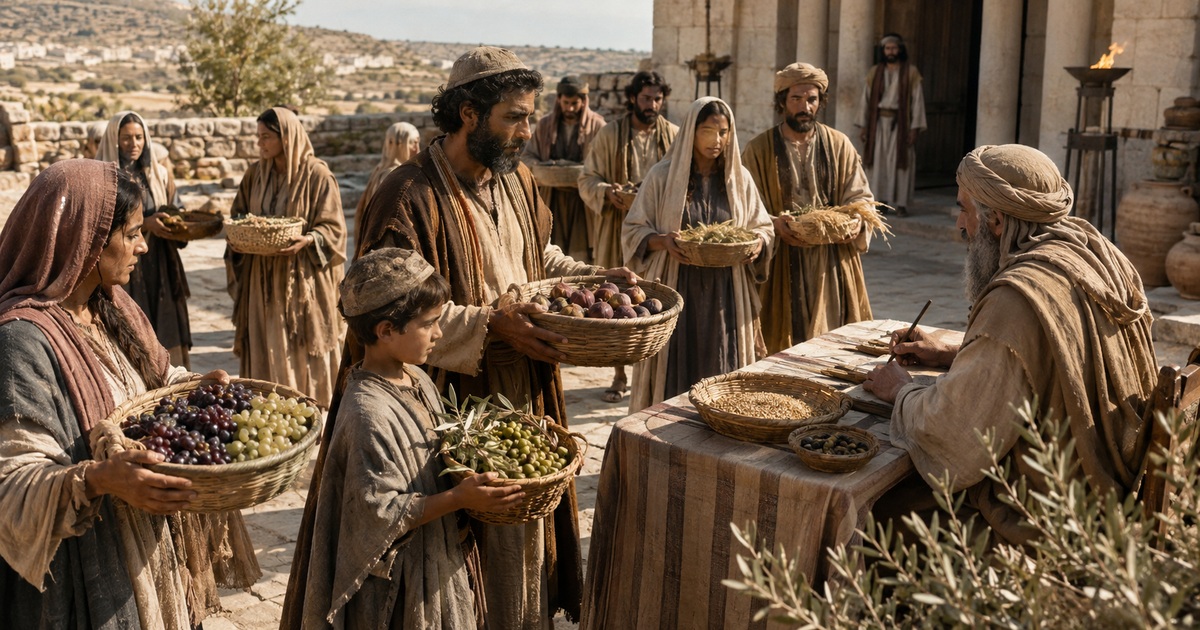
Genesis 41 records Joseph collecting grain during seven abundant years before seven years of famine. The plan was national policy under Pharaoh, not a household savings formula. Later chapters also show the concentration of land and labour under Pharaoh, so we should not turn every part of the policy into an unquestioned model for modern government or personal finance.
The clear principle is foresight. Joseph believed the warning, measured the coming need, organised storage, and protected the resource during abundance. He did not call preparation unbelief. His faith produced administration. In the same way, a household can pray for provision and still create a reserve for expenses that are likely to come. If you are currently facing a difficult season, you can read about the story of Joseph in the Bible to understand how God uses preparation to position us for promotion.
This is where planning becomes practical. I wrote about this in detail when explaining why God cannot bless a plan you never made, which challenges the habit of asking God for change while refusing to write down the responsibility already in front of us. A saving goal becomes stronger when it has a name, an amount, and a realistic time frame. Joseph did not just tell Pharaoh to "be careful"; he created a highly structured, system-wide plan to secure the grain.
As believers, we must move away from the lazy theology that uses "faith" as an excuse for poor administration. If God has blessed you with a season of abundance, as we speak, that abundance is not just for immediate luxury. It is your summer season. It is the time to gather, to organize, and to build a reserve so that when the winter season arrives, you are not forced into desperate debt or spiritual compromise.

Saving and Hoarding Are Not the Same
Jesus’ parable of the rich fool in Luke 12 warns against accumulation that is centred entirely on self. The man enlarged his barns, spoke only to himself, and treated stored goods as a guarantee of many secure years. His problem was not that barns existed. His problem was that abundance had removed God, neighbour, and mortality from the plan.
"And I will say to my soul, Soul, thou hast much goods laid up for many years; take thine ease, eat, drink, and be merry. But God said unto him, Thou fool, this night thy soul shall be required of thee: then whose shall those things be, which thou hast provided?" (Luke 12:19-20, KJV)
Saving serves a defined responsibility. Hoarding keeps accumulating because the heart never feels safe enough. Saving can be opened when its purpose arrives. Hoarding resists every claim, even when obedience, justice, or mercy requires release. Saving says, "This reserve is a tool." Hoarding says, "This reserve is my life."
A Christian therefore needs both a target and a heart check. Ask what the money is for, what "enough" looks like for that purpose, and whether building the reserve is making you more responsible or more controlled by fear. Contentment does not forbid preparation; it prevents preparation from becoming endless worship of security. When we understand how the world's financial systems operate, we can see the stark contrast in kingdom economics versus world economics, where our security is anchored in the Provider, not the provision.
If you find yourself constantly checking your savings balance, feeling a deep panic whenever you have to spend a portion of it on a legitimate need, you are no longer saving. You are hoarding. You have allowed that reserve to become your high tower. We must constantly surrender our accounts to the Lord, acknowledging that every single coin belongs to Him and must be available for His purposes at a moment's notice.
The Practical Strategy: How to Separate Your Reserves
A reserve only becomes practical when it is separated from ordinary spending. If you keep your savings in the same place where you keep your daily food money, you will eventually spend it. This is not because you are wicked; it is simply because human nature flows along the path of least resistance. Solomon understood this practical reality of managing a household well.
The Proverbs writer notes, "Prepare thy work without, and make it fit for thyself in the field; and afterwards build thine house" (Proverbs 24:27, KJV). This is a principle of order and separation. You do not mix your seed grain with your daily bread grain. You must intentionally separate your funds so that your reserves are protected from daily, impulsive consumption.
For many fellow believers, this means opening a separate account that is not easily accessible. If you are struggling to build this safety net, you should look at my practical advice on how to build an emergency fund as a christian on a small income without letting fear replace your faith. It is about taking small, consistent steps to set aside what you can, even if it is just a few coins a week.
Create a dedicated storehouse: Use a separate bank account or a physical box that is strictly designated for emergencies and future obligations.
Automate the boundary: Move your savings out of your primary account immediately after you receive your income and pay your tithes.
Give your savings a specific name: Label the fund "School Fees," "Rent Reserve," or "Medical Emergency" so your mind associates it with stewardship, not spare cash.
By establishing these clear boundaries, you prevent yourself from eating your tomorrow's seed today. It allows you to look at your primary account with absolute honesty, knowing exactly what you have available to spend right now and what must remain untouched for future responsibilities.
The Danger of False Security: Where Is Your Trust?
While the Bible clearly commends saving, it issues an equally clear warning about the deceitfulness of riches. The danger of a healthy savings account is that it can slowly, silently tempt you to shift your trust from the Creator to the creation. You begin to sleep better at night because of the balance in your account rather than the presence of the Holy Spirit.
The Apostle Paul addressed this directly when instructing Timothy on how to pastor wealthy believers. He did not tell him to command them to throw their money away, but he gave them a strict warning about their heart posture: "Charge them that are rich in this world, that they be not highminded, nor trust in uncertain riches, but in the living God, who giveth us richly all things to enjoy;" (1 Timothy 6:17, KJV)
Look at that phrase: trust in uncertain riches. Riches are inherently unstable. A sudden market crash, a currency devaluation, an unexpected political shift, or a medical crisis can wipe out years of accumulated savings in a single afternoon. If your peace of mind is built on the stability of your bank account, you are standing on sinking sand.
We must learn to hold our savings with an open hand. The money in your reserve is a resource to be used, not a shield to protect you from the realities of life. The Lord is your shield. Your savings account is simply a tool of stewardship that He has allowed you to manage. If we keep this perspective clear, we can build significant reserves without falling into the spiritual decay of self-sufficiency.
Saving to Give: The Ultimate Kingdom Purpose
Why does a Kingdom citizen save money? The worldly mindset saves solely for self-preservation, early retirement, and personal comfort. But the biblical view of saving money has a far grander purpose. We save so that we are positioned to be a blessing to others when crisis strikes. We save to give.
Consider the words of Paul to the church in Ephesus: "Let him that stole steal no more: but rather let him labour, working with his hands the thing which is good, that he may have to give to him that needeth" (Ephesians 4:28, KJV). The goal of work and financial management is not merely personal accumulation. It is to possess a surplus so that you can meet the needs of those around you.
If you live constantly on the edge of survival because of poor planning or lack of discipline, you cannot help anyone else. When a brother or sister in Christ faces a sudden medical emergency, you can only offer prayers, indeed valuable, but sometimes God wants your hands to be the answer to their prayer. Having a reserve allows you to step into those moments with immediate, practical generosity.
Imagine the joy of being able to quietly pay someone's rent or cover a child's school fees because you had the foresight to save. That is the true beauty of Kingdom accumulation. It is not about building bigger barns for ourselves; it is about having a storehouse that can be opened to feed the hungry and support the work of the ministry when the need arises.
Where To Read Next
If you want to continue growing your understanding of biblical stewardship and managing your resources with Kingdom wisdom, look into these foundational guides next:
Biblical Stewardship Versus Ownership: The Truth That Frees You From the Fear of Loss
How to Build an Emergency Fund as a Christian on a Small Income Without Letting Fear Replace Faith
- Tithes, Offerings and Firstfruits: What Is the Difference?
- What Does the Year of Jubilee Mean for Christians in Debt?
- What Does Nehemiah Teach About Planning and Leadership?
- How to Develop a Kingdom Financial Mindset for Successful Living
- When Wealth Becomes an Idol: Biblical Warnings and Protection
- Biblical Investment Principles: What Scripture Teaches and What It Does Not
- How Sabbath Rest Is a Biblical Wealth Principle That Most Believers Have Never Applied
- How Did Abraham, Isaac, and Jacob Build Generational Wealth? What the Bible Teaches
- Does the Bible Support Multiple Income Streams? What Scripture Says About Financial Diversification
Frequently Asked Questions
Is it a sin for a Christian to save money?
No, it is not a sin for a Christian to save money. Scripture repeatedly commends saving and foresight, such as in Proverbs 21:20, which calls the preservation of oil and treasure wise, and Proverbs 6:6-8, which praises the ant for gathering food during the harvest. Saving becomes sinful only when it is driven by greed, fear, or a lack of trust in God's ultimate provision.
How does tithing relate to saving money?
Tithing should always come before saving, as it is our firstfruits offering to God. When we receive income, we honour the Lord first with our tithe, showing that our ultimate trust is in Him, and then we allocate a portion of the remaining ninety percent to our savings and living expenses. This order ensures that our saving is built on a foundation of obedience and worship rather than self-preservation.
What is the difference between saving and hoarding in the Bible?
The difference lies entirely in the posture of the heart and the purpose of the funds. Saving is setting aside resources for a defined, responsible future purpose, while keeping your heart open to God's direction and generosity. Hoarding is the endless accumulation of wealth driven by fear and self-reliance, where the individual trusts in their riches for security and refuses to release them for God's work or the needs of others.
Should I save money if I am currently in debt?
Yes, you should build a small, basic emergency fund even while working to pay off your debts. Having a small reserve prevents you from falling deeper into debt when unexpected expenses, like car repairs or medical bills, inevitably arise. Once you have established a small safety net, you can aggressively direct your surplus income toward clearing your remaining debts with wisdom.
Does saving money show a lack of faith in God’s provision?
No, saving money does not show a lack of faith when it is done in obedience to biblical wisdom. True faith works together with responsible stewardship, as seen in the life of Joseph, who saved grain to preserve lives during a famine. We trust in God as our ultimate Provider, but we use the practical tool of saving to manage the resources He has entrusted to our care responsibly.
Found this helpful? Share it with someone who needs it.