
I remember sitting at my desk at midnight, staring at an empty invoice queue while my main client vanished without warning. I had built a presence online, was delivering value, and was earning comfortably. Because that single stream was working, I treated it as if it would always work. You can explore how I learned to balance these ventures in my guide on building income as a Christian without burning out.
I had not saved enough. I had not built another reliable source. When the dry season arrived, I reacted from fear rather than from a plan. That single client departure cost me income I could not afford to lose because I focused on the promised return without fully understanding what I was entering.
That experience did not teach me that every Christian must collect seven side hustles. It taught me that dependence can become dangerous when one employer, client, platform, product, or contract carries the whole financial life.
Does the Bible support multiple income streams? I believe Scripture supports wise diversification, productive work, and preparation for uncertainty. But it does not support chasing every opportunity, neglecting rest, or treating income streams as a shortcut to wealth.
Diversification can reduce one kind of risk, but poor judgement can multiply risk faster than it multiplies income.
My Single Source Lesson
When my main freelance stream slowed, the financial problem was joined by an emotional one. I had connected stability to something I did not control.
Platforms change. Clients leave. Demand shifts. Health can interrupt work. Contracts end.
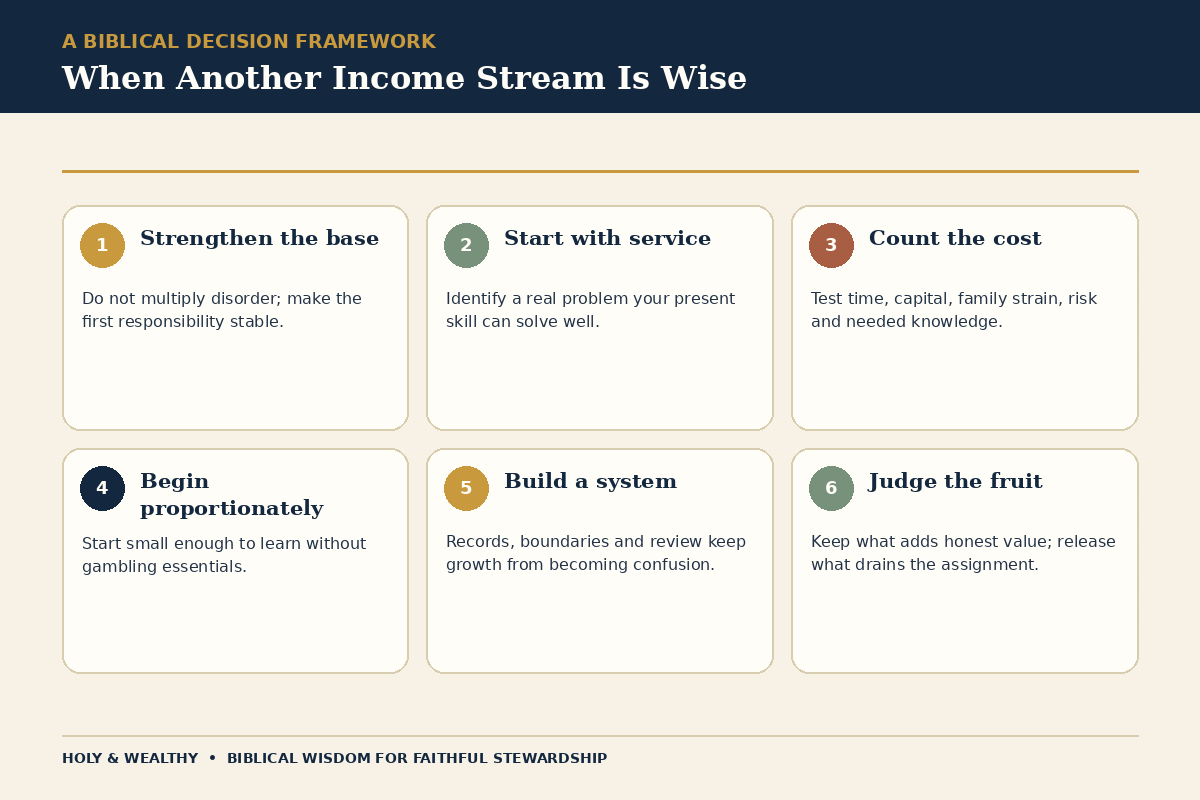
The mistake was not having a primary income. Most people need one main source that receives their strongest attention. The mistake was failing to build savings, transferable skills, and a second option while conditions were favourable. A second stream should normally be built from stability, not panic.
Ecclesiastes 11 Supports Diversification Under Uncertainty
Ecclesiastes 11:1-6 uses the language of sending goods out, giving portions to seven or eight, sowing in the morning, and continuing to work in the evening because the future is uncertain.
Translations differ in how they express the opening lines. The NIV uses direct investment language. Other translations speak about casting bread on the waters or giving portions. The precise picture is debated, but the wisdom is clear: act despite uncertainty, avoid placing everything in one place, and do not wait for perfect conditions.
The passage does not command exactly seven or eight income streams. The number pattern communicates abundance or going beyond a narrow minimum. It is wisdom about uncertainty, not a quota.
The safest second stream often begins with a proven skill and one real problem to solve. As I wrote about in my thoughts on understanding kingdom money principles, faithful stewardship requires active preparation rather than passive waiting.
It also includes a warning against paralysis. Whoever watches the wind will not plant. Diversification is not useful if endless fear prevents any responsible action.
Biblical Households Often Held Different Productive Assets
Abraham's household held livestock, silver, gold, servants, and later purchased land. Job's wealth included several kinds of livestock and a large working household. The Proverbs 31 woman works with textiles, trades, considers a field, buys it, and plants a vineyard.
These accounts show economically active households with different productive activities and stores of value. They support the idea that wise stewardship need not depend on one narrow form of income.
Still, I should not force modern financial categories onto every ancient detail. Livestock, servants, land, and household production existed in social systems very different from ours. Some aspects, including servitude, should not be romanticised.
The responsible application is the principle of productive variety, not a claim that every detail of an ancient household is a modern model.
The Parable of the Talents gives the deeper responsibility: resources and ability are entrusted for faithful action, not display. You can read more on this in my post explaining how the parable of the talents is a business plan for modern believers.
Investing is related but different; Christian investing requires due diligence and a clear distinction between wise exposure and greed.
Jacob's Story Is About Work, Conflict, and God's Providence
My original draft described Jacob's wealth as if he had mastered animal genetics through the striped branches. The text is more complicated.
Genesis 30 describes Jacob's actions, selective breeding, and the visual rods. Genesis 31 records Jacob saying that God had seen Laban's mistreatment and had transferred the livestock to him.
I can recognise Jacob's observation, hard work, and negotiation without pretending the passage gives a scientifically clear breeding method. The story also includes deception, exploitation, family conflict, and divine protection.
The financial lesson is not copy Jacob's technique. It is that knowledge, labour, negotiation, and God's providence operated inside a difficult and morally complicated workplace.
Joseph's Famine Policy Is Not a Simple Income-Stream Template
Joseph's administration stored grain during abundance and distributed it during famine. That shows foresight, logistics, record-keeping, and preparation.
Yet Genesis 47 also describes Egyptians surrendering money, livestock, land, and labour to Pharaoh. Readers should not treat the entire policy as a simple Christian business model. The passage reports the consolidation of power during a desperate crisis, and its ethical questions deserve attention.
I can learn the importance of preparation and systems without using the story to justify profiting from vulnerable people.
The Proverbs 31 Woman Shows Productive Range and Careful Management
The Proverbs 31 woman buys, produces, trades, plans, provides for her household, and gives to the poor. She pays attention to whether her trading is profitable.
Her picture is valuable because productivity and generosity are not placed in competition. She creates value and extends care.
However, the passage should not become another impossible burden placed on women, as if every godly woman must run several businesses and maintain a perfect household. The poem celebrates wisdom expressed through capable work. Its principle can encourage men and women to develop skill, notice opportunity, and manage responsibly.
Multiple Income Streams Can Become a New Form of Bondage
Diversification sounds wise, but it can become unhealthy.
A person can start too many things, perform all of them poorly, neglect family, abandon worship and rest, or borrow heavily to imitate somebody else's success. Multiple streams do not automatically create security. They can create multiple expenses, tax obligations, deadlines, and points of failure.
As I explored when discussing Sabbath rest, pushing beyond human limits breaks the very vessel God uses to produce value. Modern risk management requires us to balance our portfolios and income sources without sacrificing our mental health, family relationships, or spiritual devotion. True biblical diversification protects our ability to serve God rather than chaining us to endless hustle.
Frequently Asked Questions
Does the Bible forbid having multiple sources of income?
No, Scripture nowhere forbids holding multiple productive assets or income sources. Figures like Abraham, Job, and the Proverbs 31 woman engaged in diverse economic activities, provided they maintained integrity and stewardship.
How many income streams should a Christian have?
The Bible does not prescribe a specific number. Ecclesiastes 11:2 uses figurative language about giving portions to seven or eight to encourage preparedness against uncertainty, not to enforce a rigid quota.
Is a side hustle biblical for believers?
Yes, provided it is built on honest value, does not compromise your primary responsibilities to family and faith, and respects the biblical boundary of Sabbath rest.
Where To Read Next
How Sabbath Rest Is a Biblical Wealth Principle That Most Believers Have Never Applied
Biblical Stewardship Versus Ownership: The Truth That Frees You From the Fear of Loss
- Kingdom Economics Versus World Economics: The Biblical Financial System — Another piece in this series.
- What Does Nehemiah Teach About Planning and Leadership? — Another piece in this series.
- Tithes, Offerings and Firstfruits: What Is the Difference?
- What Does the Bible Say About Saving Money?
- What Does the Year of Jubilee Mean for Christians in Debt?
- How to Develop a Kingdom Financial Mindset for Successful Living
- When Wealth Becomes an Idol: Biblical Warnings and Protection
- Biblical Investment Principles: What Scripture Teaches and What It Does Not
- What Did Jesus Say About Money and Wealth? The Teaching Most People Miss
Found this helpful? Share it with someone who needs it.