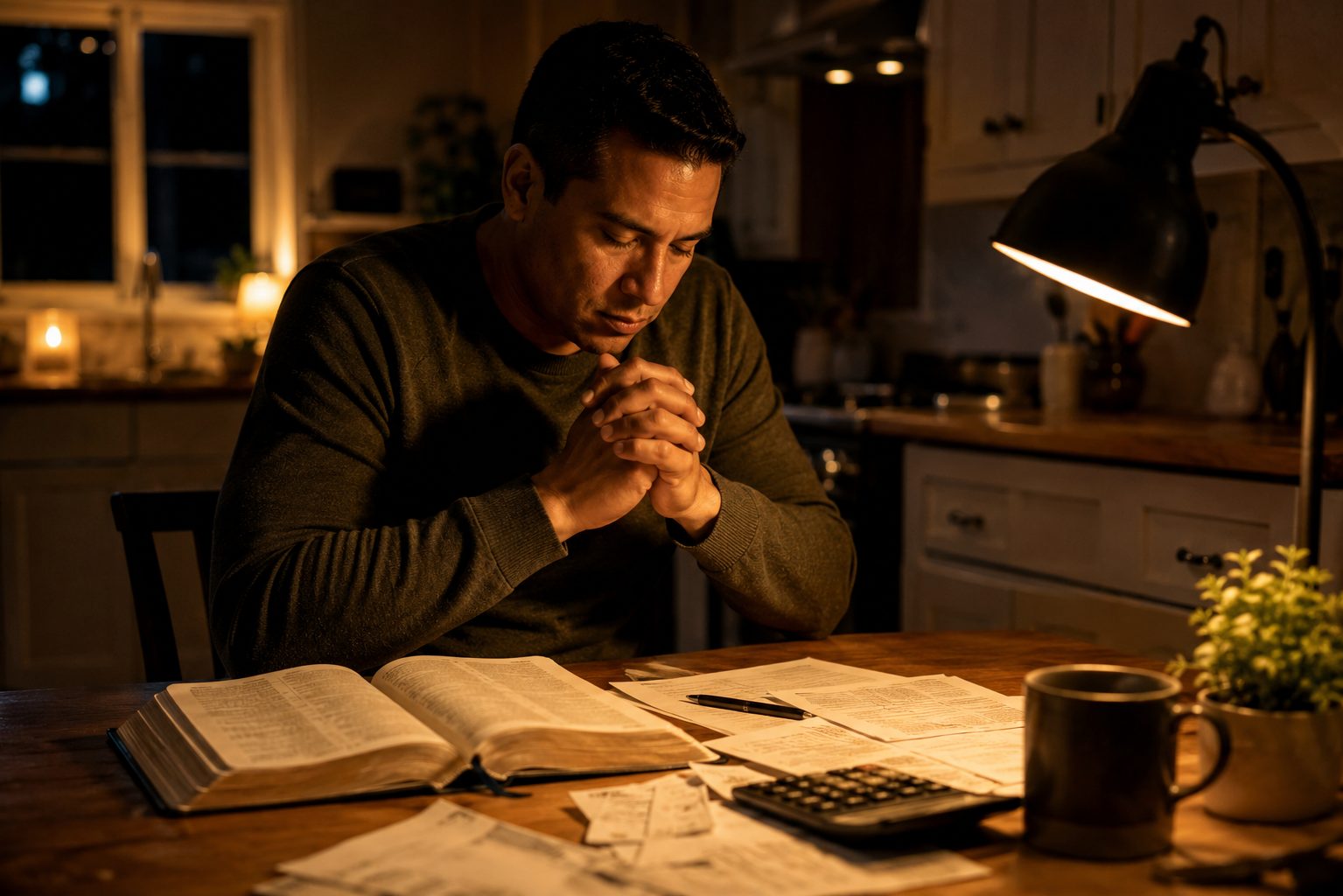
Acts 19 exposes the difference between borrowing Jesus' name as a formula and living under His authority
There's a scene in the book of Acts that unsettles me every time I read it, because it won't let me get away with saying "in Jesus' name" without asking myself what I actually mean by it. A group of travelling exorcists once tried to use the name of Jesus against an evil spirit. They knew the words and had heard how Paul ministered, but they treated the name as something they could borrow. It went about as badly as an exorcism can possibly go.
I want to walk through this with you slowly, because I think most of us, myself included, have prayed at some point and wondered why nothing seemed to move. This story isn't here to make us doubt our prayers. It's here to draw a clear line between saying a name and standing in one, and once we see that line, I believe we start praying differently, together.
What Actually Happened in Ephesus
The account sits in Acts 19:13 to 16. Luke first tells us that God was doing extraordinary miracles through the hands of Paul. Then certain travelling Jewish exorcists tried to call the name of the Lord Jesus over people with evil spirits. Seven sons of a Jewish chief priest called Sceva were among those doing this. Their words were revealing: "We adjure you by Jesus whom Paul preacheth." It sounds close to Christian language, but Jesus was still Paul's Jesus in their confession, not the Lord to whom they themselves belonged.
What follows is not subtle. The evil spirit answered, "Jesus I know, and Paul I know; but who are ye?" Then the man in whom the evil spirit was leapt on them, overpowered them and sent them fleeing from the house naked and wounded. Luke does not invite us to admire spiritual technique here. He exposes the difference between what God was doing through Paul and what these men tried to manufacture by attaching Jesus' name to their own practice.
The wider paragraph, Acts 19:11 to 20, matters. The failed exorcism became known across Ephesus, fear fell on the people, the name of the Lord Jesus was magnified, believers confessed their practices, and those involved in magic burned costly books. Luke's conclusion is not that Christians discovered a stronger incantation. It is that "the word of God grew mightily and prevailed". The event separates the gospel from magic: God cannot be manipulated, and Jesus' name cannot be reduced to a technique.
Why Matthew 1:21 Matters to This Question
Before we go further, I want us to sit with Matthew 1:21. The angel told Joseph, "Thou shalt call his name JESUS: for he shall save his people from their sins." That small word "for" joins the name to the mission. Joseph was not given a fashionable label and then told, as an afterthought, what the child might grow up to do. The name announced who this child was and what He came to accomplish.
Jesus is the English form of the Greek Iesous, which represents the Hebrew and Aramaic name Yeshua, related to the name Joshua. The name carries the confession that the Lord saves. Matthew does not leave the meaning vague: He shall save His people from their sins. That is the pattern I want us to keep in view, because the authority of Jesus' name cannot be separated from the person, character and saving work of Jesus Himself.
The Word Behind "Name": What It Actually Meant
In the Greek text of Acts, the word behind "name" is onoma, and it's worth slowing down on together, because in our culture a name is mostly just a label, while in the world the New Testament was written into it carried far more weight than that. Onoma covered everything a person's name represented, their rank, their authority, their standing, and what they were known to be able to do, so that when someone acted "in the name of" a ruler or an official, they weren't reciting a magic phrase but acting as that person's authorised representative, carrying real, delegated power.
This is also why acting falsely in someone's name was serious. To act in a ruler's name was to claim that you had been sent and authorised to represent that ruler. That is the background we need when reading the sons of Sceva. They were not merely pronouncing a syllable badly. They were treating the name of Jesus as an instrument they could add to an existing practice, even though they had not been sent by Him.
The Old Testament gives us a similar depth through the Hebrew word shem. A name could identify a person, preserve memory, express character or mark a calling, but Scripture does not turn every biblical name into a secret code. The responsible point is simpler and stronger: in the Bible, a name often carries the reality and reputation of the person who bears it. That is why God's name is to be hallowed, not handled as a charm, and why the third commandment warns against taking His name in vain.
When a Name Changes: Abraham and Israel
If a name can declare a mission before it happens, we should expect Scripture to show us moments where God changes someone's name entirely, and it does, twice, in ways that are hard to read past once you notice what's happening.
In Genesis 17, God appears to Abram at ninety-nine years old and confirms His covenant with him. In the middle of that covenant He says, "Neither shall thy name any more be called Abram, but thy name shall be Abraham; for a father of many nations have I made thee." Abram is commonly understood as "exalted father", while Abraham is connected in the passage with "a father of many nations". God gives him this name before Isaac is born. Each time Abraham hears it, he hears the covenant promise rehearsed while his circumstances still appear to contradict it.
Then there is Jacob. His first name is connected in Genesis with grasping the heel, and his life becomes marked by striving and grasping. In Genesis 32, after the night of wrestling at Jabbok, he is told, "Thy name shall be called no more Jacob, but Israel: for as a prince hast thou power with God and with men, and hast prevailed." The precise shade of Israel's meaning is discussed in scholarship, but the passage itself connects the new name with his struggle before God. The change marks a turning point. It does not mean Jacob becomes perfect overnight, and Scripture still uses the name Jacob later, but he no longer leaves that encounter as the same man.
What strikes me, reading these accounts side by side, is that the new names are not decoration. They mark God's covenant purpose and a changed relationship. The name is not the entire covenant, but it becomes a continuing witness to what God has spoken and to the life the person is now being called to live.

In the ancient world, acting in someone's name meant carrying delegated authority, not repeating a formula.
When Our Name Carries More Than We Think
Once I started paying attention to this, I noticed the same pattern showing up again and again through Scripture, because a name is never just a sound. It's a purpose spoken over a life, sometimes before that life even understood what it was carrying.
Take John the Baptist. In Luke chapter 1, Zechariah and Elizabeth's relatives assumed the baby would be named after his father, as custom demanded, but the angel Gabriel had already told Zechariah what to call him, and Elizabeth insisted, "Not so; but he shall be called John." The name means "the Lord is gracious," and it was never a sentimental choice, it was a declaration attached to a barren woman finally bearing a son, and to a child whose entire life would go on to prepare the way for grace itself to walk into the world.
We see the weight of naming around Samson as well. His name is often connected with the Hebrew word shemesh, meaning "sun", although the exact etymology is not certain and the biblical text does not explain it for us. What the text does explain is his calling. Before he was conceived, the angel told his mother that he would be a Nazirite, set apart to God from the womb, and that he would begin to deliver Israel from the Philistines. I would rather build the lesson on that clear calling than force a doctrine out of an uncertain name meaning. His life shows both the seriousness of being set apart and the damage caused when a person treats a calling carelessly.
And it is there again with Jabez, easy to miss because Scripture gives him only two verses in 1 Chronicles 4:9 to 10. His mother named him Jabez because she bore him with sorrow. He called on the God of Israel and asked for blessing, enlargement, God's hand and protection from evil, and Scripture tells us that God granted what he requested. The point is not that pronouncing new words magically cancelled an old name. Jabez brought the pain attached to his story before God instead of allowing that pain to become the final authority over his future.
Why Brands Understand This Better Than Most of Us Do
Here is a modern comparison that helps me, provided we do not push it too far. A serious brand spends years making sure its name carries a recognisable promise. The name becomes a shorthand for what people have repeatedly experienced. If human organisations understand that a name must be supported by reality, how much more carefully should we handle the name of Jesus? The comparison ends there, because Jesus is not a brand and His authority is not created by public opinion. Still, the example helps us see why a name cannot be separated from the person and reality it represents.
What Proverbs Says About the Power of a Name
Proverbs, which you already know is close to my heart, confirms the weight of a name. Proverbs 22:1 says that "a good name is rather to be chosen than great riches, and loving favour rather than silver and gold." The Hebrew word is shem. Here the good name points to reputation and character that money cannot purchase overnight. Proverbs 18:10 then says, "The name of the LORD is a strong tower: the righteous runneth into it, and is safe." The verse does not present God's name as a verbal spell. It presents the Lord Himself, in all His faithful character, as the refuge of the righteous.
I don't want us to walk away frightened of praying in Jesus' name. I want us to walk away with a corrected understanding. It was never a password that forced heaven to produce a result. That same mistake can appear when Christians pray for financial breakthrough and nothing happens, because we can keep repeating spiritual language while refusing to ask what Scripture actually promises or requires. Praying in Jesus' name is an appeal made under His authority, in agreement with His character and purposes.
What Actually Backs the Name: Abiding, Not a Formula
So what gives a believer real standing in the name of Jesus, if it is not simply knowing the right words? Jesus points us to abiding in John 15: "Abide in me, and I in you... If ye abide in me, and my words abide in you, ye shall ask what ye will, and it shall be done unto you." The word translated "abide" is meno, which carries the idea of remaining or continuing. The order matters: His words remain in us, shape us and reshape what we ask. Acts 19 also keeps our pride in check by saying that God performed the miracles through Paul's hands. The power did not come from Paul's spiritual celebrity or personal perfection. Paul was a servant through whom God chose to work.
Grace comes before anything we could earn, and our authority is never payment for behaving well enough. Yet the grace that joins us to Christ also teaches us to live under His lordship. This same principle matters in our relationship with God and money: relationship is not a transaction through which we control God. It is the life in which our desires, decisions and requests are brought under Him.
Knowing and Being Known
There is one more layer worth understanding. In Hebrew, the word yada can describe knowing by experience and relationship, not only collecting information. The Greek verb ginosko can also carry relational knowledge depending on context. When Jesus says, "I am the good shepherd, and know my sheep, and am known of mine," He speaks of mutual, lived knowing. We should still be careful with Acts 19:15: Luke does not say the evil spirit performed a complete spiritual examination of Paul, and the two Greek verbs translated "know" should not carry an entire doctrine by themselves. The clear contrast is enough. The spirit recognised Jesus and knew of Paul, but rejected the authority claimed by the exorcists.

Biblical knowing is relational: the shepherd knows the sheep, not merely facts about them.
The Man Behind the Name: How Jesus Lived Out His Own
It's worth pausing here to look directly at Jesus Himself, because His whole life is the clearest example we have of a name actually being lived out in full, rather than simply spoken and left to sit unfulfilled. We already saw that Matthew 1:21 defines Him forward, before He had done a single thing, as the one who saves His people from their sins, and what I find remarkable is watching how every part of His life afterward moved in the direction that name had already declared. He was near to the sick, the outcast, and the grieving in a way that constantly demonstrated saving and restoring rather than pushing away, and He never once treated His name as a title to be defended from a distance, but lived it out at close range, in homes, at wells, on roadsides, with people everyone else had already given up on.
First John 3:8 sharpens this further: "For this purpose the Son of God was manifested, that he might destroy the works of the devil." Matthew 1:21 declares that He saves His people from their sins, while 1 John points to His victory over the works of the devil. His compassion, mercy, cross and resurrection are not scattered actions loosely connected to His name. They reveal the saving Lord whom that name identifies.
Identity in Christ: Why So Many of Us Are Still Strangers to Our Own Name
This is where the sons of Sceva stop being ancient history and become uncomfortably present. They tried to use Christian language without belonging to Christ. I don't think we can read the story honestly without asking whether a version of that temptation exists in our churches today. A person can attend faithfully, quote the right verses and learn the phrases, yet still treat the name of Jesus as a tool for obtaining power instead of bowing to Jesus as Lord.
I think part of what has happened is that many of us have quietly become more interested in the supplier than the Saviour, chasing what God can give rather than knowing the God who gives. We can say His name to get to the breakthrough while the relationship beneath the request remains thin. The same danger appears when prayer becomes an attempt to invoke wealth from God rather than communion with the Father. The tragedy is not that we ask God for things. Jesus taught us to ask. The tragedy is treating Him as a means to an end instead of the Lord we love and obey.
How This Should Change the Way We Pray
I don't want this study to make us second-guess every prayer we have prayed. I want it to reorder what we are pursuing. The goal was never to collect the correct closing phrase. It was to abide in Christ and allow His words to abide in us. Out of that life, "in Jesus' name" stops being an attempt to strengthen a weak request with a religious ending. It becomes an honest confession that I am asking as one who belongs to Him and is willing for His will to govern the answer.
Practically, the most useful question before prayer is not only, "Am I using the right words?" It is also, "Does this request agree with the character, teaching and will of Jesus?" That is the same honest examination I need when it feels as though God is delaying an answer even though I pray every day. I must look at relationship, motive, obedience, wisdom and timing without turning any one of them into a formula that controls God.
Why a Faithful Prayer Can Still Receive No, Wait or Something Different
This is where I need to be precise, because the sons of Sceva are not a picture of every Christian whose prayer has not produced the answer they wanted. Those men were trying to use Jesus' name without belonging to Him. A faithful believer can genuinely abide in Christ, pray sincerely and still receive an answer that looks like no, wait or something different.
Jesus said in John 14:13 that He would do what we ask in His name so that the Father may be glorified in the Son. That purpose clause matters. First John 5:14 adds that our confidence is in asking according to God's will. James 4:3 warns that motives can distort requests. Paul asked three times for the thorn in his flesh to depart, but the answer was sufficient grace rather than removal. Even Jesus prayed in Gethsemane, "nevertheless not my will, but thine, be done." None of those passages makes prayer weak. They rescue prayer from becoming control.
So when a prayer appears not to work, I should not immediately accuse God, condemn myself or search for a more powerful phrase. I should remain before Him. I can ask whether the request agrees with Scripture, whether my motive is clean, whether obedience is required, whether I am trying to avoid a practical responsibility, and whether God's wisdom may be answering differently from my preference. After that honest examination, I still have to trust Him. Prayer is not proven by my ability to force an outcome. It is proven by continuing to belong to Christ even when the answer does not flatter my timetable.

Prayer in Jesus' name submits the requested outcome to the Father's wisdom and will.
A Simple Test Before I Say In Jesus' Name
Before I close a prayer with those words, I can ask four honest questions. They do not earn authority, and they are not a checklist for forcing an answer. They help me refuse the very mistake Acts 19 exposes.
Am I asking in a way that agrees with what Jesus has revealed in Scripture, or am I attaching His name to a desire He has never promised to fulfil?
Am I willing for the Father's glory and will to govern the answer, even if His answer confronts my preferred timing or method?
Is there obedience, repentance, reconciliation, planning or practical action that I already know I need to take?
If the answer does not come as I expect, will I keep abiding in Christ, or was the requested outcome the real object of my faith?
Those questions bring the name of Jesus back to its proper place. I am not using His name to make my will heavier. I am placing my request beneath His lordship.
Frequently Asked Questions
Does praying "in Jesus' name" actually matter, or is it just a phrase we say?
It matters, but not as a magic closing line. It declares that we are asking under Christ's authority and in keeping with His character and will. The phrase does not compel God to approve every request we attach it to.
What is the meaning of the Sons of Sceva in the Bible?
They were travelling Jewish exorcists in Acts 19 who tried to use the name of Jesus as part of an exorcistic formula. Their failure exposed the difference between God's work through Paul and an attempt to borrow Jesus' name without submitting to Jesus.
What does Matthew 1:21 mean by "thou shalt call his name Jesus"?
The name Jesus is related to the Hebrew and Aramaic Yeshua and carries the confession that the Lord saves. Matthew 1:21 ties the name directly to His mission: He would save His people from their sins.
Why did God change Abram's name to Abraham and Jacob's name to Israel?
In both cases a new name marked a defining moment in God's covenant purpose. Abraham's new name was connected with becoming the father of many nations, while Israel's name was connected in Genesis 32 with Jacob's struggle before God. The changes were meaningful, but they should not be treated as magical formulas.
Why do some prayers seem to go unanswered even when we pray in Jesus' name?
Because praying in Jesus' name is not a guarantee that every request will be granted in the form or timing we choose. John 15 connects prayer with abiding and Christ's words remaining in us; 1 John 5:14 adds asking according to God's will. Scripture also addresses motive, wisdom and perseverance. An unanswered prayer is therefore an invitation to remain close, examine the request and trust God, not an automatic verdict that the believer has no faith.
What does it mean to abide in Christ?
Abiding, from the Greek word meno, describes remaining or continuing in Christ. It is a daily life of trust, obedience, Scripture, prayer and dependence. It is not a technique for earning answers; it is the relationship within which our desires and prayers are formed.
The lesson of Acts 19 is not that Jesus' name sometimes lacks power. The lesson is that His name is not available as a detached spiritual instrument. The sons of Sceva tried to take the result without the Lord, the authority without the submission and the name without the person. That is what failed.
When I pray in Jesus' name, I am not giving God a password. I am confessing whose I am, whose authority I trust and whose will I want to honour. That kind of prayer can be bold without becoming manipulative, expectant without becoming entitled, and honest without pretending that every delay is unbelief.
Prayer
Father, teach me to honour the name of Jesus rather than merely repeat it. Keep me from treating prayer as a formula for controlling outcomes. Let the words of Christ remain in me so deeply that they shape what I desire, what I ask and how I respond when Your answer is different from mine. Search my motives, correct what is false, strengthen what is weak and show me any obedience or practical responsibility I have avoided. I ask with confidence in Your mercy, but I also surrender my timing and preferred result to Your wisdom. May the name of Jesus be magnified in my life, not only spoken at the end of my prayers. In Jesus' name, Amen.
Where to Read Next
Why Do Christians Pray for Financial Breakthrough and Nothing Happens?
Is It Biblical to Pray a Prayer That Invokes Wealth From God?
Why Is God Delaying My Financial Breakthrough Even Though I Pray Every Day?
Biblical-study disclaimer: This article offers pastoral teaching and practical application. Where a Hebrew or Greek word has a range of meanings, the article uses that background to illuminate the passage without claiming that one dictionary definition settles every interpretation.
Found this helpful? Share it with someone who needs it.