
Most teachings on spiritual warfare for finances sound more like pagan rituals than biblical faith.
I have heard preachers tell believers to wave their credit cards at the altar, pour oil over cash machines, or chant specific formulas to break imaginary curses of poverty.
Look, the spiritual area is real, and the enemy certainly attacks the material stability of God's children. But when you turn spiritual resistance into a magical ritual, you abandon true biblical authority for Christianised superstition.
If you want to learn how to stand firm against spiritual opposition without falling into pagan practices, you must first understand the legal foundations of your salvation, which I lay out in my guide on how to pray in the authority of Jesus' name for financial deliverance.
Real spiritual battles over money are not won by dramatic performances. They are won through truth, obedience, and grounded authority in Christ.
This is the reason why you can pray, shout, and do all sorts of things and still see no results, and trust me on this one, ignorance of the truth is no excuse for remaining stuck.
What Biblical Spiritual Warfare for Finances Actually Looks Like
Many believers assume that every financial trial is a direct demonic attack. If the car breaks down, they bind a spirit of infirmity. If they spend more than they earn, they blame a spirit of poverty.
I am here to tell you that Satan is delighted when you blame him for your poor stewardship, because it keeps you from taking responsibility.
The primary arena of spiritual warfare for finances is not your bank account; it is your mind, your desires, and your understanding of truth.
The devil cannot simply reach into your wallet and steal your paycheque. What he can do is feed you lies that tempt you into impulse buying, high interest debt, or crippling fear.
When Paul wrote to the church at Ephesus about putting on the full armour of God, he was writing to believers who lived in a commercial hub dominated by occult practices.
He did not tell them to perform incantations over their coins. He told them to gird their loins with truth, put on the breastplate of righteousness, and take up the sword of the Spirit.

The Greek Root of Resistance and What It Demands From You
To grasp how we deal with spiritual opposition, we need to look at the original language.
The Greek word used in James 4:7 for our posture against the enemy is anthistēmi. It is a military compound built from anti, meaning against, and histēmi, meaning to stand fast or set in place. When you exercise anthistēmi in your finances, you are not whispering desperate wishes into the air.
You are planting your feet firmly on the Word of God and refusing to yield an inch to greed, panic, or deceit. "Submit yourselves therefore to God. Resist the devil, and he will flee from you" (James 4:7, KJV) Notice the order in that verse, because skipping the first half is why so many people of God fail. You cannot successfully resist the enemy while living in rebellion against God's financial laws.
If you are concealing income, withholding tithes out of fear, or cheating on your taxes, your resistance has no weight in the spirit area.
As I often remind fellow believers when discussing why believers pray for financial breakthrough and nothing happens, submission to God is what gives your resistance its legal teeth.
If you want to understand how this connects to your daily survival, you might want to read my thoughts on why am I living paycheque to paycheque as a Christian to see where small adjustments change everything.
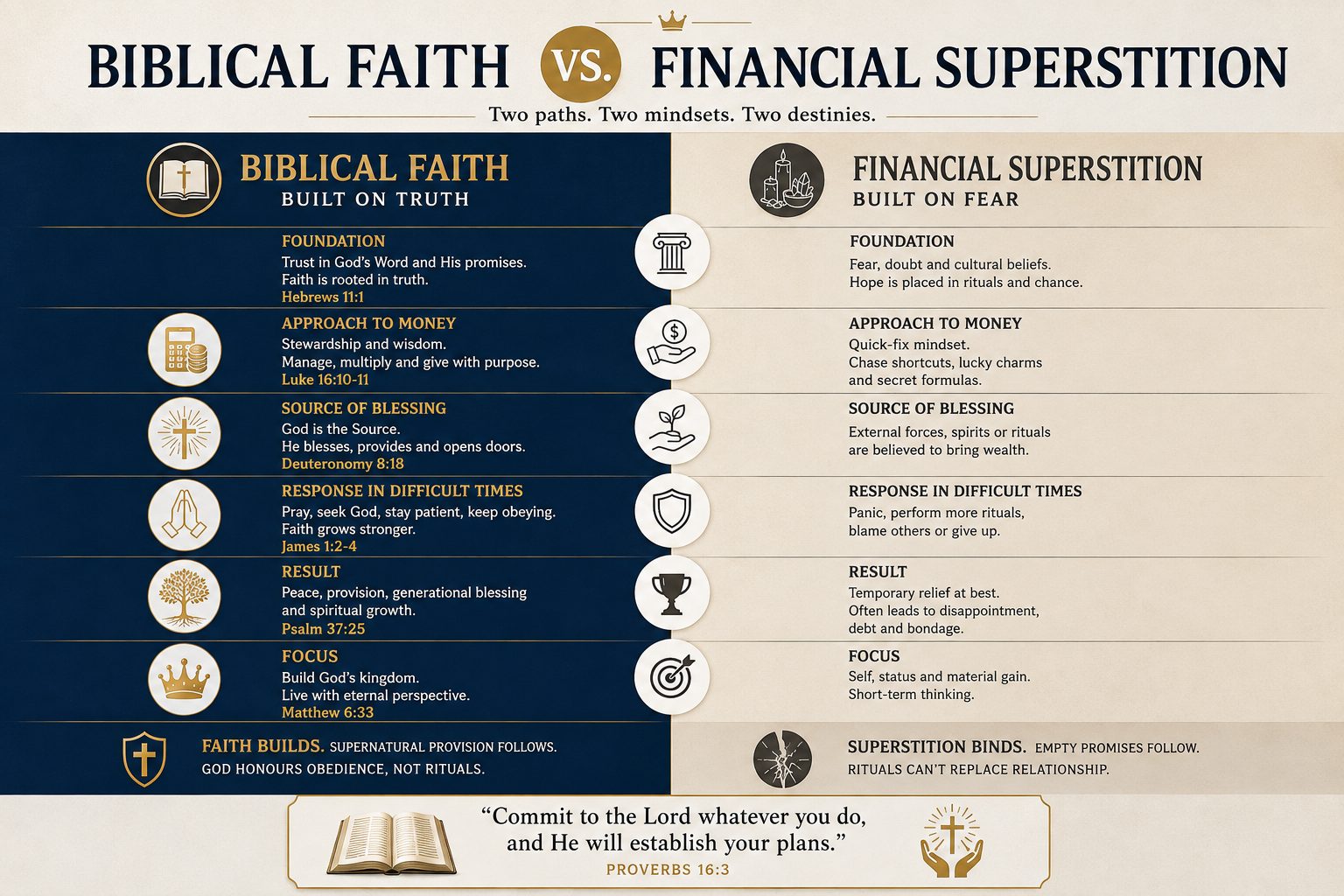
The Fine Line Between Biblical Faith and Financial Superstition
Superstition relies on human effort, special objects, or exact phrases to force a desired outcome.
Biblical faith relies on the character of God, the finished work of Jesus Christ, and simple obedience to Scripture. I have seen believers buy special anointed cloths to put in their wallets, believing the cloth itself would attract money. That is not faith; that is idolatry wrapped in Christian vocabulary.
Money is a neutral physical tool governed by both spiritual covenants and natural economic laws. God created those laws, and He does not violate His own principles to reward superstition. If you pray for eight hours against a spirit of lack but refuse to track your spending, you will remain broke.
If you claim financial breakthrough while spending every penny on lifestyle elevation, you are mocking God's design. Superstition looks for quick fixes, short cuts, and magical exemptions from work.
Scripture calls us to diligent labour, careful planning, quiet living, and generous giving.
How Satan Operates in Your Financial Life
If Satan wants to destroy a believer's financial peace, he rarely uses open, terrifying spiritual manifestations.
His tactics are far more subtle and devastating. He uses three primary weapons in the financial arena: deception, fear, and division.
First, he uses deception to reframe sin as wisdom. He tells you that taking on massive debt to impress people at church is just living by faith. He whispers that keeping God's tithe to build a safety net is being prudent.
Second, he uses financial fear to drive you into panic. When prices rise or job losses loom, the enemy attacks your perception of God as a loving Father. He wants you to believe that you are an orphan who must hustle, cheat, or hoard to survive.
Third, he uses money to bring division into Kingdom homes. Money issues are one of the leading causes of marital breakdown, even among devoted believers. The enemy fuels secret spending, arguments over priorities, and pride between spouses. Understanding this reality shifts your prayer posture entirely.
Instead of yelling at an invisible spirit of debt, you begin praying for discernment, self-control, and wisdom.
You begin evaluating whether you are viewing your money through a lens of ownership or stewardship, a fundamental distinction explained in biblical stewardship versus ownership. When you align your heart with God's ownership, the enemy loses his use over your emotions.
Four Steps to Fight Spiritual Battles Over Money Biblically
Spiritual battles require spiritual weapons, but those weapons must be wielded according to God's order.
Here is how you engage in spiritual warfare for finances without falling into traps:
Audit your obedience first: Check your heart against Scripture before binding anything in the spiritual area.
Renew your mind daily: Replace cultural anxiety with the unchanging promises of God regarding your provision.
Walk in financial diligence: Combine prayer with practical budgeting, saving, and honest labor.
Stand firm in your identity: Rest in the finished work of Christ rather than running after religious gimmicks.
As you build these habits, remember that God is faithful to sustain you through every season.
Frequently Asked Questions
Is every financial struggle a spiritual attack?
No. Many financial struggles are simply the natural result of poor planning, impulse spending, or economic downturns. Blaming demons for bad budgeting keeps you from making the practical changes needed to fix your situation.
How do I pray against financial lack without sounding superstitious?
Instead of demanding miraculous windfalls while ignoring your responsibilities, pray for wisdom, self-control, and the diligence to work hard. Align your petitions with God's Word and commit to stewarding what He has already placed in your hands.
What does the Bible say about generational curses of poverty?
Scripture teaches that believers are redeemed from the curse through Christ (Galatians 3:13, KJV). While generational habits like poor money management can pass down families, they are broken through repentance, learning biblical principles, and disciplined execution.
Should I stop giving when I am in severe debt?
No. Giving is a foundational act of worship and trust that breaks the hold of money over your heart. As you learn how to get out of debt as a Christian without stopping giving, you maintain your posture of faith while systematically clearing your obligations.
Where To Read Next
If you want to dig deeper into trusting God with your resources without falling into worldly traps, I recommend reading these related articles:
Found this helpful? Share it with someone who needs it.