
God is not a hedge fund manager and surely He is not looking for investors, and He is certainly not looking for a business partner who expects a thirty fold return on every pound put into the collection plate. If you have been told that tithing is a financial strategy to "get God to move" in your bank account, you have been told a lie that misses the entire heart of the Father.
The question of whether is tithing mandatory in the new testament is one of the most debated topics in the modern church, often leaving believers caught between legalistic guilt and prosperity gospel greed. I have spent years talking to people who feel like they are failing God because they cannot hit a ten per cent target, and others who treat their tithe like a spiritual slot machine. Neither of these approaches reflects the freedom we have in Christ.
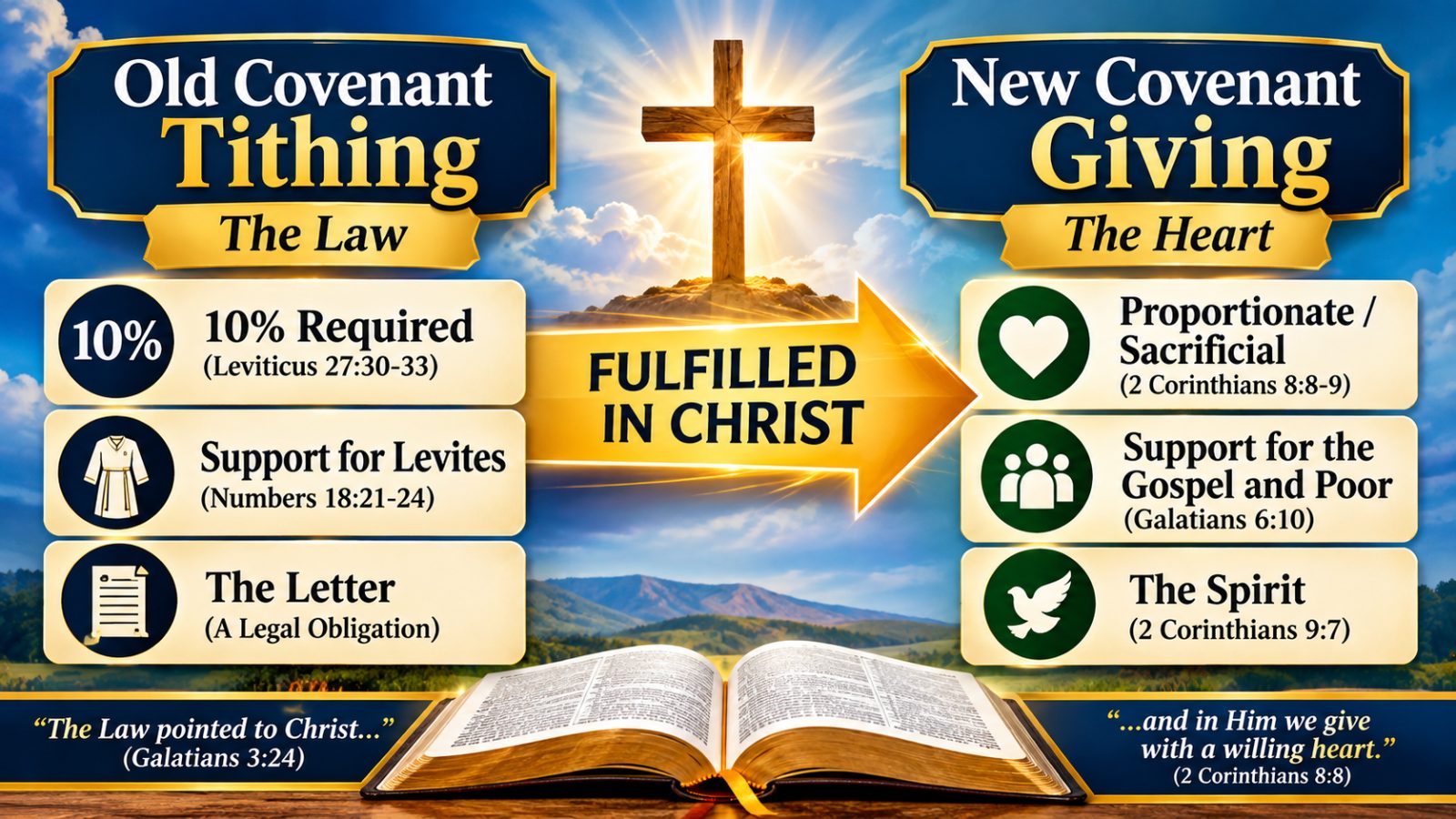
To answer the question directly: No, tithing is not a "mandatory" legal requirement for Christians under the New Covenant in the same way it was a civil and religious law for the nation of Israel. However, that does not mean we are called to give less; in fact, the New Testament calls us to a much higher standard of stewardship. It moves us from a percentage based law to a heart led devotion where we acknowledge that God owns one hundred per cent of what we have, not just the first ten.
The shift from the Old Testament to the New Testament is a shift from the "letter" to the "spirit." In the following sections, I want to walk you through exactly what changed, what Jesus actually said about tithing, and why the "seed faith" teaching you hear on television is a dangerous distortion of Kingdom principles. We are going to look at the Word of God together to find the peace that comes from cheerful, obedient giving.
The English word "tithe" simply means a tenth. It sounds like a tax or a subscription fee. But the Hebrew word used throughout the Old Testament is ma'aser, and its meaning carries a weight that many modern Christians have never been taught. Ma'aser comes from the root word eser, meaning ten, but in the context of the covenant, it represents the whole. By giving the ma'aser, the Israelite was not just paying a fee; they were acknowledging that the entire harvest belonged to the Creator.
In the King James Version, we see this most clearly in Leviticus: "And all the tithe of the land, whether of the seed of the land, or of the fruit of the tree, is the LORD'S: it is holy unto the LORD" (Leviticus 27:30, KJV). Notice the word "is." It does not say the tithe "becomes" the Lord's when you give it. It says it is His. The ma'aser was the portion set apart to remind the person that they were a steward, not an owner. It was a recognition of the Source. When you understand this, it reframes your money entirely. You are not "giving" God ten per cent of your money. You are returning the portion He designated as a reminder that the other ninety per cent is also His to direct.
This root concept is vital because it destroys the idea of transactional giving. If the tithe is already "holy unto the LORD," then you cannot use it as a "seed" to buy a blessing. You cannot trade with what you do not own. In the New Testament, this principle of ownership is expanded. We are no longer just giving a tenth of our grain and cattle; we are offering our very lives as a living sacrifice. The ma'aser was the schoolmaster that pointed us toward a life where everything we touch is managed for His glory.
Is Tithing Mandatory in the New Testament?
When we ask if tithing is mandatory, we are usually asking if we are still under the Mosaic Law. The short answer is that the Law of Moses, including the specific requirement to give ten per cent to the Levites, has been fulfilled in Jesus Christ. Paul is very clear in his letters that we are not justified by the works of the law, but by faith. But wait; before you decide that this means you can stop giving entirely, we have to look at how the New Testament actually treats the concept of the tithe.
If you are looking for a verse in the Epistles where Paul commands the Gentile churches to give exactly ten per cent, you will not find it. What you will find is a much more demanding call to "proportionate" and "sacrificial" giving. For a deeper look at the technical differences, you should read about tithes, offerings and firstfruits to see how these categories functioned under the law and how they translate to us today.
I believe the reason many people want a "mandatory" rule is that rules are easier than relationships. A rule tells you exactly when you have done enough. It lets you check a box and keep the rest for yourself without ever having to pray about it. But the New Testament is about a relationship with the Holy Spirit. He might lead you to give ten per cent, or He might lead you to give fifty per cent. The "mandatory" nature of the tithe has been replaced by the "voluntary" nature of love, which always gives more than the law requires.
What Jesus Really Said About Tithing
Some people argue that because Jesus mentioned tithing, He was reinforcing it as a permanent command for the church. The most famous instance is in Matthew 23. Jesus is rebuking the Pharisees, not for tithing, but for their hypocrisy. He says: "Woe unto you, scribes and Pharisees, hypocrites! for ye pay tithe of mint and anise and cummin, and have omitted the weightier matters of the law, judgment, mercy, and faith: these ought ye to have done, and not to leave the other undone" (Matthew 23:23, KJV).
Look closely at those words. Jesus tells the Pharisees they "ought" to have tithed. But we must remember that Jesus was speaking to people still living under the Old Covenant. The temple was still standing. The Levitical priesthood was still active. Jesus was upholding the law because He had not yet gone to the cross to fulfill it. He was pointing out that their meticulous "percentage counting" was worthless because their hearts were cold toward mercy and faith.
I have seen so many believers make the same mistake today. They are precise with their standing orders to the church, but they are harsh with their employees or stingy with their time for the poor. Jesus' point was that tithing is the "easy" part. The "weightier matters" are where the real heart of giving lies. If your tithe does not lead you toward judgment, mercy, and faith, it is just religious accounting. It is not worship.
The Melchizedek Factor: Tithing Before the Law
One of the strongest arguments for tithing in the New Testament era is that tithing existed before the Law of Moses was ever given. Abraham tithed to Melchizedek in Genesis 14, and Jacob promised a tenth to God in Genesis 28. Because these events happened hundreds of years before the Law, many teachers , myself included , believe that tithing is a "Kingdom principle" that transcends the Mosaic Law.
The writer of Hebrews picks up on this in Chapter 7. He explains that Melchizedek was a type of Christ , a priest king with no beginning and no end. When Abraham gave a tenth to Melchizedek, he was acknowledging a priesthood that is higher than the Levitical one. "And here men that die receive tithes; but there he receiveth them, of whom it is witnessed that he liveth" (Hebrews 7:8, KJV). This is a profound thought for you to consider today.
When you give into the work of the Kingdom today, you are not just giving to a "man that dies" , a pastor or a charity. In a spiritual sense, you are acknowledging the eternal priesthood of Jesus Christ. Tithing was a practice of faith for Abraham long before it was a practice of law for Israel. This suggests that while it may not be a "mandatory legal requirement" for your salvation, it remains a powerful way to honour the One who is our High Priest forever. It is an act of covenantal alignment.
The New Testament Standard: Cheerful and Proportionate
If we are not under a mandatory ten per cent rule, what is the standard? Paul gives us the blueprint in his second letter to the Corinthians. This is the "gold standard" for Christian giving in the New Testament. It is not based on a percentage, but on a purpose. "Every man according as he purposeth in his heart, so let him give; not grudgingly, or of necessity: for God loveth a cheerful giver" (2 Corinthians 9:7, KJV).
Let's break that down because it is the antidote to financial guilt. "As he purposeth in his heart" means that your giving should be a deliberate, prayerful decision. It is not an emotional reaction to a sad video or a high pressure sermon. It is a plan. "Not grudgingly" means you shouldn't feel like you are being robbed. If you are angry while you are writing your tithe cheque, stop. God does not need your money that badly. He wants your joy.
The phrase "not of necessity" is the final nail in the coffin of mandatory tithing. If it were a legal requirement for your standing with God, it would be "of necessity." But Paul says it isn't. Instead, we are called to give proportionately. In 1 Corinthians 16:2, he tells the believers to set aside money "as God hath prospered him." If you have been blessed with much, ten per cent might be "stingy" for you. If you are in a season of extreme lack, like the widow with her two mites, your small gift might be worth more in heaven than a millionaire's tithe.

Why the "Seed Faith" Teaching is Not Biblical
I have to be very direct with you here, people of God. There is a teaching prevalent today that says tithing is a "seed" you plant to get a "harvest" of more money. They tell you that if you give £100, God is obligated to give you £1,000 back. This is not the New Testament. This is a pagan transaction dressed up in Christian language. It treats God like an ATM and the tithe like a debit card.
Nowhere in the New Testament does Jesus or the Apostles promise that giving money will result in a guaranteed financial return. When Paul talks about "sowing and reaping" in 2 Corinthians 9, he is talking about the grace and righteousness that abound to the giver. Yes, God provides for our needs, and yes, He blesses those who are generous. But the "blessing" is often the ability to give even more, not just an increase in your personal luxury. For those currently feeling the weight of this, I recommend reading about shame and financial failure as a christian to help untangle your worth from your bank balance.
The danger of the "investment" mindset is that it makes you the centre of the story. You give so that you can get. But true tithing is about God being the centre. You give because He is the Owner. If you only give when you expect a cheque in the post, you aren't worshipping God; you are worshipping your own greed. We give because we trust Him, not because we are trying to manipulate Him into a "financial breakthrough."
Ownership vs. Investment: A Shift in Perspective
The core issue of tithing in the New Testament is ownership. Most of us live as if we own our income and "give" a portion to God. But the Bible teaches that "The earth is the LORD'S, and the fulness thereof; the world, and they that dwell therein" (Psalm 24:1, KJV). You do not own your salary. You are a manager of His funds. When you realise this, the question "How much do I have to give?" changes to "How much of God's money am I allowed to keep for myself?"
This perspective shift is what allows for true financial peace. If it is His money, then the pressure is off you to "make it work." You simply follow the Owner's instructions. If He says to give, you give. If He says to save, you save. I have found that practical money management for christians only works when this foundation of stewardship is in place. Without it, budgeting is just a chore; with it, budgeting is an act of worship.
I remember a time when I was terrified to tithe because my bills were higher than my income. I was looking at the tithe as a "loss." It was only when I realised that the money wasn't mine to begin with that I could release it. I had to trust that the Owner of the universe was better at managing the remaining ninety per cent than I was at managing the whole hundred per cent. He proved Himself faithful, not by making me a millionaire overnight, but by giving me the wisdom to manage what remained with peace instead of panic.
The Early Church: Beyond the Ten Per Cent
If you want to see what "New Testament tithing" looks like in practice, look at the book of Acts. You won't see people arguing about whether they should tithe on their gross or net income. You see something much more radical. "And all that believed were together, and had all things common; And sold their possessions and goods, and parted them to all men, as every man had need" (Acts 2:44-45, KJV).
The early church didn't stop at ten per cent. They were so overwhelmed by the grace of God that they gave everything they had to ensure no one in their community was in need. This is the "mandatory" heart of the New Testament: love. They didn't give because a law told them to; they gave because the Spirit of God lived within them and they could not bear to see a brother or sister suffer. They understood that their resources were tools for the Kingdom, not just comforts for themselves.
While we may not live in a communal setting today, the principle remains. Our giving should be driven by the needs of the Kingdom and the promptings of the Spirit. If you are strictly tithing ten per cent but ignoring a neighbour in crisis, you have missed the point of the New Testament. We are called to be conduits of God's provision. A conduit doesn't hold onto the water; it lets the water flow through to where it is needed.
How to Give Cheerfully When Finances Are Tight
It is easy to talk about cheerful giving when you have a surplus. It is much harder when you are looking at a "small income" and wondering how to survive. I know that many of you are in that position right now. You want to honour God, but the math just doesn't seem to work. You might be interested in how to save money on a small income as a christian, but giving still feels like a bridge too far.
Here is the truth: God values the sacrifice, not the amount. If you are giving five per cent with a heart of total trust and a desire to give more as soon as you are able, I believe God is more honoured by that than by a wealthy person giving ten per cent without a second thought. The "mandatory" part of the New Testament is the direction of your heart, not the destination of your decimal point.
Start where you are. If ten per cent feels impossible, start with what you can give cheerfully. Then, as God provides and you learn to manage better, increase it.
Prioritise the Kingdom. Even if it is a small amount, give it first. This is the principle of "firstfruits." It signals to your own heart that God is first.
Be honest with God. Pray and say, "Lord, I want to tithe, but I am scared. Help my unbelief and show me how to manage what I have."
Look for non-financial ways to give. While this article is about money, stewardship includes your time and talents. If you are in a season of extreme financial lack, give of your service while you work toward financial health.
The Trap of Transactional Giving
The greatest danger in the tithing debate is falling into a transactional mindset. This is the idea that "I do X, so God must do Y." We see this in people who say, "I tithed, so why did my car break down?" or "I gave an offering, so where is my promotion?" This is a form of spiritual pride. It assumes we can put God in our debt. But as Paul asks in Romans: "Or who hath first given to him, and it shall be recompensed unto him again?" (Romans 11:35, KJV).
The answer is no one. God owes us nothing. He has already given us everything in Christ. Our giving is a response to His grace, not a request for more. When we tithe or give, we are saying, "Thank You, Father, for what You have already done." If we give with the expectation of a payout, we are not giving; we are gambling. And God is not a bookie.
We must guard our hearts against this "investment" theology. It is a subtle poison that turns worship into work. It robs us of the joy of generosity because we are always looking for the return on investment. If you find yourself frustrated that God hasn't "paid you back" for your giving, it is time to repent and ask for a heart that gives simply because He is worthy. You might find it helpful to learn how to pray for financial breakthrough from a place of surrender rather than a place of demand.
Stewardship is Not Just About the Tenth
If we focus only on the ten per cent, we tend to ignore the ninety per cent. But in the New Testament, we are accountable for every penny. If you tithe ten per cent but waste the other ninety per cent on things that do not honour God or provide for your family, you are not being a good steward. Stewardship is the holistic management of all God's resources.
This includes how you handle debt, how you save for the future, and how you provide for those under your roof. "But if any provide not for his own, and specially for those of his own house, he hath denied the faith, and is worse than an infidel" (1 Timothy 5:8, KJV). Giving to the church should never be an excuse to neglect your family's basic needs. A balanced approach is required. For more on this, I suggest looking at what Proverbs says about money to see how daily wisdom and spiritual devotion work together.
The goal is to reach a place where your bank statement is a reflection of your values. Every transaction should be able to pass the test of "Does this glorify God?" That doesn't mean you can't buy a nice coffee or enjoy a holiday, but it means those things are done with a heart of gratitude and within the boundaries of the resources He has entrusted to you. The tithe is the training ground, but the ninety per cent is the battlefield where your stewardship is truly proven.
Where To Read Next
If you are looking to go deeper into the heart of biblical finance and stewardship, here are the best places to start your study.
Should You Tithe on Gross or Net Income? What the Bible Says
My Honest Story of a Christian Struggling With Money: Empty Hands and What I Finally Learned
How to Give to the Poor Without Creating Dependency (coming soon)
The History of Tithing in the Early Church (coming soon)
- What Is the New Testament Principle of Giving Without Tithing?
- Did Jesus Command His Disciples to Tithe in the New Testament?
- What Does 2 Corinthians 9 7 Mean by Not Under Compulsion?
- Is Tithing an Act of Obedience to God or a Way to Get Rich?
Frequently Asked Questions
Is tithing mandatory in the New Testament?
No, tithing is not a mandatory legal requirement for Christians under the New Covenant in the same way it was under the Mosaic Law. Instead, the New Testament emphasizes heart-led, cheerful, and proportionate giving as an act of worship. "Every man according as he purposeth in his heart, so let him give; not grudgingly, or of necessity: for God loveth a cheerful giver" (2 Corinthians 9:7, KJV).
Is it a sin to not tithe as a Christian?
Failure to give exactly ten per cent is not a sin that separates you from God's grace, as we are no longer under the condemnation of the law. However, a total lack of generosity or refusing to support the work of the Kingdom can be a sign of a heart that is not fully surrendered to the Lordship of Christ. Stewardship is a matter of obedience and trust rather than a legalistic quota.
What does the Bible say about tithing 10 per cent?
The Bible introduces the tithe (meaning a tenth) as a way to acknowledge God's ownership of all things, starting with Abraham and later codified in the Law of Moses to support the Levites and the temple. In the New Testament, the principle remains that we should give "as God hath prospered" us (1 Corinthians 16:2, KJV), often using the ten per cent as a helpful benchmark for disciplined generosity.
Should I tithe if I am in debt and struggling?
You should prioritize being a faithful steward, which includes both giving to God and paying what you owe to others. While some believe you must tithe before paying any debt, the New Testament focuses on the heart's intent; you might start with a smaller amount you can give cheerfully while working a plan to clear your debts. "Owe no man any thing, but to love one another" (Romans 13:8, KJV).
Can I give my tithe to someone in need instead of the church?
While the Old Testament tithe was specifically for the "storehouse" (the temple and its workers), New Testament giving is more fluid, covering the support of ministers, the needs of the saints, and the poor. Most believers find it biblically sound to give their primary support to their local church while also giving offerings to help those in need as the Spirit leads. The key is ensuring the work of the Gospel is supported first.
Found this helpful? Share it with someone who needs it.