
I have sat in services where the atmosphere suddenly shifts from worship to a high pressure sales pitch. The music drops to a low, emotional hum, the preacher’s voice takes on a rhythmic urgency, and suddenly, the "word from the Lord" is that fifty people need to sow a specific amount to "unlock" their next season. In those moments, your heart beats a little faster, not with the joy of the Spirit, but with the cold weight of guilt. You feel like if you don't reach for your wallet, you are somehow blocking your own blessing or, worse, being disobedient to God.
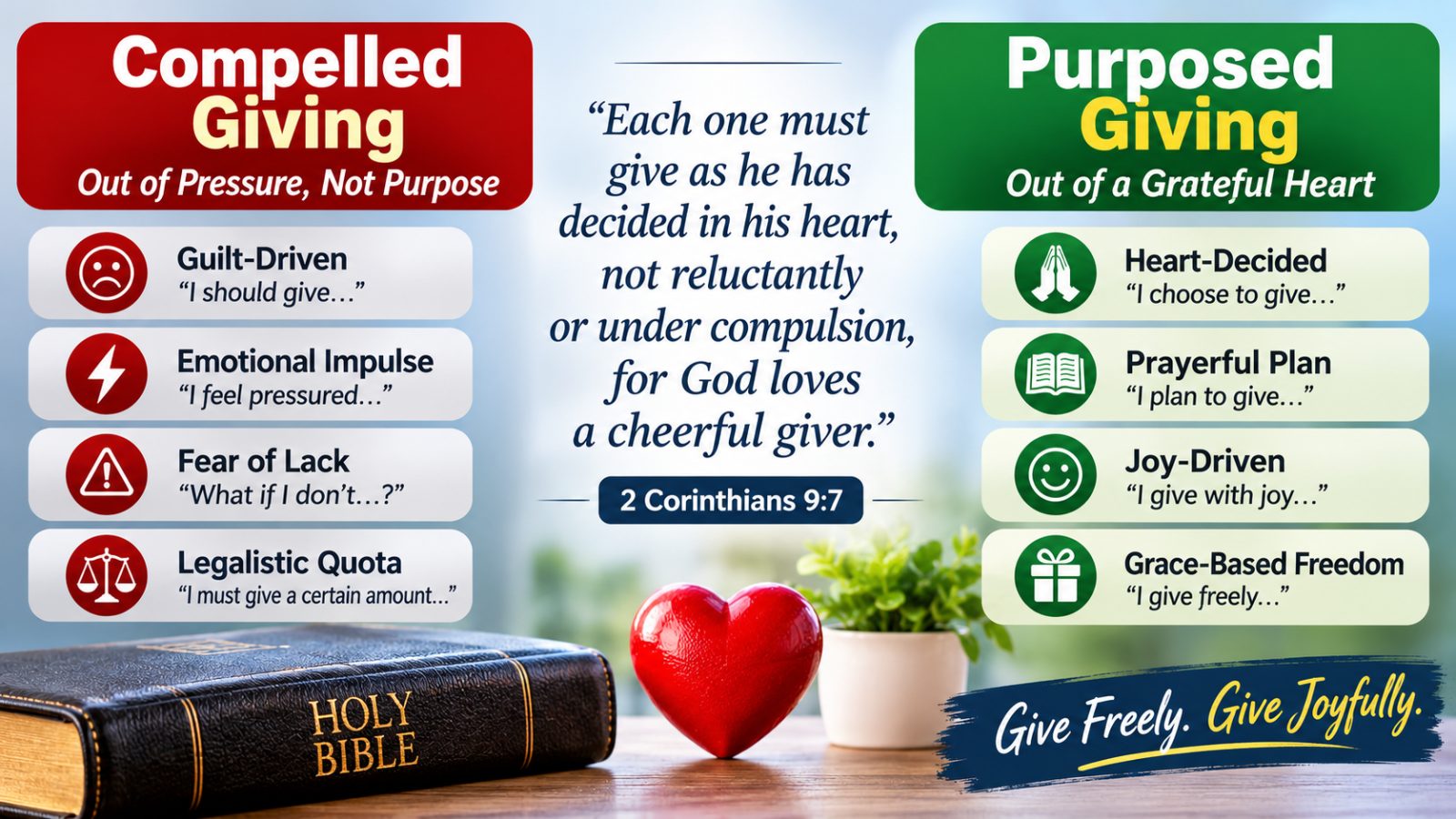
This is the exact environment that Paul was writing against. If you are searching for the 2 corinthians 9:7 meaning not under compulsion, you are likely trying to reconcile the freedom you feel in Christ with the pressure you feel in the offering line. The direct answer is that biblical giving must be a pre decided act of the heart, entirely free from external pressure, manipulation, or the fear of missing out on a "divine window." Paul is making it clear that if you are giving because you feel you have to, or because someone has made you feel guilty, that gift has lost its spiritual character in the eyes of God.
Understanding this verse is the key to escaping the "spiritual taxation" that many modern ministries have substituted for true New Testament generosity. It is a vital part of the broader conversation about whether Is Tithing Mandatory for Christians in the New Testament? because it shifts the entire focus from a legal quota to a heart led decision. When Paul says "not under compulsion," he is setting a boundary that protects your heart from the predatory tactics of those who would use the Gospel for personal gain. He is teaching us that God is more interested in the why of our giving than the how much.
The Root of Your Freedom in Giving
The English word "purposeth" in 2 Corinthians 9:7 can feel a bit formal, like a legal document. But the Greek word Paul uses is proaireomai, and it carries a depth that completely reframes how you should look at your bank account on a Sunday morning. Pro means "before" and aireomai means "to choose" or "to prefer." It describes a choice made in advance, away from the heat of the moment, away from the emotional swelling of a worship song or the shouting of a preacher. It is a deliberate, reasoned preference of the heart.
"Every man according as he purposeth in his heart, so let him give; not grudgingly, or of necessity: for God loveth a cheerful giver" (2 Corinthians 9:7, KJV). The word for "necessity" there is anagke, which refers to external pressure, distress, or a requirement imposed by law. Paul is drawing a sharp line. On one side is proaireomai , the quiet, pre-decided choice you made at your kitchen table while looking at your budget and praying. On the other side is anagke , the frantic, pressured "necessity" felt when someone tells you that your miracle is tied to your seed. God is not looking for the money that was squeezed out of you by a clever sermon. He is looking for the money that you set apart because you love Him.
I believe this one word, proaireomai, is the antidote to the prosperity gospel. It demands that you take back the agency of your own stewardship. You are not a passive participant in someone else's fundraising campaign; you are a kingdom citizen making a sovereign decision before your King. When you understand that 2 corinthians 9 7 meaning not under compulsion is about protecting your ability to choose, you stop being a victim of religious manipulation. You realize that "cheerful" (hilaros) giving is only possible when the "compulsion" (anagke) has been removed. You cannot be truly hilarious in your joy if you are being coerced by a threat.
Why Context Changes Everything About This Verse
Most of the time, we hear 2 Corinthians 9:7 quoted in isolation, usually right before the buckets are passed. But we have to remember that Paul wasn't writing a general "giving manual" for a weekly tithe. He was coordinating a massive international relief effort for the poor believers in Jerusalem who were suffering under a severe famine. This was a specific, one time collection intended to show the unity between the Gentile churches and the Jewish mother church. Paul had been talking about this for over a year, and he had even "boasted" to other churches about how ready the Corinthians were to help.
The "compulsion" he is warning against is not just the pressure from a preacher; it is also the pressure of social embarrassment. He didn't want them to give just because he was showing up with a delegation and they didn't want to look stingy. He wanted their generosity to be "as a matter of bounty, and not as of covetousness" (2 Corinthians 9:5, KJV). He was more concerned about the state of their souls than the size of the total amount collected. This is a radical departure from how many modern ministries operate, where the "goal" or the "target" is the only thing that matters.
When you look at the 2 corinthians 9:7 meaning not under compulsion through this historical lens, you see that Paul is actually being incredibly protective of the Corinthians. He is saying, "I know I've talked you up to the Macedonians, but I don't want you to give a single penny just to save my face or yours. If it isn't from your heart, don't do it." Can you imagine a modern televangelist saying that? "If you feel pressured by my 40 minute sermon on seed faith, please, keep your money." That is the standard of the New Testament. It is a standard of absolute integrity and total freedom.
The Two Enemies of Cheerful Giving
Paul identifies two specific ways that giving goes wrong: "grudgingly" and "of necessity." If we are going to walk in the freedom of the New Covenant, we have to recognize these two thieves when they show up in our hearts. To give "grudgingly" is to give with a sense of sorrow or regret. It’s the feeling of letting go of something you’d rather keep. It’s the "ouch" factor. If you are calculating exactly how much you can get away with not giving, you are likely giving grudgingly. It shows that your heart is still tied to the resource rather than the Source.
But giving "of necessity" is the one that catches most of us. This is the 2 corinthians 9 7 meaning not under compulsion in action. Necessity is the feeling that you must do it to be a good Christian, to stay in God's good graces, or to avoid a curse. I have seen so many believers who treat their giving like a spiritual insurance premium. They pay it because they are afraid that if they don't, their car will break down or their health will fail. That is not faith; that is superstition. It is giving "of necessity," and Paul says it is not the way of the Kingdom.
Look at the contrast Paul sets up. He doesn't say "give because the law says 10%." He says give "as he purposeth in his heart." If your giving is driven by a fear of Malachi 3:10 being used as a whip against you, then you are giving under compulsion. I am not saying you shouldn't give; I am saying you should give from a place of "bounty" and "cheerfulness." If you cannot give 10% cheerfully, give 5% with a heart full of praise. If you can give 20% without a hint of necessity, then do that. The amount is secondary to the "purposing" of the heart. You might find it helpful to read about What Is the New Testament Principle of Giving Without Tithing? to see how this works in practice.
How Prosperity Preachers Twist "Cheerful Giving"
It is one of the great ironies of modern theology that the very verse Paul wrote to stop manipulation is now used to facilitate it. You will often hear a preacher say, "God loves a cheerful giver, so you should be happy to give this thousand-pound seed!" They use the promise of God’s love as a tool to extract more money. They turn "cheerfulness" into a work that you have to perform. They tell you that if you don't feel happy about giving, you just need to "give by faith" until the joy comes. This is a complete reversal of Paul’s logic.
In the 2 corinthians 9 7 meaning not under compulsion, cheerfulness is the result of freedom, not a requirement for a transaction. You are cheerful because you aren't being forced. You are cheerful because you have looked at what God has given you, you have decided what you can share, and you are doing it out of love. The prosperity gospel turns this into a "pay to play" system. They suggest that your cheerfulness is what "triggers" God’s hand to move. But God’s hand is moved by His own grace and His covenant promises, not by how much enthusiasm you can muster while writing a cheque you can't afford.
The thing is, God doesn't need your money. He owns "the cattle upon a thousand hills" (Psalm 50:10, KJV). He wants your heart. If a ministry is telling you that God is "waiting" for your gift before He can act in your life, they are making God look small and needy. Paul’s point is that God loves the character of a person who gives freely. He loves the reflection of His own nature in you,because God is the ultimate cheerful giver. "For God so loved the world, that he gave his only begotten Son..." (John 3:16, KJV). He didn't give under compulsion; He gave out of the abundance of His love.

The Practical Power of "Purposing in the Heart"
So, how do you actually do this? How do you move from "giving under compulsion" to "purposing in the heart"? It starts with a shift in your administrative habits. If the only time you think about giving is when the offering plate is six inches from your face, you are setting yourself up for emotional compulsion. You are leaving your stewardship to the mercy of your feelings in that moment. To purpose in your heart means to bring your giving into your "secret place" with God, long before you get to the church building.
Review your increase: Look at what has actually come into your hands. Not what you wish you had, but what you actually have.
Consult the Spirit: Ask the Lord, "What would You have me set apart for Your work and for the poor?" This is not a legalistic calculation; it is a conversation.
Decide the amount: Fix a number or a percentage in your mind. This is your proaireomai , your pre-decided choice.
Stick to it: When you get to church and the preacher starts talking about "special anointings" for those who give extra, stay at peace with what you have already purposed. Your obedience is to what God told you in private, not what a man is telling you in public.
This practice builds a "wall of freedom" around your finances. It allows you to be generous without being foolish, and faithful without being manipulated. I have found that when I purpose in my heart, I actually end up being more generous over the long term because I am not constantly recovering from "giving hangovers" where I gave more than I had out of a moment of guilt. If you want to dive deeper into the theology of this, I highly recommend checking out Did Jesus Command His Disciples to Tithe in the New Testament? to see how Jesus Himself approached the heart of the law.
Is It a Sin to Give Under Compulsion?
This is a question I get often. People feel that if they give out of guilt, they have somehow sinned. Let's be clear: God is not "angry" with you because you were manipulated. He is a Father who understands the pressure we are under. However, giving under compulsion is a missed opportunity. It is a form of "dead works",religious activity that has no spiritual life in it because it didn't come from a place of faith and love. It might help the church pay the light bill, but it isn't building the "treasure in heaven" that Jesus spoke about.
The 2 corinthians 9 7 meaning not under compulsion is actually a message of grace. It is God saying, "I don't want you to carry the burden of religious debt." If you have been giving out of fear or pressure, you can stop today. You can repent of the fear,not the giving,and ask God to help you reset your heart. There is no condemnation for those who are in Christ Jesus. If you find yourself in a ministry that constantly uses compulsion, you may need to ask yourself if that is an environment where you can truly grow in New Testament grace.
I believe that true Kingdom wealth is built on the foundation of freedom. When you give because you want to, you are aligned with the flow of heaven. When you give because you have to, you are still operating in the systems of the world, just with a religious label on it. Paul wanted the Corinthians to experience the "grace of God bestowed on the churches of Macedonia" (2 Corinthians 8:1, KJV), who gave out of their deep poverty with "abundance of joy." That joy wasn't because they were rich; it was because they were free.
The Promise of the Cheerful Giver
We cannot talk about the 2 corinthians 9 7 meaning not under compulsion without talking about the promise that follows it. "And God is able to make all grace abound toward you; that ye, always having all sufficiency in all things, may abound to every good work" (2 Corinthians 9:8, KJV). This is the "why" behind the freedom. God wants you to be sufficient so that you can keep being generous. But notice the order: the "all grace abounding" follows the heart that has decided to give without compulsion.
This is not a "magic formula" for wealth. It is a description of the Kingdom economy. When God finds a heart that He can trust to be a "conduit" rather than a "cul-de-sac," He flows resources through that person. If you are a cheerful giver,one who gives because they love the work of God and the people of God,you become a partner with Heaven. You aren't giving to get; you are giving because you have received, and in that flow, God ensures you have what you need to keep going.
Look at those words: "all sufficiency in all things." That is the promise for the one who rejects compulsion and embraces the purpose of the heart. It isn't a promise of a private jet; it is a promise that you will always have enough to do the "good work" God has called you to. That is true financial freedom. It is the ability to see a need and have the resources and the heart-freedom to meet it without checking a religious rulebook first. This is the heart of stewardship in 2026 and beyond.
Where To Read Next
If you want to continue your journey into understanding biblical generosity without the weight of legalism, these articles will help you build a solid foundation:
Did Jesus Command His Disciples to Tithe in the New Testament?
What Is the New Testament Principle of Giving Without Tithing?
Shame and Financial Failure as a Christian: What the Bible Says
Frequently Asked Questions
What does 2 Corinthians 9 7 mean by not under compulsion?
It means that your giving should never be the result of external pressure, guilt-tripping, or a sense of legal obligation. Paul is teaching that for a gift to be pleasing to God, it must be a deliberate choice made in your own heart, free from the manipulation of others. "Every man according as he purposeth in his heart, so let him give; not grudgingly, or of necessity" (2 Corinthians 9:7, KJV).
Is it a sin to not tithe 10 percent every month?
No, it is not a sin, as the New Testament does not mandate a specific percentage like the 10% tithe required under the Mosaic Law. While tithing was a requirement for Israel, Christians are called to give according to their means and the "purposing" of their heart. The focus in the New Covenant is on generosity and cheerfulness rather than a legalistic quota.
How do I know if I am giving under compulsion?
You are likely giving under compulsion if you feel anxious, guilty, or fearful when the offering plate passes. If you are giving primarily because a preacher told you that you would be cursed or miss a "blessing window" if you didn't, that is compulsion. True biblical giving is marked by a "purposed" heart and a sense of "cheerful" freedom.
What does the Bible say about giving when you are in debt?
The Bible teaches that we should be responsible stewards and pay what we owe, as "the borrower is servant to the lender" (Proverbs 22:7, KJV). While God loves a generous heart, He does not demand that you neglect your legal debts to give to a ministry, especially if that giving is done under compulsion. You should purpose in your heart a manageable amount that allows you to remain faithful to your creditors while still honouring God.
Can I still be blessed if I give less than 10 percent?
Yes, God’s blessing is not a mathematical calculation based on a percentage of your income. In the New Testament, the widow who gave two mites was more highly commended by Jesus than the rich who gave large amounts (Luke 21:1-4, KJV). God looks at the sacrifice and the heart behind the gift, not just the number on the cheque. Blessing comes from walking in obedience to what the Spirit has put in your heart.
Found this helpful? Share it with someone who needs it.