
Jesus never commanded you to tithe. Most of us have spent years sitting in pews hearing that tithing is a "red letter" requirement because Jesus mentioned it in the Gospels. We assume that because He affirmed it for the Pharisees, He must have intended it as a permanent tax for the Church. But when you look closely at the actual words of Christ, a very different picture emerges.
If you are asking did jesus command his disciples to tithe, the direct answer is no. Jesus never issued a command to His disciples, the apostles, or the future Church to give a specific ten per cent of their income. He mentioned tithing only twice in the Gospels, and on both occasions, He was speaking to people who were still legally bound by the Mosaic Law before the New Covenant was established at the cross.
Understanding this distinction is foundational for your walk. It is the difference between living under a religious quota and living under the total Lordship of Jesus Christ. While many use the Gospels to defend a mandatory ten per cent rule, I believe that Is Tithing Mandatory for Christians in the New Testament? is a question that requires us to look at the transition from the old way of the Law to the new way of the Spirit. Jesus did not come to tweak the tax code of Israel; He came to transform the hearts of men.
The "Mint and Rue" Mention: Matthew 23:23 Explained
The most common verse used to suggest Jesus commanded tithing is Matthew 23:23. In this passage, Jesus is rebuking the scribes and Pharisees. He says, "Woe unto you, scribes and Pharisees, hypocrites! for ye pay tithe of mint and anise and cummin, and have omitted the weightier matters of the law, judgment, mercy, and faith: these ought ye to have done, and not to leave the other undone" (Matthew 23:23, KJV).
At first glance, it looks like a command. Jesus says "these ought ye to have done," referring to the tithing of herbs. But we must ask: who is the "ye" in this sentence? Jesus is speaking to the religious leaders of Israel who were living under the jurisdiction of the Mosaic Covenant. The Temple was still standing. The Levitical priesthood was still active. The Law was still the governing document of the land.
The Greek word Jesus uses here for "pay tithe" is apodekatoo. This word is specifically tied to the religious duty of the Jewish people. It comes from apo, meaning "away from," and dekatoo, meaning "to take a tenth." In the context of the Second Temple period, apodekatoo was a legalistic measurement. It was about precision. The Pharisees were so obsessed with the "away from" part,making sure every tenth leaf of mint was separated,that they lost the "weightier matters."
When Jesus says they "ought" to have done it, He is affirming their duty under the Law. He was not establishing a new law for the Church that would be born at Pentecost. He was pointing out their hypocrisy. They were perfect at the math but bankrupt in the spirit. If you are a Kingdom citizen today, you are not a Pharisee in first century Jerusalem. You are a member of the Body of Christ, living under a "better covenant, which was established upon better promises" (Hebrews 8:6, KJV).
Why Context Changes Everything for Kingdom Citizens
I have seen so much confusion caused by ignoring the timeline of the New Testament. We often forget that the "New Testament" as a covenant did not begin at the birth of Jesus, but at His death. During His earthly ministry, Jesus lived as a Jew under the Law to "redeem them that were under the law" (Galatians 4:5, KJV). This is why He told the leper He healed to "go thy way, shew thyself to the priest, and offer the gift that Moses commanded" (Matthew 8:4, KJV).
Does that mean we should still go to priests and offer animal sacrifices for skin diseases? Of course not. We recognise that Jesus was instructing the man to follow the Law because the Law was still in effect. The same logic applies to tithing. Jesus affirmed tithing for those under the Law, but He never repeated that affirmation to His disciples when He was teaching them about the life of the Kingdom.
Look at the Sermon on the Mount. This was the manifesto of the Kingdom. Jesus teaches on murder, adultery, divorce, oaths, retaliation, and love for enemies. He teaches on prayer, fasting, and giving to the needy. But in three whole chapters of the most comprehensive teaching on Christian living ever recorded, Jesus never mentions tithing. Not once.
If tithing were a foundational command for His disciples, this would have been the moment to say it. Instead, He says, "Give to him that asketh thee, and from him that would borrow of thee turn not thou away" (Matthew 5:42, KJV). He moves the focus from a ten per cent requirement to a posture of open handedness. He is not looking for a decimal point; He is looking for a heart that reflects the generosity of the Father.

The Pharisee Who Tithed vs. The Publican Who Repented
The second time Jesus mentions tithing is in a parable. In Luke 18:12, He describes a Pharisee praying in the Temple: "I fast twice in the week, I give tithes of all that I possess" (KJV). This man was a "perfect" tither. He didn't just tithe on his income; he tithed on everything he owned. By any modern church standard, he was the model donor.
Yet, Jesus tells us that this man did not go down to his house justified. The publican, who simply beat his breast and cried for mercy, was the one God accepted. This is a massive warning for us. It is possible to tithe perfectly and be completely out of alignment with the heart of God. If we focus on did jesus command his disciples to tithe as a way to tick a box, we are following the spirit of the Pharisee, not the spirit of Christ.
Jesus was showing that religious performance,including the tithe,cannot bridge the gap between man and God. The Pharisee used his tithe as a shield against his own pride. He thought his ten per cent bought him the right to look down on others. I have met many believers who use their "faithful tithing" as a reason why God "owes" them a blessing. That is not faith; that is a contract. And Jesus did not come to give us a better contract; He came to give us a new life. This is why today we have so many people in the body of christ who tithe because they want their financial lives to be improved, howeverm when you look at the reason we tithe this whole mindset distorts God's purpose for why we tithe.
From a Legal Percentage to Radical Generosity
One of the reasons I believe people cling to the tithe is that it's easy. It is much easier to calculate ten per cent of your salary and write a check than it is to ask, "Lord, how much of Your money do You want me to give away today?" The tithe gives us a sense of "completion." Once the ten per cent is gone, we feel like the other ninety per cent is ours to do with as we please.
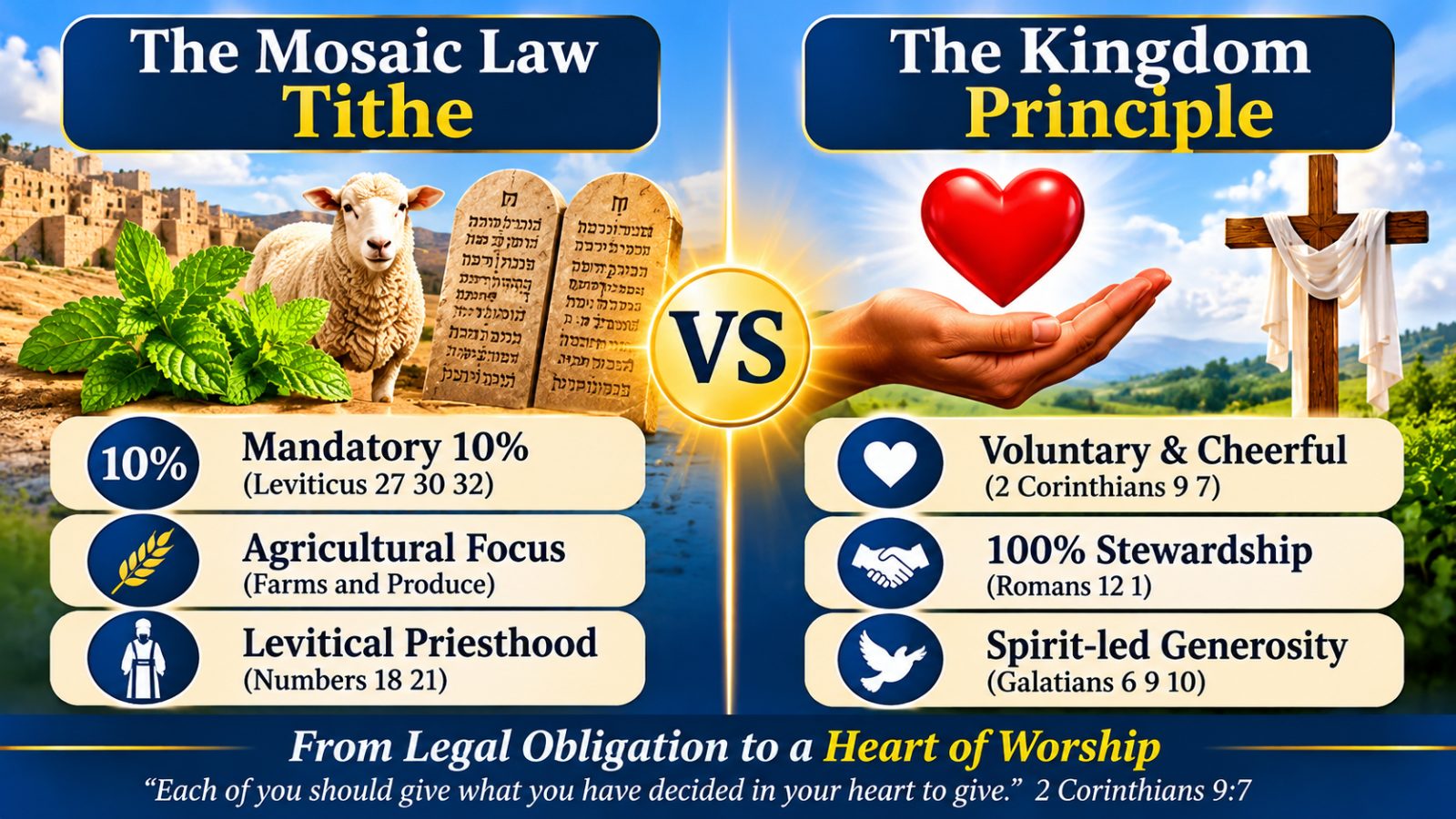
But Jesus never taught that. He taught that 100% belongs to God. In the New Testament, we don't see a "tithe" principle; we see a "stewardship" principle. This is why when Jesus encountered the rich young ruler, He didn't ask for a tithe. He didn't say, "Go and make sure you are tithing on your gross income." He said, "Sell all that thou hast, and distribute unto the poor, and thou shalt have treasure in heaven: and come, follow me" (Luke 18:22, KJV).
This is the radical shift. The Law asked for a portion, but Grace asks for the person. If you are looking for the new testament principle of giving without tithing, you will find it in the total surrender of assets. Jesus doesn't want your ten per cent; He wants your bank account, your house, your car, and your career. He wants you to manage it all according to His priorities. Sometimes that means you give 10%. Sometimes it means you give 50%. Sometimes it means you give 2% and use the rest to care for a sick relative. That is the freedom of the Spirit.
What Jesus Said to the Rich Young Ruler Instead of Tithing
The story of the rich young ruler is the ultimate proof that Jesus was not interested in the tithe as a standard for His followers. This man was a keeper of the Law. He likely tithed meticulously. He was "very rich," and in that culture, wealth was often seen as a sign of God's favour for keeping the commandments.
When he asked what he must do to inherit eternal life, Jesus pointed him to the commandments. The man claimed to have kept them all from his youth. If tithing were the "key" to financial or spiritual breakthrough, Jesus would have affirmed him there. Instead, Jesus looked at him and loved him, then told him to give it all away. Why?
Because for this man, his wealth was his idol. A ten per cent tithe would have been a comfortable tax that kept his idol intact. Jesus went for the throat of the problem. He showed that in the Kingdom, there is no set percentage that can substitute for heart-allegiance. If your tithe is the thing that makes you feel "safe" with God, then your tithe has become an idol. Jesus invites us to a place where our safety is found in Him alone, regardless of the numbers in our budget.
The Silence of Jesus in the Great Commission
Think about the final instructions Jesus gave to His disciples. He told them to go into all the world and "teach all nations... to observe all things whatsoever I have commanded you" (Matthew 28:19-20, KJV). If Jesus had commanded tithing, we would expect to see the apostles teaching it everywhere they went. We would expect to see it in the book of Acts as they established the first churches.
But we don't. When the first believers sold their possessions and brought the money to the apostles' feet in Acts 4, they weren't tithing. They were practicing radical, sacrificial love. When Paul wrote to the churches in Corinth and Galatia about giving, he never once cited a command from Jesus about tithing. Instead, he said, "Every man according as he purposeth in his heart, so let him give; not grudgingly, or of necessity: for God loveth a cheerful giver" (2 Corinthians 9:7, KJV).
The phrase "not of necessity" is crucial. If tithing were a command from Jesus, it would be a "necessity." It would be a legal requirement. But Paul says giving should come from the purpose of the heart. This aligns perfectly with what Jesus taught: that the heart is the source of all true worship. You cannot be a "cheerful giver" if you are giving out of a sense of legalistic obligation to a rule Jesus never gave you.
Understanding the Transition from Law to Grace
We must realise that we serve a God who owns "the cattle upon a thousand hills" (Psalm 50:10, KJV). He does not need your money to keep the lights on in heaven. The purpose of giving in the New Testament is not to fund a temple; it is to transform the giver and bless the recipient. Jesus moved us from a system of shadow to a system of substance.
The tithe was a shadow. It pointed to the fact that everything belongs to God. Now that the Substance (Christ) has come, we don't need the shadow to tell us who owns our lives. We have the Holy Spirit living within us to guide us in our stewardship. I have found that when people stop tithing out of legalism and start giving out of love, they often end up giving far more than ten per cent. They give because they are compelled by the grace of God, not because they are afraid of a curse.
I am not saying you should stop giving to your local church. Far from it. We should support those who teach us the Word and help the poor among us. But do it because you love Jesus and want to see His Kingdom expand. Do it because you recognise that you are a steward of His resources. Don't do it because you think there is a "red letter" command that Jesus gave to the disciples which you are failing to keep. There isn't.

Why the "Tithe" Argument Persists in the Church
If the evidence is so clear, why do so many leaders insist that Jesus commanded tithing? Honestly, it is often about budget security. It is much easier to manage a church budget when you can tell people that God requires ten per cent of their income. It creates a predictable stream of revenue. But we must never sacrifice biblical truth on the altar of administrative convenience.
Some argue that tithing existed before the Law (with Abraham and Melchizedek) and therefore continues after the Law. While it's true Abraham tithed once, it was from the spoils of war, not his regular income, and there is no record of him ever doing it again or being commanded to do it. Jesus never used Abraham’s tithe as a template for His disciples. He used the widow’s mite. He used the woman with the alabaster box. He used examples of extreme, "irresponsible" generosity that broke all the rules of percentage-based giving.
We must be brave enough to follow Jesus into the freedom of the New Covenant. It is a scarier way to live because it requires constant communication with the Holy Spirit. You can't just set an autopay for ten per cent and call it a day. You have to stay awake. You have to listen. You have to be ready to give when He says give and hold when He says hold. That is what it means to be a disciple.
Final Thoughts on Jesus and the Tithe
The question of did jesus command his disciples to tithe is ultimately a question of how we relate to God. Are we servants trying to satisfy a Master with a portion of our wages? Or are we children, heirs of the Kingdom, who realise that everything the Father has is ours, and everything we have is His?
Jesus came to set us free from the yoke of the Law. "Stand fast therefore in the liberty wherewith Christ hath made us free, and be not entangled again with the yoke of bondage" (Galatians 5:1, KJV). Tithing as a mandatory command is a yoke. Generosity as a response to grace is a delight. I encourage you to stop counting the leaves of mint in your herb garden and start looking at the "weightier matters" of judgment, mercy, and faith.
May you walk in the freedom of Christ today. I am praying that the Holy Spirit would lead you into a new level of stewardship,one that isn't defined by a percentage, but by a heart that is fully surrendered to the King. Trust Him with your finances. He is a better manager than you could ever be.
Where To Read Next
If you want to go deeper into how the New Testament reframes our approach to money and giving, I recommend these resources:
What Is the New Testament Principle of Giving Without Tithing?
What Did Jesus Say About Money and Wealth? The Teaching Most People Miss
Frequently Asked Questions
Did Jesus command his disciples to tithe in the New Testament?
No, Jesus never commanded His disciples to tithe. He affirmed tithing for the Pharisees who were under the Mosaic Law, but He taught His followers a principle of total stewardship and radical generosity rather than a fixed percentage.
Is it a sin to not tithe 10% as a Christian?
No, it is not a sin for a Christian to give less than 10%, as we are under grace and not the legal requirements of the Mosaic Law. However, we are called to give cheerfully and sacrificially as "God loveth a cheerful giver" (2 Corinthians 9:7, KJV).
What did Jesus say about tithing in Matthew 23:23?
Jesus told the Pharisees they "ought" to have tithed their herbs while not neglecting justice and mercy. Since the Pharisees were still under the Old Covenant at that time, Jesus was affirming their legal duty while pointing out their spiritual hypocrisy.
Should I tithe if I am struggling to pay my bills?
You should prioritise providing for your household, as "if any provide not for his own... he is worse than an infidel" (1 Timothy 5:8, KJV). Giving should be done from a place of peace and purpose, not out of legalistic fear that will leave your family in want.
What is the difference between tithing and New Testament giving?
Tithing was a mandatory 10% tax under the Law of Moses to support the Levites and the Temple. New Testament giving is a voluntary, heart-led response to God's grace, where the believer acts as a steward of 100% of God's resources.
Found this helpful? Share it with someone who needs it.