Most Christians who stop tithing out of a sense of legalism actually end up giving nothing at all. It is a harsh truth, but I have seen it happen time and again in the lives of well meaning believers. They find out that the 10% rule was part of the Mosaic Law, they feel a sudden surge of "grace based" relief, and then their generosity slowly withers into a monthly tip for the church. This happens because they have traded a religious rule for a spiritual void, rather than trading it for the new testament principle of giving without tithing.
I believe that if you are searching for the new testament principle of giving without tithing, you aren't looking for an excuse to be stingy. You are looking for a way to honour God that doesn't feel like a tax audit. You want your giving to be an act of worship, not a performance based requirement that leaves you feeling guilty if you hit 9.5% instead of 10%. The New Testament does not command a specific percentage, but it does demand a much higher level of heart engagement than the Old Covenant ever did.
The transition from the Law of Moses to the Grace of Christ is not a move from "doing something" to "doing nothing." It is a move from "having to" to "wanting to." When you understand how the early church approached their finances, you realise that they didn't see their money as something to be divided into "God's bit" and "my bit." They saw everything as His. Once you grasp that, the 10% ceiling becomes a floor, and your generosity begins to flow from a place of deep, abiding trust rather than religious obligation.
The English word "cheerful" in our modern Bibles often feels a bit soft, doesn't it? We think of a polite smile or a pleasant disposition. But the Greek word Paul uses in 2 Corinthians 9:7 is hilaros, and it is the root of our English word "hilarious." When Paul says "God loveth a cheerful giver," he isn't talking about someone who gives with a resigned sigh. He is talking about hilaros giving , giving that is so joyful, so free, and so ungrudging that it almost looks like madness to the world. "Every man according as he purposeth in his heart, so let him give; not grudgingly, or of necessity: for God loveth a cheerful giver" (2 Corinthians 9:7, KJV). The word "necessity" there is the Greek anagke, which refers to distress or a heavy burden. If your giving feels like a heavy burden or a bill you "must" pay to keep God happy, you are not operating in the New Testament principle. You are operating under anagke. God is not looking for your 10% as a debt repayment; He is looking for a hilaros heart that recognises His ownership of the 100%.
Why the 10% Rule Doesn't Bind the New Covenant Believer
I have spent years talking to believers who are terrified of Malachi 3. They have been told that if they don't bring the full "tithe" into the "storehouse," they are under a curse. But we must be honest about what the Bible actually says. The tithe was a specific civil and religious tax for the nation of Israel to support the Levites, the orphans, and the widows. If you are a Gentile believer living in 2026, you are not a citizen of ancient Israel, and your local church building is not the Temple in Jerusalem.
The new testament principle of giving without tithing is rooted in the fact that Christ has redeemed us from the curse of the law. Paul is very clear in his letter to the Galatians: "Christ hath redeemed us from the curse of the law, being made a curse for us" (Galatians 3:13, KJV). If you are giving because you are afraid of being cursed, you are effectively saying that Christ's sacrifice wasn't enough to cover your bank account. That is a dangerous place to be.
In my own walk, I had to unlearn the idea that God was a celestial debt collector. I used to calculate my tithe to the very penny, making sure I didn't "rob" God, but my heart was cold. I was fulfilling a requirement, but I wasn't practicing stewardship. The moment I realised that the New Testament never once commands a 10% tithe for the church, I felt a weight lift. But that weight was immediately replaced by a much more profound conviction: if I am no longer under the Law, I am under Grace. And Grace always gives more than the Law requires.
The Macedonian Example: Giving Beyond Your Means
If you want to see the new testament principle of giving without tithing in action, you have to look at the church in Macedonia. Paul uses them as the "gold standard" for Christian generosity in 2 Corinthians 8. These people weren't wealthy. In fact, Paul says they were in "deep poverty." Yet, they begged for the privilege of giving. This is the exact opposite of the legalistic tithing we often see today.
"How that in a great trial of affliction the abundance of their joy and their deep poverty abounded unto the riches of their liberality. For to their power, I bear record, yea, and beyond their power they were willing of themselves" (2 Corinthians 8:2-3, KJV).
Notice the phrases there: "willing of themselves" and "beyond their power." They didn't need a 10% command. They didn't need a preacher to threaten them with a curse. They were so overwhelmed by the grace of God that they gave until it hurt, and then they kept giving because it brought them joy. This is the heart of the New Covenant. It is not about what you are "required" to give; it is about what you are "privileged" to give.
I have noticed that when we focus on the 10%, we tend to stop there. We think, "I've done my bit, the rest is mine." But the Macedonians didn't think like that. They first "gave their own selves to the Lord" (2 Corinthians 8:5, KJV). When you give yourself to God, your wallet naturally follows. If you are struggling to give, the problem is rarely a budget problem; it is usually a "self" problem. We are still holding onto the throne of our own lives.
The Principle of Proportionality (1 Corinthians 16)
While the New Testament does not give a fixed percentage, it does give a clear method for how we should prepare our giving. Paul instructed the Corinthian believers on how to handle the collection for the saints, and his advice is incredibly practical for us today. He didn't say "everyone give 10%." He said something much more nuanced.
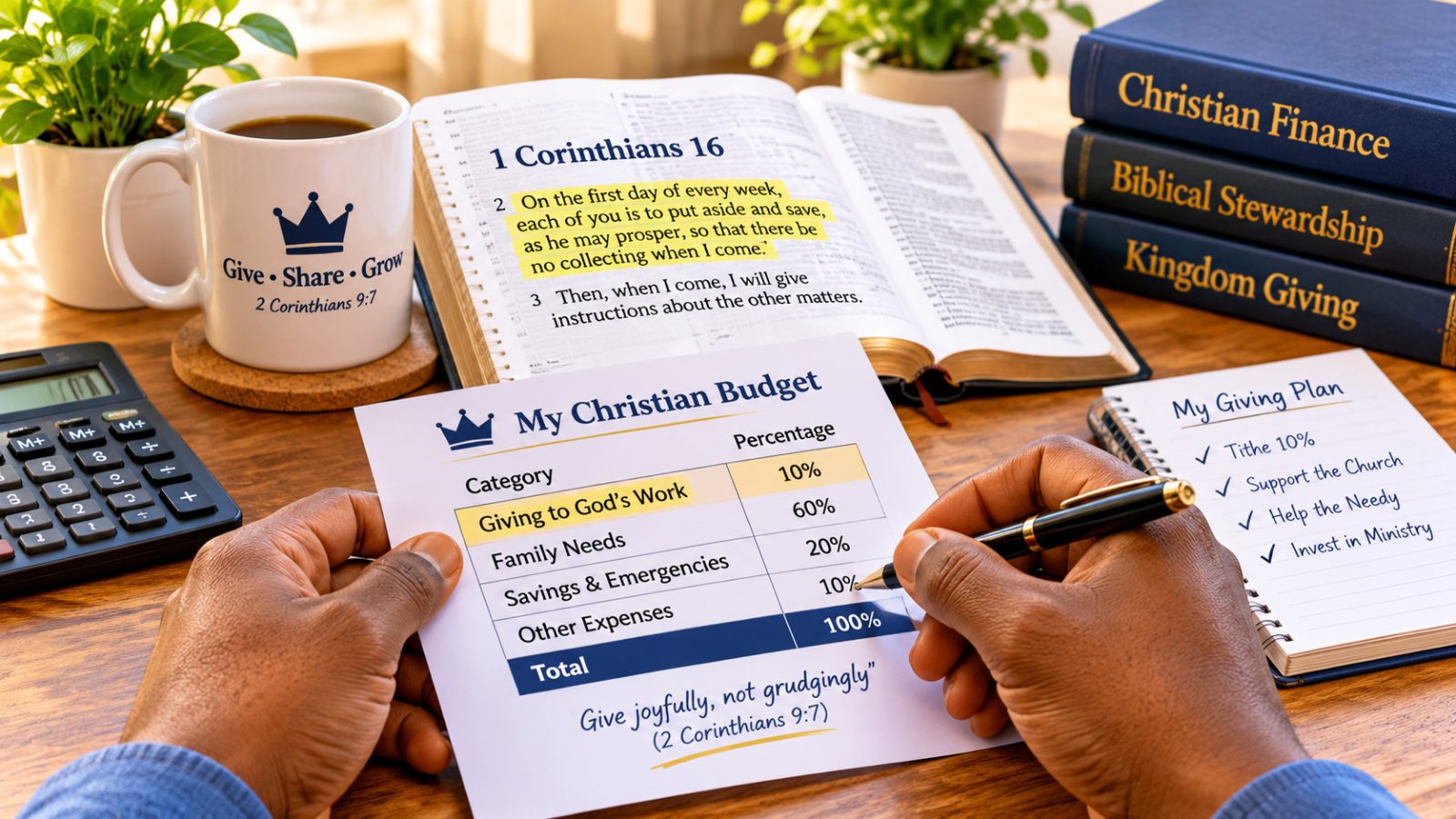
"Upon the first day of the week let every one of you lay by him in store, as God hath prospered him, that there be no gatherings when I come" (1 Corinthians 16:2, KJV). This verse contains three vital components of the new testament principle of giving without tithing: it is regular, it is individual, and it is proportional.
Regularity: "Upon the first day of the week." Giving isn't an emotional impulse when the worship music hits a certain chord. It is a planned, disciplined habit of the heart.
Individuality: "Let every one of you." No one is exempt, regardless of income level. Even the person with very little has the dignity of being a giver in the Kingdom.
Proportionality: "As God hath prospered him." This is the key. If you have been prospered greatly, 10% might be far too little. If you are in a season of extreme lack, your "proportional" gift might look different.
This is where the "without tithing" part becomes challenging. It requires you to actually sit down with God and ask, "Lord, how have You prospered me this week?" It requires a level of honesty and intimacy that a fixed percentage avoids. It is much easier to just tick a box and pay 10% than it is to look at your bank account and ask the Holy Spirit what "proportionality" looks like for you right now.
The Storehouse Myth and the Local Church
We need to address the elephant in the room: the "storehouse." Many modern preachers use Malachi 3:10 to claim that the "storehouse" is the local church building and that your entire 10% must go there before you give a penny anywhere else. Let me be clear: I believe in the local church. I believe we should support the elders and the work of the ministry. But the New Testament never equates the local church building with the Old Testament Temple storehouse.
In the New Testament, giving was directed toward people in need and those preaching the Gospel. We see this in the support of Paul’s missionary journeys and the collection for the poor in Jerusalem. The new testament principle of giving without tithing means you have the freedom , and the responsibility , to direct your giving where the Holy Spirit leads. This might be your local church, but it might also be a missionary on the field, a widow in your neighbourhood, or a ministry serving the "least of these."
If you are looking for more clarity on how these terms differ, you might find my article on TithesTithes, Offerings and Firstfruits: What Is the Difference? , Offerings and Firstfruits helpful. It breaks down the original context of these words so you can see why the "storehouse" argument often falls flat when applied to a 21st century non profit organisation. We are called to be stewards of God's money, not just donors to a building fund.
I have seen believers feel trapped because their local church was not using funds wisely, yet they felt they "had" to keep giving there because of the storehouse teaching. Beloved, you are accountable to God for how you manage His resources. If you are giving to a place that is not bearing fruit, you are not being a faithful steward. You are free to give where the work of God is actually being done.
Is the New Testament Standard Actually Higher?
Some people think that moving away from tithing means they can give less. In reality, every time Jesus touched an Old Testament law, He made the standard harder, not easier. The Law said "don't commit adultery"; Jesus said "don't even look with lust." The Law said "don't murder"; Jesus said "don't even harbor anger." Why would we think the law of giving is any different?
The Old Covenant demanded 10%. The New Covenant suggests 100%. "I beseech you therefore, brethren, by the mercies of God, that ye present your bodies a living sacrifice, holy, acceptable unto God, which is your reasonable service" (Romans 12:1, KJV). If your whole body is a sacrifice, then every pound in your pocket belongs to the Altar. The new testament principle of giving without tithing isn't about doing less; it's about doing everything from a different motive.
I often tell people that if you are a high earner and you are only giving 10%, you might actually be robbing God of the "proportionality" Paul spoke about. For someone earning £200,000 a year, giving £20,000 is easy. It doesn't require faith. It doesn't change their lifestyle. But for someone earning £20,000, giving £2,000 is a massive act of trust. The New Testament calls the wealthy to give "liberally" and "willing to communicate" (1 Timothy 6:18, KJV). It calls us to a standard of sacrifice that a mere percentage can never capture.
Moving From "How Much Do I Have to Give?" to "How Much Can I Keep?"
This is the mental shift that changes everything. Most of us start our budget by asking how much we "have" to give away. We treat giving like a tax or a bill. But the new testament principle of giving without tithing flips the script. It starts with the realisation that God owns it all, and He has graciously allowed us to manage some of it for our needs and the needs of our families.
Paul tells Timothy to charge those who are rich in this world "that they do good, that they be rich in good works, ready to distribute, willing to communicate" (1 Timothy 6:18, KJV). The goal of a Kingdom citizen isn't to see how close to the 10% line they can stay without falling off. The goal is to see how much of God's wealth they can channel into the Kingdom. We are conduits, not cul-de-sacs.
I have found that when I stopped tithing as a rule and started giving as a response, my "percentage" naturally went up. Not because I was trying to be "extra holy," but because I was more aware of the needs around me and more grateful for the provision I had. If you are struggling with this, I recommend reading Is Tithing Mandatory for Christians in the New Testament? for a deeper dive into the theological shift from Law to Grace.
When you move to this mindset, you stop looking for the minimum. You start looking for the maximum. You start asking, "Lord, do I really need this upgrade, or could this money be used to fund that mission project?" That is the freedom of a Kingdom citizen. It isn't about being "allowed" to spend your money; it's about being "invited" to invest God's money in things that last for eternity.
Practical Steps to Grace-Based Giving
If you are ready to transition to the new testament principle of giving without tithing, you need a plan. Freedom without discipline often leads to sloth. If you just "give when you feel like it," you will likely give very little. Here is how I suggest you structure your generosity in a way that honours the New Covenant.
Start with Prayer, Not a Calculator: Before you open your banking app, open your heart. Ask the Holy Spirit to show you how He has prospered you and what He wants you to release.
Audit Your Motives: Are you giving to get a "breakthrough"? Are you giving because you're afraid of a curse? If so, stop. Read this article on shame and financial failure to help reset your heart. Give because you are already loved, not to earn love.
Set a "Floor" for Consistency: Even though 10% isn't a law, it can be a helpful training wheel. Many people find that starting at 10% as a personal "floor" helps them stay disciplined while they grow in grace.
Identify Your "Fields": Where is God working in your life? Who is feeding you spiritually? Who is suffering in your circle of influence? These are your fields for sowing.
Review Monthly: Your "proportionality" might change. If you get a bonus, your giving should reflect that. If you lose your job, your giving might look like the widow's mite , small in amount, but massive in sacrifice.
Remember, God is not looking for a specific number. He is looking for a specific nature. He wants givers who look like Him. "For ye know the grace of our Lord Jesus Christ, that, though he was rich, yet for your sakes he became poor, that ye through his poverty might be rich" (2 Corinthians 8:9, KJV). That is the ultimate new testament principle of giving without tithing. It is the imitation of Christ.
I have seen people's lives transformed when they finally "get" this. They stop being anxious about their budget and start being excited about their impact. They realize that they can pray for financial breakthrough not so they can hoard more, but so they can give more. That is the heart of a Kingdom steward.
The Freedom of the Faithful Steward
At the end of the day, the new testament principle of giving without tithing is about trust. Do you trust God enough to give without a law telling you to? Do you trust Him enough to be generous even when the numbers don't seem to add up? Legalism is actually a form of control , we think that if we do X, God must do Y. Grace is a form of surrender.
I want to encourage you to walk in the liberty wherewith Christ has made you free. Don't let anyone put a yoke of bondage on you regarding your finances. But also, don't use your liberty as an excuse for the flesh. Use it as an opportunity to show the world that your God is a provider who can be trusted with everything you have.
As you move forward, keep your eyes on the One who gave everything for you. When you truly see the cross, the question "how much do I have to give?" disappears. It is replaced by a heart that says, "Lord, all I have is Yours. Show me how to use it for Your glory." That is the only principle that matters in the New Covenant. May God grant you the wisdom and the courage to live it out in 2026 and beyond.
Where To Read Next
If you want to go deeper into the heart of biblical stewardship and how to manage your resources for the Kingdom, I recommend these articles:
Tithes, Offerings and Firstfruits: What Is the Difference?
Frequently Asked Questions
Is it a sin to not tithe 10% as a Christian?
No, it is not a sin for a New Testament believer to give less than 10%, as the Mosaic tithe is not a command for the Church. However, we are commanded to be generous and to give proportionally as God has prospered us. "Every man according as he purposeth in his heart, so let him give; not grudgingly, or of necessity" (2 Corinthians 9:7, KJV).
What is the New Testament principle of giving without tithing?
The primary principle is grace-based, proportional, and cheerful giving that acknowledges God's ownership of everything. Rather than a fixed percentage, believers are called to give systematically and liberally according to their ability and the leading of the Holy Spirit. It moves giving from a legal requirement to a heart-driven act of worship.
Does God curse you if you don't tithe?
No, the "curse" mentioned in Malachi 3 was for the nation of Israel under the Old Covenant for failing to support the Levitical system. For the believer in Christ, Galatians 3:13 (KJV) states that "Christ hath redeemed us from the curse of the law, being made a curse for us." We give out of gratitude for our blessing, not out of fear of a curse.
Should I give my money to the church or to the poor?
The New Testament encourages both supporting those who labour in the Word and helping those in need. While the local church is a primary vehicle for ministry, the New Testament principle is that we are stewards of God's money and should direct it where it will most effectively advance the Gospel and care for the "least of these."
How do I know how much to give if I don't use the 10% rule?
You should determine your giving through prayerful consideration of your income and the needs you see around you. Paul suggests giving "as God hath prospered him" (1 Corinthians 16:2, KJV), which means your giving should be a reflection of your current financial situation and your trust in God's provision. For many, 10% is a helpful starting point, but grace often leads to giving much more.
Found this helpful? Share it with someone who needs it.