
You cannot out give God, but you can certainly overcomplicate the math. Many believers spend hours staring at their pay slips, wondering if they are doing their calculations correctly. They worry that a simple mistake on a spreadsheet might affect their standing before God.
The question of whether to tithe on gross or net is one of the most common struggles in Christian personal finance. I have sat with many fellow believers who feel genuine anxiety over this exact question, wanting to honour God while trying to pay bills and feed their families.
This struggle is a natural part of walking out your faith in a practical way. It is a sign of a heart that wants to be obedient, but we must be careful not to let rules replace relationship.
Should You Tithe on Gross or Net?
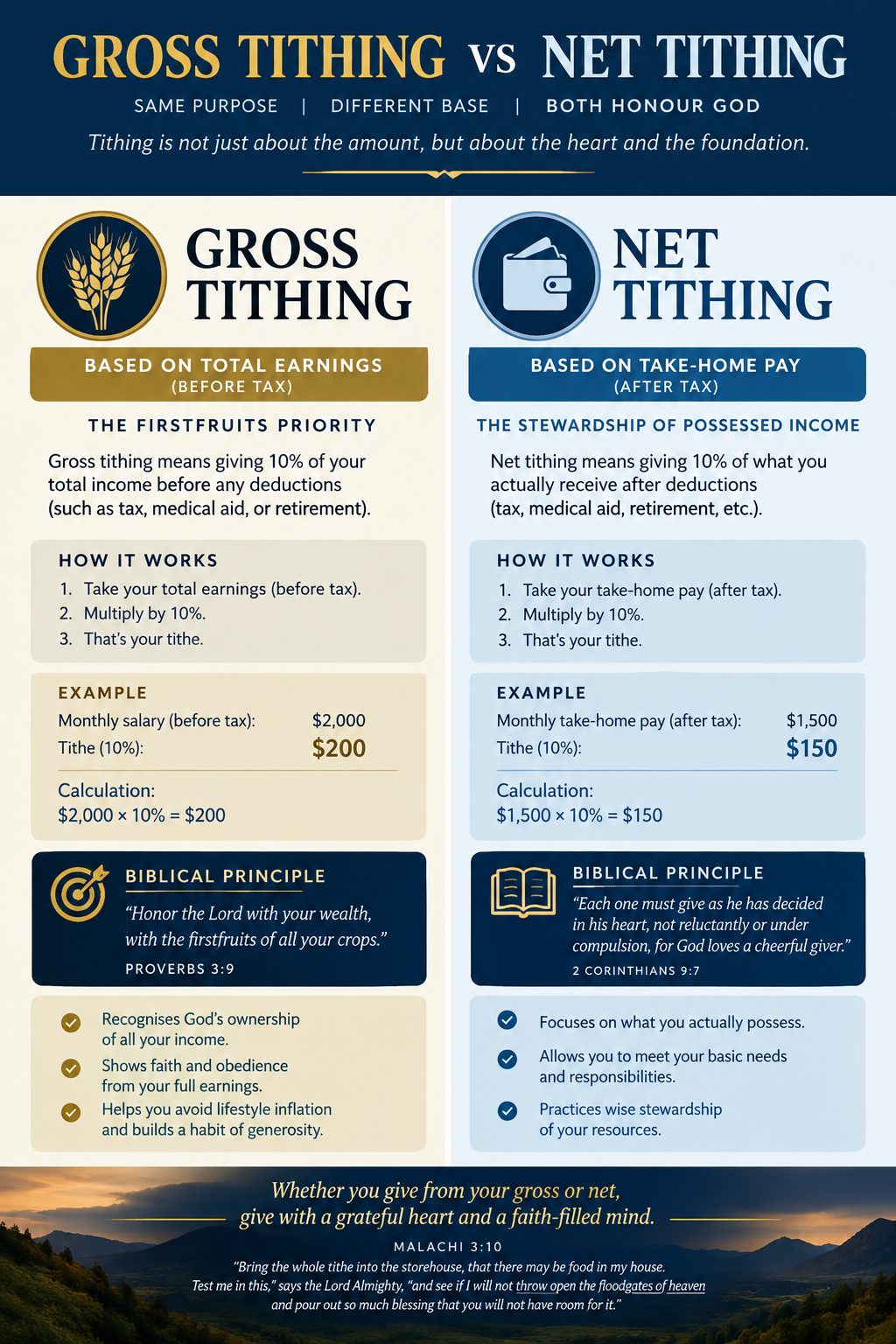
To decide whether to tithe on gross or net income, you must understand how each calculation affects your giving and your household budget. Gross income is your total earnings before any taxes or deductions are removed, while net income is the actual take home pay that lands in your bank account.
When you sit down to calculate your giving, the choice of whether to tithe on gross or net can feel like a major theological hurdle. I want to help you look into this without the heavy burden of guilt that so often creeps into our conversations about money.
Let us start by defining the terms clearly, because financial language can sometimes feel confusing. Gross income is the total amount of money you earn before any deductions are taken out. This is the big number at the top of your payslip, before taxes, national insurance, or pension contributions disappear.
Net income, on the other hand, is the money that actually lands in your bank account on payday. This is your take home pay; the amount you actually use to pay your rent, buy your groceries, and manage your daily life. The core of the issue is simple: do you calculate your ten per cent from the big number at the top, or the smaller number that actually reaches your bank account?
This practical decision is a core part of managing your household well. If you want to build a strong foundation for your family, you can explore my guide on practical money management for Christians and how to steward resources, which looks at how we align our daily habits with Kingdom principles.
What Does the Bible Say About Tithing and Your Increase?
The Bible teaches that we should tithe on our increase, which refers to the growth, product, or revenue generated from our labour. To understand what this means for modern taxpayers, we must look past modern tax brackets and return to the ancient scriptures.
The Hebrew word for tithe in the Old Testament is ma'aser, which literally means a tenth part. But the biblical meaning of tithing is not just about a mathematical fraction; it is about the order of giving.
In Proverbs, we are instructed: "Honour the Lord with thy substance, and with the firstfruits of all thine increase" (Proverbs 3:9, KJV).
The Hebrew word for "substance" here is hon, which refers to wealth, riches, or substance, while "increase" is tevuah, meaning product, revenue, or harvest. To the ancient Israelite farmer, the increase was the actual crop gathered from the field. They did not wait to see what was left after paying Roman taxes or temple dues before deciding what to give.
The firstfruits were the very first, best portion of the harvest, brought to the storehouse before anything else was consumed. This reveals that tithing is fundamentally a principle of priority, not a calculation of leftovers. When we examine what Proverbs says about money and the financial wisdom that we often overlook, we see that putting God first is the foundation of biblical wealth.

Why the Decision to Tithe on Gross or Net for Families Can Be Difficult
Choosing between gross and net tithing is difficult for families because the difference between these two numbers directly impacts their ability to cover essential household expenses. For many households, that difference represents real world buying power for groceries, utilities, and childcare.
When you are trying to decide whether to tithe on gross or net for families, the decision can feel particularly weighty. I understand the financial pressure that households face today, especially when the cost of living continues to rise.
If you earn three thousand pounds gross but take home two thousand three hundred pounds after taxes, tithing on gross means giving three hundred pounds. Tithing on net means giving two hundred and thirty pounds. That seventy pound difference is not just numbers on a screen; it represents groceries, school uniforms, or utility bills for your children.
For many Kingdom citizens, that difference is a real world budgetary decision that requires careful planning. If you are already struggling to make ends meet, you might want to look at how to create a Christian budget when money is tight to see where your money is actually going. Managing a household budget under pressure requires both practical strategy and deep faith.
The Firstfruits Principle: The Case for Tithing on Gross
The case for tithing on gross income rests on the firstfruits principle, which dictates that God should receive the very first portion of our earnings before any other authority, including the government, takes a share. This approach treats the entire salary as the believer's primary increase.
I remember when I first wrestled with this concept and had to look closely at my own motives. It is easy to look for a discount when we are calculating our giving, but God is looking at our hearts.
The primary biblical argument for tithing on your gross income is the principle of firstfruits. If we believe that God is our primary provider, then He should receive His portion before anyone else, including the tax collector. When we allow taxes, national insurance, and pension contributions to be deducted first, and then tithe on what remains, we are essentially giving the government the firstfruits of our labour.
In Malachi, the Lord challenges His people: "Bring ye all the tithes into the storehouse, that there may be meat in mine house, and prove me now herewith, saith the Lord of hosts, if I will not open you the windows of heaven, and pour you out a blessing, that there shall not be room enough to receive it" (Malachi 3:10, KJV).
Tithing on gross is a bold declaration that we trust God to stretch the remaining ninety per cent of our gross income further than we could stretch the entire hundred per cent on our own. It positions our giving as the ultimate priority of our financial life. When we give from the gross, we are telling our hearts that God is our source, not our employer and certainly not the state.
The Stewardship Perspective: The Case for Tithing on Net
The case for tithing on net income is built on the idea of practical stewardship, arguing that you can only manage and give from the resources that actually enter your possession. Proponents of this view argue that taxes are a compulsory civil obligation that does not constitute personal increase.
Now, let us examine the argument for calculating your tithe on net income. I have spoken to many Christians who hold this view with deep sincerity and biblical conviction. They are not trying to cheat God; they are trying to be honest stewards of what they actually receive.
Some fellow believers argue that net income is the only true "increase" they actually receive. They point out that income tax is money they never see, never touch, and have no control over. If the government takes twenty or thirty per cent of your salary before it ever hits your bank account, can that deducted money truly be considered part of your personal increase? You cannot steward money that you never possessed.
In Matthew, when the Pharisees tried to trap Jesus with a question about taxes, He gave a famous reply: "Render therefore unto Caesar the things which are Caesar's; and unto God the things that are God's" (Matthew 22:21, KJV).
From this perspective, taxes are a civil obligation that belongs to the state, and our personal stewardship only begins with the resources that are actually placed into our hands. If you are currently wondering why you are living paycheque to paycheque as a Christian, the pressure to choose between gross and net can feel overwhelming, and starting your calculations from your net pay can feel like the only way to keep your household afloat.
What About Pension Contributions and Company Benefits?
Pension contributions present a unique tithing challenge because they represent income that is earned now but deferred for future use. If you tithe on your gross income, you are tithing on your pension contributions today, which means you do not need to tithe on those funds when you withdraw them in retirement.
Conversely, if you choose to tithe on your net income, you are excluding pension contributions from your current calculations. This means that when you eventually retire and begin drawing your pension, those monthly payouts will represent your actual, active increase, and you should tithe on them as they land in your account.
This is where the math can get incredibly messy if you do not establish a clear, consistent boundary. Some employers also offer matching pension contributions or share schemes. If your company matches your pension contribution, that matched amount is a form of financial blessing, but it is not liquid cash you can spend today.
I advise believers to keep their approach as simple as possible. Do not double tithe by giving on your pension contributions now and then tithing on the pension payouts again in thirty years. Choose one method, write down your decision, and stick to it with peace of mind.
If you are trying to build long term security while remaining generous, you might want to read about how to build an emergency fund as a Christian, which helps you balance saving for the future with giving in the present.
The Trap of Legalism And What Jesus Said About Tithing Calculations
Jesus warned against tithing legalism, showing that an obsession with precise mathematical calculations can cause believers to neglect weightier matters like justice, mercy, and faith. While the percentages matter, the spiritual posture behind the gift is what God observes.
It is very easy to turn tithing into a cold, clinical transaction. We can become so focused on getting the pence and pounds exactly right that we lose the heart of worship. Jesus dealt with this exact issue when He confronted the religious leaders of His day.
In the Gospel of Matthew, He spoke clearly: "Woe unto you, scribes and Pharisees, hypocrites! for ye pay tithe of mint and anise and cummin, and have omitted the weightier matters of the law, judgment, mercy, and faith: these ought ye to have done, and not to leave the other undone" (Matthew 23:23, KJV).
The Pharisees were so obsessed with the exact math of their tithing that they were counting out individual leaves of garden herbs. Yet their hearts were far from God. They had no mercy, no justice, and no real faith.
God does not have a calculator in heaven, checking your tax return to see if you missed a decimal point. He is looking at your heart. If you are tithing on gross but doing it with a bitter, resentful spirit, that gift does not please Him. If you are tithing on net with a heart full of gratitude, love, and a desire to see His Kingdom grow, He sees that devotion.
We must understand that giving is not a system to buy God's favour. I have written before about why tithing alone will not make you wealthy, because God is looking for complete stewardship of the remaining ninety per cent, not just a mechanical transaction with the first ten.

How to Choose Between Gross and Net Without Guilt
To choose between gross and net tithing without guilt, you must prayerfully evaluate your financial situation, make a decision based on your convictions, and commit to tithing that portion consistently. Peace comes from alignment with God's word, not from trying to meet legalistic standards.
If you are feeling torn, I want to give you a simple framework to help you make this decision. This is not about giving you a new rule; it is about helping you find clarity and peace in your financial stewardship.
First, look at your heart. Are you choosing net because you genuinely believe it represents your actual increase, or are you choosing it out of fear and scarcity? If fear is driving your decision, you need to address that spiritual root before you adjust your numbers.
Second, look at your household numbers. If you want to tithe on gross but doing so would mean neglecting your basic household needs or failing to pay your debts, you may need to start with net while you work on your financial health. Remember, God also calls us to pay our debts and provide for our families.
If you are currently working your way out of financial trouble, you should read my guide on how to get out of debt as a Christian without stopping giving, which shows how to balance your obligations to creditors with your desire to honour God.
Third, once you make your decision, stick to it. Do not constantly change your tithing method based on how much money you have left at the end of the month. Consistency builds discipline, and discipline builds trust.
The True Goal of Tithing: Generosity Beyond the Law
The ultimate goal of tithing is to train our hearts to live generously, recognizing that God owns everything and we are simply managing His estate. The ten per cent is not a ceiling for our giving; it is a training ground for a life of open handed stewardship.
We must never forget that under the New Covenant, we are called to a standard of generosity that actually goes beyond the Old Testament law. Jesus did not come to abolish the law, but to fulfill it. He raised the bar from external compliance to internal devotion.
When we look at the early church in the Book of Acts, they were not arguing about gross versus net. They were selling houses and lands to make sure there was no needy person among them. They lived with a deep conviction that everything they owned belonged to the Lord.
Whether you choose to calculate your giving from your gross salary or your take home pay, let your decision be marked by joy. God loves a cheerful giver, and He is far more interested in your trust than your tax brackets.
May God grant you wisdom as you walk this out. I am praying for you as you take this step, manage your household, and honour the One who provides our daily bread. Walk in faith. Steward with wisdom. Trust the One who owns it all.
Where To Read Next
If you want to deepen your understanding of biblical stewardship and manage your household finances with peace and wisdom, I highly recommend reading these articles next:
Why Tithing Alone Will Not Make You Wealthy and What the Bible Says It Actually Does
How to Create a Christian Budget When Money Is Tight: A Biblical Step by Step Guide
How to Get Out of Debt as a Christian Without Stopping Giving: A Biblical Approach
- How to Teach Children About Money the Biblical Way Without Raising Them to Chase Salary, Status or Possessions
- How to Talk About Money With Your Spouse Biblically When Financial Decisions Keep Causing Conflict
- How to Save Money on a Small Income as a Christian Without Living in Fear
Frequently Asked Questions
Is tithing on gross income a requirement for salvation?
No, tithing on gross income is not a requirement for salvation. Salvation is a free gift of grace through faith in Jesus Christ, not something we earn through financial contributions or keeping Old Testament laws. Tithing is a personal spiritual discipline and an act of worship, not a legal requirement for eternal life.
What if my spouse and I disagree on tithing on gross or net?
If you and your spouse disagree on tithing on gross or net, you should prioritise household peace and unity over mathematical precision. Pray together, discuss your financial concerns openly, and agree on a compromise that both of you can support without resentment. God values unity in marriage and a peaceful home far more than a forced calculation.
Should I tithe on my tax refund if I tithe on my gross income?
If you already tithe on your gross income, you should not tithe on your tax refund because that money has already been tithed. A tax refund is simply the government returning your own overpaid, pre-tax money to you. If you tithe on net income, however, that refund represents income that has not yet been tithed, so you should calculate your giving on it.
Do I tithe on student loans or borrowed money?
No, you do not tithe on student loans or any other borrowed money. A loan is a debt that you are legally obligated to pay back, not an increase or a source of personal income. Tithing is calculated on your actual earnings and increase, not on borrowed funds that you must eventually return with interest.
Should business owners tithe on business revenue or personal take-home pay?
Business owners should tithe on their personal draw or net profit from the business, not on the total business revenue. Business revenue must cover operating expenses, taxes, payroll, and business debts before it becomes personal increase. Tithing on gross business revenue can quickly bankrupt a company, which is poor stewardship of the enterprise God has entrusted to you.
Found this helpful? Share it with someone who needs it.