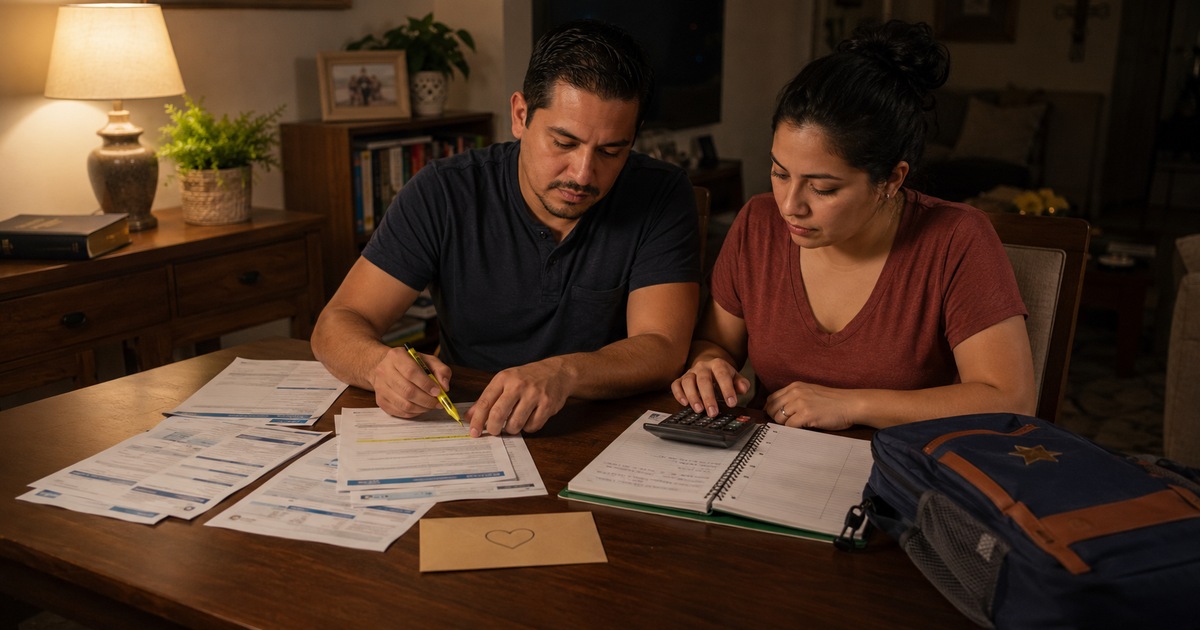
I want to begin with honesty because this subject deserves more than polished marriage advice. Money has been one of the difficult areas in my own marriage. My wife and I cared for one another, yet there were seasons when we were making financial decisions apart, and sometimes I made decisions she did not agree with or did not fully know about. The money problem did not remain inside a budget. It entered the trust between us.
I remember seeing what I believed was a genuine investment opportunity. I had researched it and I was convinced. My wife looked at the same opportunity and saw danger. Instead of slowing down and working through her concern, I went ahead without her agreement. The investment failed and the money was lost. There was a period when we had no food at home because money the household needed had been committed to something that did not produce what I expected.
I take responsibility for that. The deeper cost was relational because my wife had to live with a decision she had warned me about. Another time, we had money set aside for a property we were building, and I redirected it elsewhere without her full knowledge. When she discovered it, the question was larger than the funds. Could she trust decisions about a future that belonged to both of us?
Those experiences changed how I understand financial leadership in marriage. I once thought carrying responsibility meant carrying the final decision. I now believe it includes bringing the truth into the open, listening seriously and refusing to use leadership as permission to override. If money is tense in your marriage, I am not writing to shame you. I am writing from inside the consequences of getting this wrong. Unity grows when important decisions are shared and neither person discovers the family's financial direction only after the commitment has been made.
Money Conflict Can Reveal More Than the Numbers
Financial conflict in marriage is rarely just about the mathematics of your bank account. Money disagreements usually signal deeper differences in values, fears, childhood experiences, and trust. When you and your spouse argue over a purchase, you are often arguing about security, respect, and how you view your shared future.
A money disagreement can genuinely be about money. A household may simply not have enough income for everything two people want to do. An interest rate may be too expensive. A purchase may not fit the budget. I do not want to reduce every disagreement to psychology when sometimes the maths really is the problem.
Yet money conversations often uncover other things as well: different experiences from childhood, different levels of comfort with risk, different ideas about generosity, fear of scarcity, embarrassment over debt, or the feeling that one person's voice matters less. When money has been hidden or redirected, the argument is no longer only about the amount. It is also about whether information and decision-making were shared honestly. If you are trying to resolve these tensions, you need to understand practical money management for Christians who want to honour God before you can fix the relational friction.
I used to lean on Amos 3:3 when teaching this point because the verse asks, "Can two walk together, except they be agreed?" (Amos 3:3, KJV). The words sound ready-made for marriage, but Amos is not teaching a marriage seminar. The surrounding chapter is about God's message of judgement through the prophet. I can still learn that agreement matters in human relationships, but I do not need to make Amos say something about household budgeting that the passage itself was not written to say.
Genesis Gives Us Oneness That Reaches the Household’s Money
The biblical foundation for marital finance rests entirely on the principle of total covenant partnership. Scripture demands that husband and wife operate as a single unit in every area of life. This means your income, your debts, your savings, and your financial choices belong to the covenant, not just to the individual who signed the contract.
Genesis 2:24 says a man shall leave his father and mother, cleave to his wife, and they shall be one flesh. The Hebrew verb behind "cleave" is dabaq (H1692), carrying the sense of clinging, adhering, or being glued fast together. It describes a bond so tight that you cannot separate the two components without tearing them apart. The phrase "one flesh" is basar echad: flesh and one. This profound union reaches the bank account, the mobile-money wallet, the card and the spreadsheet because those tools carry decisions that shape the one household both spouses share.
"Therefore shall a man leave his father and his mother, and shall cleave unto his wife: and they shall be one flesh." (Genesis 2:24, KJV)
Marital oneness reaches into money because financial choices shape the household both spouses share. Scripture gives the governing command of covenant unity while allowing couples to organise the practical structure jointly, separately or through a mixture of both. The test is not the number of accounts. The test is whether the arrangement is honest, mutually understood and faithful to shared responsibilities.
Proverbs 11:3 says that the integrity of the upright guides them. For marriage and money, the financial picture should not depend on one spouse remaining ignorant. Hidden debt, secret borrowing, concealed income or redirected savings can wound trust because the other spouse may have to share consequences they were denied the chance to understand. If you are struggling with hidden financial burdens, you must learn paying off what you owe without stopping your giving so you can clear the path to complete honesty.
Transparency does not require that two adults lose every reasonable area of personal discretion. A couple may agree that each person has a modest amount they can spend without consultation. They may manage different bills. One may be more skilled at keeping records. The question is whether those arrangements were agreed together, and whether either spouse can understand the household position without having to investigate the other person.
Do Not Turn Different Money Temperaments Into Rules About Men and Women
You must not mistake natural personality differences for spiritual roles in your marriage. God combines different temperaments in a home to protect the household, not to create a hierarchy of wisdom. One spouse is often wired to see future opportunities, while the other is naturally wired to protect current stability.
There is one part of my earlier thinking that I now state more carefully. In my marriage, I was often the person drawn to future opportunity and willing to take risk, while my wife was often the one protecting the household's immediate stability. That pattern was real in our home, and I ignored her caution at a cost. But my experience is not a biblical law about every husband and every wife.
Some husbands are cautious savers. Some wives are entrepreneurs who see opportunities before anyone else. Many couples change roles depending on the decision. Scripture itself will not support a picture of women as financially passive. Proverbs 31 describes a capable woman who considers a field and buys it, plants a vineyard and engages in productive work. I therefore do not want to baptise a personality pattern and call it God's design for all men and women.
Different instincts can protect a household when both are heard. One spouse may notice an opportunity; the other may see a downside that enthusiasm has hidden. Wisdom is not produced by automatically choosing the cautious spouse or the adventurous spouse. Bring the reasons, costs, consequences and the household's actual capacity into the same conversation. When we fail to do this, we quickly see how material possessions can alter your closest relationships in ways that damage your spiritual walk.
Different temperaments do not have to become enemies; caution and enterprise can strengthen the same household when truth holds them together.
How to Have a Christian Money Conversation That Builds Unity
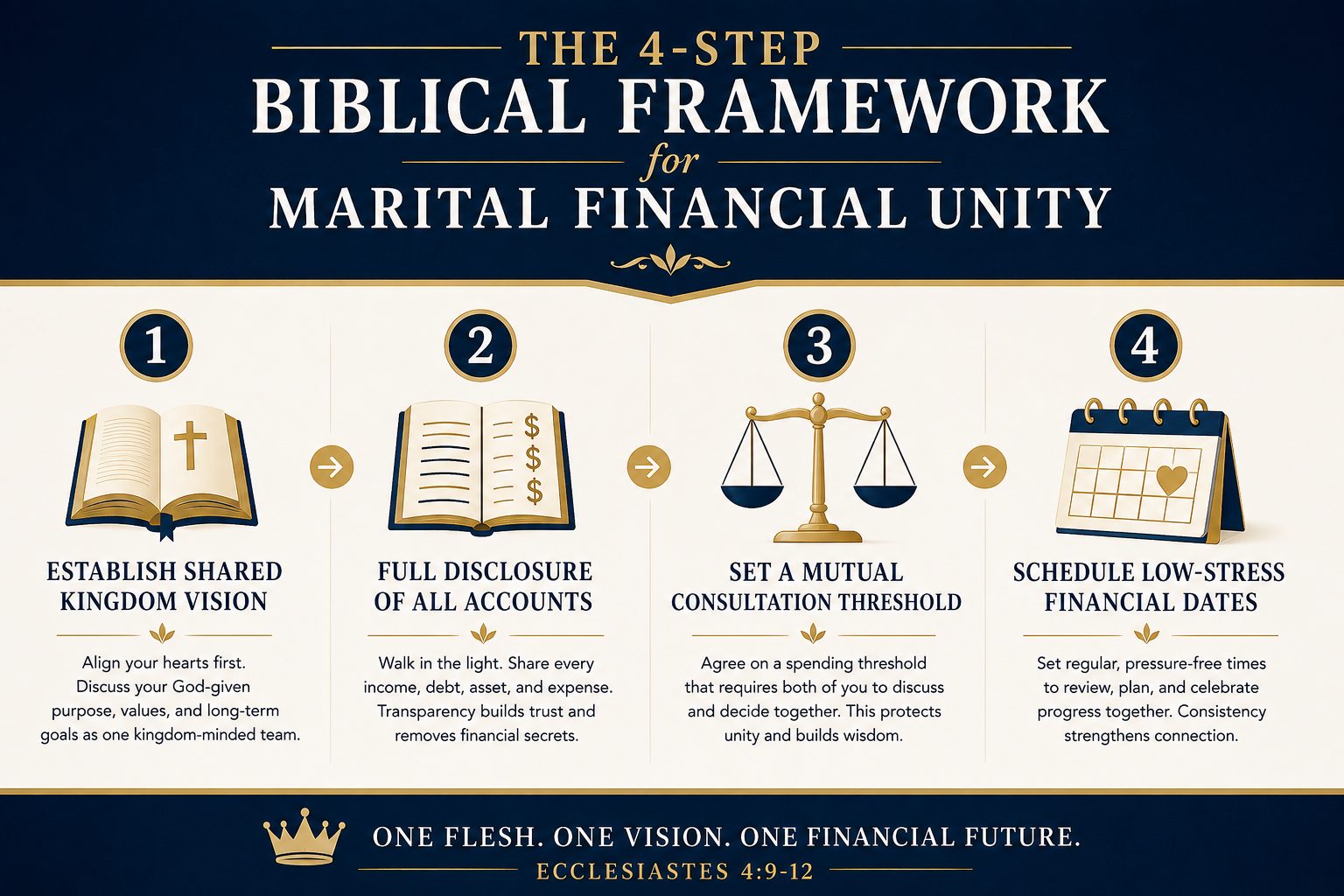
I have found that good money conversations become easier when the couple knows what belongs in the conversation before emotions rise. These four habits are not commandments from Scripture. They are practical disciplines that help me apply biblical honesty, mutual concern and responsible stewardship inside ordinary married life.
1. Begin with the shared future before defending a position
Before discussing the disputed purchase, investment or expense, remind yourselves what the household is trying to build. You may be clearing debt, finishing a home, educating children, building an emergency reserve, supporting ministry or starting a business. Shared goals do not remove disagreement, but they shift the question from whose preference wins to which choice serves the responsibilities and future you have already named together.
2. Put the whole financial picture on the table
Bring the information needed for the decision: income, essential bills, debts, savings, giving commitments, upcoming obligations and the real cost of what is proposed. For an investment or loan, look at the downside as seriously as the hoped-for return. My own mistakes became more dangerous when conviction turned into stubbornness, and I refused to let the actual numbers correct my optimism. If you are struggling to get these numbers on paper, you should review our guide on how to create a simple budget when money is tight to establish a clear starting point.
3. Establish a mutual threshold for independent spending
You do not need to ask permission for every loaf of bread, but you must have a clear limit for unannounced spending. Agree on a specific amount that either spouse can spend without consulting the other. Anything above this agreed figure requires a conversation. This simple rule eliminates the feeling of being controlled while protecting the household from sudden, unexpected financial shocks.
4. Separate the budget review from your daily relationship
Do not bring up financial stress when you are tired, hungry, or trying to relax at the end of the day. Schedule a specific, low-stress time to look at the numbers together. Keep this meeting focused purely on stewardship, keeping it brief and constructive. By separating the financial review from your romantic life, you prevent money anxiety from consuming the emotional warmth of your home.

Rebuilding Trust After Financial Secrets or Broken Agreements
If you have hidden financial decisions or broken agreements in the past, you must accept that healing takes time. Restoring broken trust requires complete transparency, consistent honesty, and the humility to answer hard questions without becoming defensive. You cannot expect your spouse to trust your financial judgment immediately when previous choices have caused pain.
I know the temptation to minimize a financial mistake. You tell yourself that you meant well, or that you were trying to provide for the family. But Scripture is clear about our speech. Ephesians 4:25 tells us to put away lying and speak every man truth with his neighbour, for we are members one of another. In marriage, this membership is absolute.
"Wherefore putting away lying, speak every man truth with his neighbour: for we are members one of another." (Ephesians 4:25, KJV)
Rebuilding starts when you open every account, every debt, and every statement to your spouse. If you have made mistakes, bring them into the light. Allow your partner the time to process the disappointment without demanding immediate forgiveness or instant trust. True reconciliation is a process of daily, faithful actions rather than a single emotional conversation.
You may also need to stand against the spiritual pressures that affect your home. Financial strain can open the door to division, bitterness, and fear. By recognizing these pressures, you can engage in standing against the spiritual pressures that affect your home, ensuring that you protect your marriage from the enemy's attempts to exploit your financial trials.
How to Handle Money When Only One Spouse Wants to Budget
It is incredibly difficult to build financial stability when your partner refuses to participate in the planning. You cannot force your spouse to budget, but you can lead by example and manage your own responsibilities with integrity. Nagging or manipulating your partner will only increase their resistance and deepen the conflict.
If your spouse refuses to sit down with a spreadsheet, start by managing your portion of the household duties faithfully. Keep your own spending disciplined. Show them the positive results of your stewardship rather than lecturing them on their lack of participation. When they see that your budgeting leads to less stress and more peace, they will often become curious about the process.
Focus your conversations on the positive outcomes of planning. Instead of saying, "You need to stop spending," try saying, "I want to make sure we have enough saved so we do not have to worry about emergencies." Frame the budget as a tool for freedom, not as a financial prison. When your spouse realizes that a budget actually gives them permission to spend guilt-free within agreed limits, their resistance will often begin to soften.

Where To Read Next
Building a unified household budget takes time, patience, and deep commitment. Here are several articles to help you and your spouse grow together in your financial stewardship:
How to Create a Christian Budget When Money Is Tight: A Biblical Step by Step Guide
How to Get Out of Debt as a Christian Without Stopping Giving: A Biblical Approach
Frequently Asked Questions
Should Christian couples have separate bank accounts?
Christian couples can choose to have separate, joint, or a mix of both accounts, as Scripture does not command a specific banking structure. However, the underlying principle of covenant oneness requires complete transparency, mutual agreement, and shared responsibility over all household funds, regardless of whose name is on the account.
How do we handle different spending habits in a Christian marriage?
You must recognize that different money temperaments can protect your household when you communicate openly. Instead of trying to change your spouse's natural personality, establish clear spending boundaries and a mutual consultation limit so both partners feel respected and secure.
What does the Bible say about hiding money from your spouse?
The Bible warns against deceit, dishonesty, and withholding the truth from those to whom we are joined. Proverbs 11:3 teaches that integrity guides the upright, and hiding money, debts, or assets from your spouse violates the covenant of oneness and damages the foundation of trust in your marriage.
How can we talk about money without arguing?
You can reduce money arguments by scheduling specific, low-stress times to discuss finances rather than bringing them up during moments of frustration. Begin your conversations by focusing on your shared goals and future plans before looking at individual expenses or disagreements.
Found this helpful? Share it with someone who needs it.