
Few things carry as much silent shame in the church as the word bankruptcy. You sit in the pews, singing of freedom, while your phone buzzes in your pocket with another debt collector's call.
You wonder if you have failed God, if your faith was too weak, or if you are living under some kind of spiritual curse. It is a heavy weight that leads to the single question keeping you awake at night: is bankruptcy a sin?
This is not just a legal question; it is a deeply spiritual one that touches the very core of your identity. I have spoken with many fellow believers who are drowning in debt due to medical emergencies, business failures, or job losses, and they feel completely trapped between the legal option of debt relief and the fear of God's displeasure.
Let us talk plainly, brethren. Most of us have been taught that a good Christian is always prosperous, always ahead, and always the lender rather than the borrower. So when you find yourself in a position where you cannot even pay your basic utilities, let alone your credit cards, a deep crisis of faith begins.
The silence in our churches on this topic only makes the pain worse. We celebrate the promotions and the new houses, but we rarely talk about the families quietly packing their boxes because they can no longer afford the mortgage. This silence breeds a toxic shame that isolates believers when they need community the most.
The Broken Bench: The Etymology of Bankruptcy
To understand this struggle, we need to look at where this heavy word actually comes from. The word "bankruptcy" has its roots in the Latin words bancus, meaning a bench or table, and ruptus, meaning broken. In medieval Italy, when a merchant in the marketplace could no longer pay his debts, his creditors would physically smash his trading bench to pieces.
This "broken bench" was a public declaration of failure. It was designed to humiliate the merchant, showing the entire community that his ability to trade was completely ruined. When you face financial collapse today, you feel that exact same public humiliation, don't you? You feel as though your life has been smashed to pieces in front of everyone.
But we must understand that God does not look at a broken bench the way the world does. The world sees a broken bench as a sign of permanent worthlessness. God, however, is a specialist in rebuilding what has been shattered. He does not smash our tables to destroy us; sometimes He allows the broken structures of our lives to fall so we can build on a firmer foundation.
As Kingdom citizens, we must stop looking at our financial standing through the lens of worldly pride. Your broken bench does not mean you are a broken person in the eyes of your Father. He looks at your heart, not your credit rating.
The Biblical Meaning of Debt Relief and the Law of Release
To understand how God views this situation, we must look past modern legal systems and return to the ancient scriptures. The English word "release" or "discharge" sounds like a modern courtroom term. But the Hebrew word used in the Old Testament is shemitah, and it carries a radical meaning that completely reframes how we look at financial failure.
In Deuteronomy 15:1-2, the King James Version says: "At the end of every seven years thou shalt make a release. And this is the manner of the release: Every creditor that lendeth ought unto his neighbour shall release it; he shall not exact it of his neighbour, or of his brother; because it is called the Lord's release." (Deuteronomy 15:1-2, KJV)
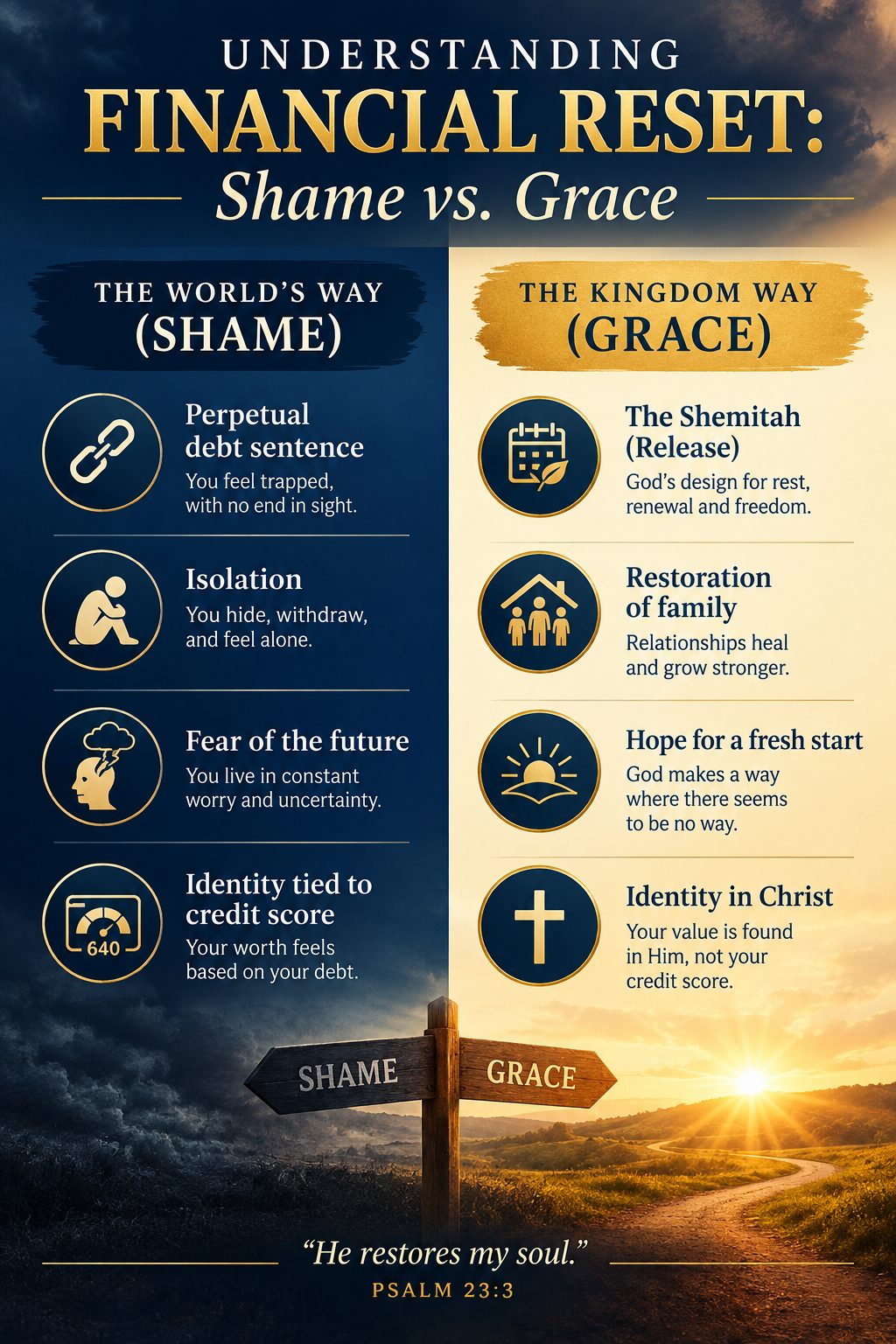
The word shemitah literally means to let drop, to fling down, or to release entirely. It was not a punishment for the borrower, but a command to the lender to let the debt go. This reveals the true biblical meaning of debt relief as a divine reset button.
God established this rhythm because He knew that human societies naturally accumulate debt, and without a systemic release, the poor would be permanently enslaved. The shemitah was God's way of declaring that human dignity and family restoration matter more to Him than perpetual interest payments.
The concept of shemitah was not just a suggestion; it was a foundational law of the covenant community. Every seventh year, the entire economic system of Israel was reset. Imagine the relief that swept through the tents of Israel when the seventh year arrived.
A family that had been crushed by debt due to a failed harvest or a family emergency was suddenly handed a clean slate. This tells us something profound about the character of God. He is a God of the fresh start. He designed a system that placed a limit on human financial suffering.
Is Bankruptcy a Sin for Kingdom Citizens?
We must address the verse that causes the most guilt for Kingdom citizens facing financial collapse. You have probably read it, or perhaps someone has quoted it to you during a difficult conversation about your finances.
"The wicked borroweth, and payeth not again: but the righteous sheweth mercy, and giveth." (Psalm 37:21, KJV)
On the surface, this verse seems to settle the matter. It seems to say that if you borrow money and cannot pay it back, you are acting wickedly. But we must look closer at the heart of this scripture, my fellow believers.
The Hebrew word for "wicked" in this context refers to someone who has the means to pay but actively chooses to withhold it. It describes a person of deceitful character who borrows with no intention of repaying, or who hoards wealth while their creditors suffer. This is very different from a believer who desperately wants to pay, but simply does not have the physical means to do so.
If you are struggling with this, let me ask you a question. Did you enter into your debt with the intention of defrauding your lenders? Or did life happen to you in the form of a sickness, a redundancy, or a global economic shift?
I believe God looks at the intent of your heart. If you have been forced into a corner where you must choose between feeding your children or paying a credit card company, your inability to pay is a tragedy, not a sin. We must understand the difference between a moral failing and a physical impossibility.
If you borrow money to buy luxury items that you know you cannot afford, and then use bankruptcy as a clever trick to wipe the slate clean so you can do it again, that is a sin. That is the behaviour of the wicked described in Psalm 37. But what if you borrowed money in good faith to build a business, and a global crisis destroyed your market? In these cases, your inability to pay is not a choice.

Why Your Budget and Financial Plans Sometimes Break
Many believers think that financial failure only happens to those who are lazy or foolish. But that is simply not true, guys. You can do everything right, follow every rule, and still find yourself in a desperate situation.
Perhaps you have tried to build a solid budget, only to watch it get wiped out by an unexpected crisis. A sudden medical bill, a roof that collapses, or a sudden job loss can destroy months of careful planning in a single afternoon.
The writer of Proverbs understood this reality well. He wrote about how unexpected events can completely alter our financial standing in an instant. "Boast not thyself of to morrow; for thou knowest not what a day may bring forth." (Proverbs 27:1, KJV)
When these storms hit, they do not ask for permission, and they do not care how carefully you have mapped out your future. Sometimes, the structures we build simply cannot hold up under the weight of a broken world. This is where we must separate our self-worth from our net worth.
If your financial plans have broken, it does not mean your relationship with God is broken. It simply means you are living in a fallen world where economic storms are real. Acknowledging that a plan has failed is not a lack of faith.
In fact, it can be the first step of genuine wisdom. If you are tired of fighting this losing battle alone, you might want to look at creating a Christian budget when money is tight so you can find a practical, clean way forward. It starts with being honest about your numbers.
The Spiritual Toll of Carrying Debt Shame
We need to talk about what happens to your spirit when you carry this kind of financial pressure for months or years. It is not just about the numbers on a screen; it is about the slow erosion of your peace, your joy, and your ability to hear God's voice.
When you are constantly worrying about how to avoid the next collection call, your mind is in a perpetual state of fight-or-flight. You cannot focus on your family, you cannot serve in your church with a free heart, and you certainly cannot experience the abundant life that Jesus promised.
I remember a season in my own life when the bills piled up so high I could barely breathe. Every time I bowed my head to pray, all I could see was my bank balance, and my prayers turned into a desperate negotiation with God for a miracle. I was trapped in a cycle of fear, and I know many of you are feeling that exact same suffocation right now.
This is the real danger of debt shame. It distorts your view of the Father. You start to see Him as a harsh taskmaster who is punishing you, rather than a loving Provider who desires your freedom.
If you are in this place, I want you to know that there is no condemnation for those who are in Christ Jesus. The shame you are carrying does not come from God. He is not interested in keeping you in a spiritual prison because of a financial debt.
Sometimes, the enemy uses our financial struggles to convince us that we are second-class citizens in the Kingdom. But your identity was bought with the blood of Jesus, not your credit score. You are still His child, even if your bank account is empty.
If you want to understand how to break this cycle of worry, it helps to look at breaking the cycle of living paycheque to paycheque so you can start building real breathing room. But if the debt has already grown too large to manage, you need to look at the legal and spiritual tools God has put in place for your protection.
What Does the Bible Say About Legal Bankruptcy?
Now that we have looked at the spiritual foundation, let us look at the actual legal framework of bankruptcy through a biblical lens. Many believers assume that filing for bankruptcy is a modern, secular invention that bypasses God's laws.
But the truth is that modern bankruptcy laws are heavily based on the biblical principles of the shemitah and the Year of Jubilee. The secular legal system has actually copied God's design for protecting debtors from permanent ruin.
When you file for bankruptcy, you are not cheating your creditors. You are using a legal provision that has been established by the authorities that God has placed over us. As Paul wrote in his letter to the Romans, we are called to respect these legal frameworks.
"Let every soul be subject unto the higher powers. For there is no power but of God: the powers that be are ordained of God." (Romans 13:1, KJV)
The legal system provides bankruptcy as a way to orderly distribute what you have to your creditors and legally wipe out the rest. It is a structured, honest acknowledgment that you cannot pay, rather than a deceitful attempt to run away from your responsibilities.
I have often shared with people who are struggling with tithing guilt during financial ruin. They ask if they should keep tithing when they cannot even pay their rent. I wrote about this extensively when I looked at why tithing alone will not make you wealthy, and the truth is that God desires mercy, not sacrifice.
If you are using bankruptcy to protect your family and reset your stewardship, you are acting within the legal protections that God has allowed to exist in our society. It is a tool of mercy, not a loophole of sin.
Practical Steps to Rebuild After Filing for Bankruptcy
If you decide that bankruptcy is the only viable path forward for your family, you must treat it as a sacred reset, beloved. It is not just about wiping out the numbers; it is about changing the habits that brought you to this point in the first place.
This is where we must return to the core principles of stewardship. God has given you a clean slate, and you must use it wisely. Here are the practical steps you need to take as you rebuild your financial life:
Acknowledge the reality: Stop hiding from your financial truth. Sit down with your spouse, look at the numbers, and accept where you are without shame.
Establish a basic survival budget: Before you worry about paying off old debts, make sure your basic needs are met. Keep it simple and focused only on food, shelter, and utilities.
Build a small safety net: The main reason people fall back into debt after bankruptcy is that they do not have any savings to cover unexpected emergencies. You need to start small, even if it is just a few pounds a week.
Seek godly counsel: Do not walk this path alone. Find a mature believer, a pastor, or a Christian financial counsellor who can hold you accountable and pray with you.
If you are recovering from a business failure, the emotional toll can be especially heavy. You feel like you have failed not just your family, but your calling. If that is your story, I encourage you to read what I wrote about recovering after a business failure without losing hope.
We also need to think about how we handle our giving during this recovery period. If you are trying to figure out how to manage your tithes and offerings while rebuilding, you can find guidance in my post on getting out of debt without stopping giving.
Remember, the goal of this reset is not to become rich; it is to become a faithful steward of whatever God places in your hands. A clean slate is a gift. Treat it with the respect it deserves.
The Journey of Restoration and Faithful Stewardship
As we begin to close this discussion, I want to leave you with a message of hope, child of God. Bankruptcy is a hard road, but it is not the end of your story. It is simply the end of a chapter.
Our God is a specialist in restoration. He does not just forgive our sins; He restores our broken lives. He can take your financial ruin and turn it into a testimony of His faithfulness and provision.
If you need to make this difficult decision, do it with a clear conscience. Walk through the legal process with honesty and integrity. Do not lie on your bankruptcy petitions, and do not try to hide assets. Let your yes be yes, and your no be no.
Once the legal discharge is complete, embrace your fresh start. Do not allow the enemy to keep dragging you back into the prison of shame. The debt has been released, both legally and spiritually.
We are all learning how to manage the resources God has entrusted to us. Sometimes, we have to learn the hard way. But His grace is always sufficient for us, and His strength is made perfect in our weakness.
If you want to dive deeper into how to manage your finances from a healthy, biblical perspective, you should read our comprehensive guide on Practical Money Management for Christians: A Biblical Guide to Budgeting, Saving, Debt and Stewardship. It will give you the tools you need to build a firm foundation for the future.
Where To Read Next
If you are walking through a difficult financial season, please do not carry this burden alone. Here are a few articles that will help you rebuild your finances and find peace of mind:
How to Recover Financially After a Business Failure as a Christian Without Losing Hope
Frequently Asked Questions
Is filing for bankruptcy a sin according to the Bible?
Filing for bankruptcy is not a sin if you are physically unable to pay your debts and are using the legal system honestly to seek relief. The Bible establishes the principle of debt release through the shemitah in Deuteronomy 15, showing that God values human restoration over perpetual debt. However, borrowing with the intent to defraud or avoid paying when you have the means is sinful.
What does Psalm 37:21 mean when it says the wicked borrow and do not pay back?
This verse refers to individuals who have the financial capacity to repay their debts but deliberately choose to withhold payment. It describes a heart of deceit and greed, not a believer who has experienced a genuine financial catastrophe and physically lacks the means to pay. God looks at the intent of your heart and does not condemn those who are facing honest insolvency.
Should a Christian feel guilty about discharging their debts?
A Christian should not carry toxic guilt or shame for using legal debt relief systems. Modern bankruptcy laws are built on the biblical principles of mercy and fresh starts found in the Old Testament. While it is tragic that creditors may lose money, holding onto crushing debt that destroys your family's basic survival is not what God desires for your stewardship.
Can a Christian still tithe while going through bankruptcy?
If you cannot afford your basic living expenses, God does not demand that you neglect your family to pay a tithe. Scripture teaches that God desires mercy over sacrifice, and your priority must be providing for your household. Once your finances are legally reset and stabilized, you can resume giving out of a place of peace and abundance.
How can I rebuild my financial life after bankruptcy as a believer?
You can rebuild by treating your discharge as a sacred fresh start. Focus on creating a tight budget, saving a small emergency fund, and seeking wise, godly counsel to keep you accountable. Use this season to grow your understanding of biblical stewardship so you can manage God's future provision with wisdom and integrity.
Found this helpful? Share it with someone who needs it.