
We spend forty years saving up for a season of pure, uninterrupted leisure. We want to sit on beaches, play golf, and finally do whatever we want. But this vision of the golden years has no foundation in the word of God. Honestly, the idea of spending the last third of your life doing nothing of eternal value should alarm you.
It is a concept invented by twentieth century marketing, not scripture. God never designed us to unplug our hearts, turn off our minds, and coast into eternity on a cruise ship. We need to talk about this because many of us are building our entire financial lives around a lie. We are exhausting ourselves today so we can be completely idle tomorrow.
When we ask ourselves if retirement is biblical, we must look past our cultural comfort and search the scriptures. If you are a Kingdom citizen, you need to understand that your final years are meant to be your most fruitful. Let us look at how we got here, what the Word actually says, and how we can prepare our finances for a life of continuous kingdom service.
The Secular History and Deception of Modern Retirement
To understand the biblical view of retirement, we must first understand where our modern ideas came from. The concept of stopping all productive work at age sixty five is not a natural law, nor is it a divine decree. It is a very recent human invention, designed for industrial efficiency rather than spiritual well being.
Before the late nineteenth century, people worked as long as they were physically able. Farmers farmed, craftsmen built, and merchants traded until their bodies could no longer carry the load. Families lived in multi generational households where the elderly were cared for and respected for their wisdom. There was no expectation of a twenty year vacation at the end of life.
The shift began in Germany in 1889. Chancellor Otto von Bismarck was facing political pressure from socialist groups and a growing youth unemployment crisis. To solve these problems, he introduced the world's first state run pension system. He chose the age of seventy, which was later lowered to sixty five, as the point where the state would pay citizens to stop working.
"The government must take the matter into its own hands; it is the duty of the state to cooperate in the solution of the social question." - Otto von Bismarck, 1889
Bismarck did not design this system out of benevolence. He knew that very few people in 1889 actually lived to see seventy. It was a calculated political move to keep the peace and move older workers out of the factories so younger men could take their places. When other nations passed their own social security acts in the decades that followed, they simply copied Bismarck's arbitrary age of sixty five.
After World War II, the financial services industry saw a massive business opportunity. They began to market retirement not as a safety net for the infirm, but as a reward for decades of hard work. They created the image of the golden years, a paradise of endless leisure, consumption, and self indulgence. We were taught to believe that our value is tied to our economic productivity, and once we stop producing, we should focus entirely on consuming.
This history matters because it reveals that our retirement goals are built on a secular foundation. We have accepted a system designed by politicians and marketing executives as if it were God's plan for our lives. But as believers, we are called to a much higher standard of stewardship than the world's model of self funded idleness.

What the Bible Actually Says About Stopping Work
When we ask if retirement is biblical, we must look at the actual text of scripture. If you search your Bible from Genesis to Revelation, you will not find a single verse that encourages healthy people to stop serving, stop contributing, or stop working for the glory of God just because they have reached a certain age. The idea of complete withdrawal from productive activity is foreign to the biblical worldview.
I believe we must distinguish between the cessation of a commercial job and the retirement of our divine assignment. This distinction is vital for understanding practical money management for Christians who want to walk in obedience because our financial planning must align with our eternal purpose. The modern concept of retirement asks you to save enough money so you can stop working and start consuming. But scripture presents a completely different model.
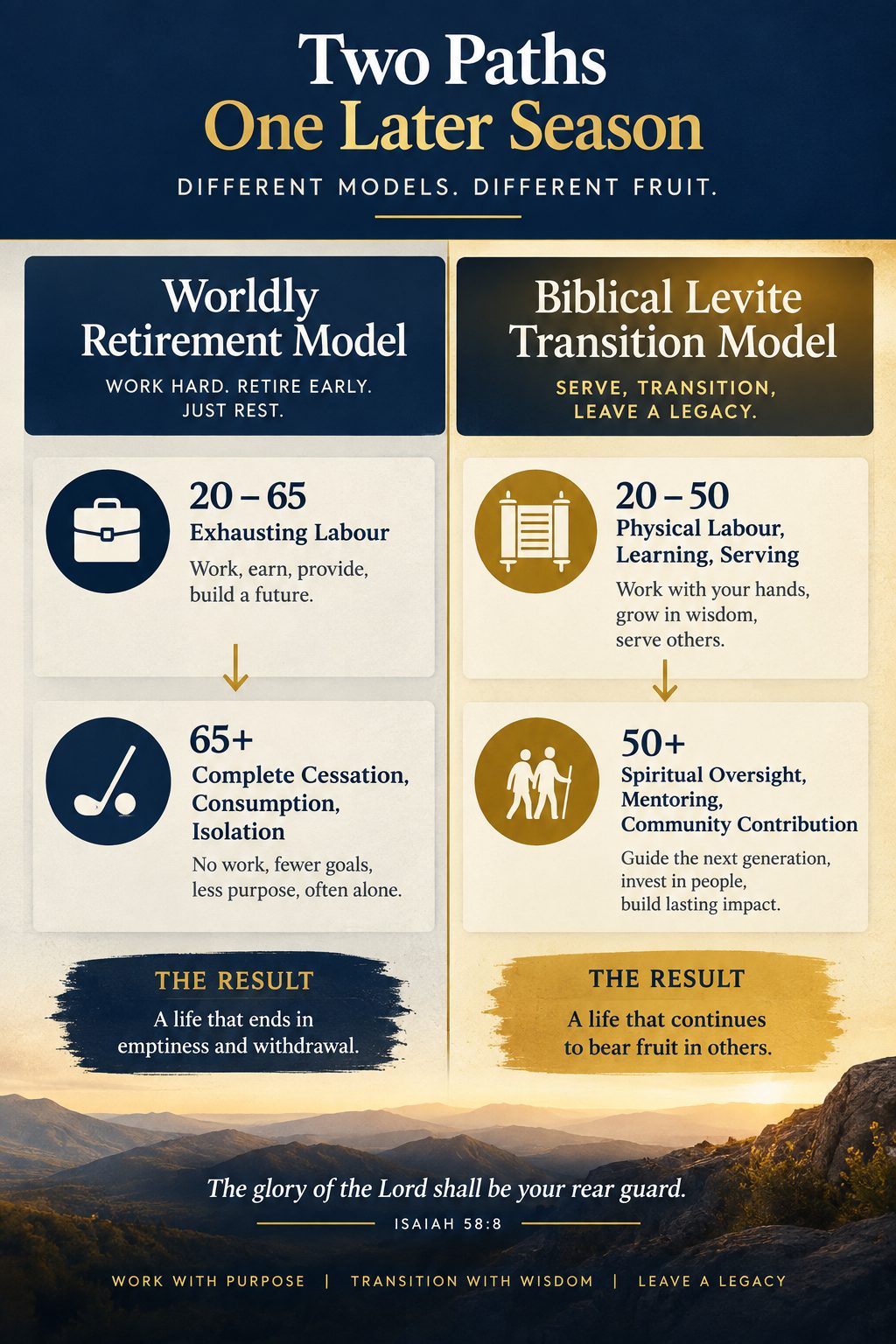
The English word "retirement" sounds like a retreat, a pulling back into safety. But the Hebrew scriptures offer a far richer picture in the book of Numbers, which contains the only biblical instruction regarding an age based transition from work. In Numbers, God commands that Levites at the age of fifty must transition their duties in the tabernacle.
The primary keyword of our study is "retirement". The Hebrew root word used in Numbers 8:25 for "cease" is shub, and its meaning changes everything. Shub does not mean to expire, dissolve, or quit. It means "to return", "to turn back", or "to turn home".
"And from the age of fifty years they shall cease waiting upon the service thereof, and shall serve no more" (Numbers 8:25, KJV)
To the original Hebrew audience, this was not an invitation to passive leisure. It was a transition of responsibility. The Levites were returning to their families and their communities to act as guides, judges, and mentors. They stopped carrying the heavy physical burdens of the tabernacle, but they did not stop serving. They returned to a different, more mature expression of their calling.
They did not retire from their relationship with God, nor did they retire from their covenant responsibilities. They simply shifted their focus from physical labour to spiritual oversight. This is a vital lesson for us today. Your physical strength may decline as you age, but your spiritual authority should increase. You may leave your corporate career, but you never leave your assignment as a priest in the house of God.
The Levite Model of Transitioning Work
Look at the very next verse in that passage. It says the Levites "shall minister with their brethren in the tabernacle of the congregation, to keep the charge, and shall do no service" (Numbers 8:26, KJV). I find this incredibly beautiful. The older Levites did not pack up their tents and move to a resort on the Mediterranean. They shifted from physical labour to spiritual oversight.
They became the guardians of the sanctuary, mentoring the younger men who were now lifting the heavy pillars. They were still active, still needed, and still deeply integrated into the community of faith. Their wisdom was preserved, not discarded. They kept the charge, which meant they guarded the spiritual boundaries of the camp and ensured that the younger generation did not desecrate the holy things of God.
If you are planning for your later years, this Levitical pattern should be your blueprint. We should not save money so we can escape our communities. We save so we can serve them without needing to charge them for our time. When you are learning how to save money on a small income without letting fear control you, the goal is not to amass a fortune for self indulgence. The goal is to buy back your time so you can give it away.
We are preparing to transition our energy, not our character. The Levite at fifty was just as holy, just as committed, and just as responsible to God as he was at twenty five. He simply served in a way that matched his physical capacity. He traded his muscles for his wisdom, and the entire community benefited from the transition.
This is why the modern church is struggling to reach the younger generation. We have allowed our elders to retire and disappear. We have encouraged them to move away to retirement villages, taking decades of spiritual wisdom, financial experience, and marriage maturity with them. We have left our young people to fight their battles alone, while our veterans are busy playing shuffleboard. That is a tragedy, brethren.
The Warning of the Rich Fool
Let us turn our attention to the New Testament, where Jesus addresses the retirement plan of a wealthy man. The parable of the rich fool in Luke 12 is the ultimate critique of the modern retirement dream. This man had a highly successful business year. His fields produced abundantly, so much so that he did not have room to store his harvest. His response was immediate and entirely self-focused.
"And he said, This will I do: I will pull down my barns, and build greater; and there will I bestow all my fruits and my goods. And I will say to my soul, Soul, thou hast much goods laid up for many years; take thine ease, eat, drink, and be merry." (Luke 12:18-19, KJV)
This is exactly what the financial brochures tell us to do today. Build a big enough nest egg, retire early, take your ease, eat, drink, and be merry. But God called this man a fool. The tragedy of the rich fool was not his wealth. It was his assumption that his life belonged to himself and that his resources were meant solely for his comfort.
We explored this deeply when examining what Jesus actually taught about wealth and possessions, and the lesson remains sharp. The rich fool thought his money was a shield against the future. He did not realise that his soul was required of him that very night. He saved for a future he never saw, for a purpose God did not honour. He was rich toward himself, but bankrupt toward God.
Look at the language the rich fool used. He spoke of "my barns", "my fruits", and "my goods". He had completely forgotten that he was a steward, not an owner. He believed that his financial success gave him the right to withdraw from his community and live a life of isolated consumption. He wanted to retire from his responsibilities to others, and that is why God called him a fool.
When you build your retirement plan on the foundation of self-preservation and self-indulgence, you are following the path of the rich fool. You are accumulating resources to fund a lifestyle of ease, while the kingdom of God goes underfunded and the vulnerable are left without support. We must repent of this mindset, fellow believers. Our financial surplus is not a license to quit; it is an assignment to serve.
Why Your Calling Has No Expiry Date
Kingdom citizens, your job is what you get paid for, but your calling is what you were made for. You can retire from your job, but you can never retire from your calling. I look at the great heroes of scripture, and I see a pattern of lifelong engagement. Moses began his greatest leadership assignment at eighty. Caleb was eighty-five when he demanded his mountain and went to war against the giants.
"As yet I am as strong this day as I was in the day that Moses sent me: as my strength was then, even so is my strength now, for war, both to go out, and to come in." (Joshua 14:11, KJV)
Caleb did not want a quiet retirement village. He wanted another battle because he knew his covenant with God was still active. His strength was preserved for the purpose of the kingdom. When we understand this, it changes how we prepare for our careers. If you are developing your talents, you are not just working for a retirement date. You are sharpening tools that you will use to serve God until your last breath.
If you are trying to understand your place in this world, it is worth looking at how to discover what God has called you to do with your work because your professional life is a training ground. We are called to be faithful stewards of our talents, regardless of age. The idea that we should spend our final years doing nothing of eternal consequence is an insult to the gifts God has placed inside us.
Consider the prophetess Anna in the New Testament. She was a widow of about eighty-four years, but she did not spend her days sitting by a pool. She "departed not from the temple, but served God with fastings and prayers night and day" (Luke 2:37, KJV). Her later years were marked by intense, purposeful spiritual activity. She was positioned to see the Messiah because she had not retired from her post.
Your calling does not have a pension plan, and God does not issue gold watches for forty years of service. He expects you to remain faithful until the very end. The form of your service may change as your physical strength wanes, but your commitment to the advancement of His kingdom must never waver. We are called to press toward the mark, not to sit on the sidelines.

The Danger of Spiritual Atrophy in Later Life
There is a very real danger that comes with the pursuit of idle leisure. When you stop using your mind, your body, and your spiritual gifts, they begin to decay. This is a law of creation. What is not used is lost. Spiritual atrophy is the natural consequence of a retirement built on the world's model of self-indulgence.
Many believers spend their working lives dreaming of the day they can finally stop. They believe that once they reach sixty-five, they will have earned the right to be comfortable. But comfort is a terrible master. When you make comfort your primary goal, you begin to shrink. Your world becomes smaller, your concerns become more selfish, and your faith becomes passive.
I have seen this happen to many dear saints. They were active, vibrant, and committed members of their churches while they were working. But once they retired, they began to drift. They travelled more, attended church less, and slowly withdrew from their ministry responsibilities. Within a few years, their spiritual fire had gone cold, and they were consumed by minor health complaints, financial anxieties, and personal boredom.
"They shall still bring forth fruit in old age; they shall be fat and flourishing" (Psalm 92:14, KJV)
This is God's promise for our later years. We are meant to bring forth fruit in old age. We are meant to be flourishing, not fading away. But fruit-bearing requires connection to the vine and active participation in the work of the garden. If you cut yourself off from the work of the kingdom, you will inevitably wither.
The world tells us that the goal of life is to reach a place where we no longer have to do anything we do not want to do. But scripture tells us that the goal of life is to be conformed to the image of Christ, who came not to be ministered unto, but to minister. If you want to stay spiritually healthy, you must keep your hands on the plow. You must refuse the temptation to retire from your responsibilities to the body of Christ.
How to Prepare Financially Without Chasing Idle Leisure
Some believers might think that because retirement is not a biblical concept, we should not save money for the future. They believe that saving for later life is a sign of a lack of faith, or that we should simply live day by day without any regard for tomorrow. But this is another dangerous error. The Bible does not condemn saving; it condemns saving for the wrong reasons.
If you are struggling to build financial breathing room today, you need to understand why you are saving. We are not saving so we can escape our work. We are saving so we can fund our calling. If you are constantly living under financial pressure, you cannot serve others freely. You are forced to make decisions based on survival rather than obedience.
We must learn how to build financial margin so we can buy back our time. If you want to understand how to break the cycle of financial stress, I encourage you to read about why so many believers struggle to get ahead financially and how to build margin. The goal of financial planning is not to fund a twenty-year vacation; it is to fund a twenty-year assignment of unpaid service.
The writer of Proverbs understood this principle deeply. He pointed us to the ant as a model of wise financial preparation. The ant does not prepare because it wants to spend the winter on a beach. It prepares because it knows that a season is coming when it will not be able to gather resources in the same way.
"Go to the ant, thou sluggard; consider her ways, and be wise: Which having no guide, overseer, or ruler, Provideth her meat in the summer, and gathereth her food in the harvest." (Proverbs 6:6-8, KJV)
We must apply this wisdom to our own lives. We must use our high-earning years to build a financial foundation that will support us when our physical strength begins to decline. We must save and invest with a kingdom perspective, ensuring that our resources are positioned to serve others when we are no longer earning a regular salary. I write about this in my guide on what the book of Proverbs teaches about financial wisdom, and the principles are clear: preparation is a sign of faith, not fear.
When you save for the future with this mindset, your financial planning becomes an act of worship. You are not hoarding resources like the rich fool. You are stewarding resources like Joseph, who gathered grain during the years of plenty so he could feed the nations during the years of famine. You are building a storehouse that will fund your ministry in your later years.
Redefining Christian Retirement Planning for Kingdom Impact
So how do we practically transition from the world's model of retirement to a biblical model of kingdom service? It starts with a renewal of our minds. We must stop asking ourselves, "How much money do I need to stop working?" and start asking, "How much money do I need to serve God for free?"
This shift changes everything. It changes how you save, how you invest, and how you view your career. If you are in your thirties or forties, you should not be looking for an early escape from your job. You should be focused on building your skills, increasing your income, and managing your expenses so you can build a massive surplus of capital for the kingdom.
If you want to understand the foundational shift from consumer to steward, you should read what I wrote about the biblical difference between stewardship and ownership. When you realise that everything you have belongs to God, your desire to hoard it for your own comfort disappears. You begin to see your savings as a ministry fund, not a retirement nest egg.
For those who are already approaching sixty-five, this is not a time to panic. It is a time to pivot. Do not look at this transition as the end of your usefulness. Look at it as the beginning of your greatest assignment. Sit down with your spouse, look at your resources, and ask yourselves how you can use your time, your wisdom, and your capital to serve your local church and community.
If you have built a solid financial foundation, you might also want to look into how to invest wisely without falling into greed because your investment returns can directly fund kingdom projects. This is how we make our money work for eternity. We transition our financial assets from instruments of self-preservation to engines of gospel advancement.
Here are some practical ways to transition your later years for kingdom impact:
Become a mentor to younger believers: Offer your professional experience, your marriage wisdom, and your spiritual insights to the next generation without charging them.
Volunteer for ministries that require mature leadership: Many churches and missions organisations are desperate for experienced administrators, trustees, and counsellors who can work without needing a salary.
Use your home for hospitality: Open your doors to young families, single believers, and missionaries who need a safe place to rest and receive counsel.
Fund kingdom projects with your surplus: If God has blessed you with financial abundance, use your later years to actively distribute that wealth where it is needed most, rather than leaving it to sit in a bank account.
This is the biblical view of retirement. It is not a retreat into self-indulgence; it is an advance into spiritual maturity and community contribution. It is a life lived in full alignment with the purposes of God, from your first breath to your last. May God grant you the wisdom and the courage to build your financial future on this eternal foundation.
Where To Read Next
If you want to dive deeper into how to manage your resources biblically and build a life of faithful kingdom stewardship, I highly recommend starting with these resources:
Is Investing Biblical for Christians? How to Tell Wise Investing From Greed
Frequently Asked Questions
Is it a sin for a Christian to retire?
No, it is not a sin to leave a commercial job or retire from a secular career, especially if physical limitations make the work difficult. However, it is a spiritual mistake to retire from your divine calling and spend your final years in pure self-indulgence. The biblical model is to transition your energy from commercial labour to spiritual service and mentoring.
What does the Bible say about saving for old age?
The Bible supports wise preparation for the future, as seen in the model of the ant in Proverbs 6:6-8 and Joseph's storehouses in Genesis. Saving for old age is wise stewardship, provided your goal is to avoid becoming a burden to others and to free up your time to serve God. It becomes sinful when it turns into greedy hoarding, like the rich fool in Luke 12.
How can I serve God in retirement if my health is failing?
If your physical health is failing, your ministry shifts to the spiritual realm. You can become a powerful prayer warrior, interceding for your church, your family, and global missions. You can also offer wisdom, encouragement, and counsel to younger believers through phone calls, letters, or quiet visits in your home. Your spiritual value is never tied to your physical strength.
Should Christians rely on state pensions or Social Security?
There is nothing unbiblical about receiving a pension or social security benefits that you have contributed to throughout your working life. These systems can be part of God's provision for your needs. However, your ultimate trust must remain in the Lord as your provider, and you should use those resources to fund a life of continued stewardship and kingdom service.
Found this helpful? Share it with someone who needs it.