
You have been told that managing money is a secular skill you bring to your spiritual life and that money is the root of all evil. You think the Bible is for your soul and the spreadsheet is for your bank account, leaving your duty at the feet of others. But that divide is exactly why so many believers feel a constant, nagging tension between their faith and their finances.
The truth is that the Bible has more to say about money than almost any other topic because money is the primary competitor for your heart. If you and i want to know the biblical principles of money management, we have to start by realising that God is not interested in our budget nearly as much as He is interested in who you are becoming while you manage it.
Biblical money management is the practice of managing God's resources according to God's instructions to achieve God's purposes. It begins with the absolute acknowledgement that you own nothing and God owns everything. Once you shift from the mindset of an "owner" to the mindset of a "manager," the pressure of provision lifts and is replaced by the responsibility of faithfulness.
I have spent years studying how Scripture frames our interaction with wealth, and I can tell you that most of our financial stress comes from ignoring these foundations. We try to apply "tips" without adopting the "truth." In this guide, I want to walk you through the core pillars that every Christian must apply to move from financial chaos to Kingdom clarity. This is a vital part of my broader teaching on Practical Money Management for Christians: A Biblical Guide to Budgeting, Saving, Debt and Stewardship, which serves as the anchor for everything we discuss here.
The Principle of Absolute Ownership
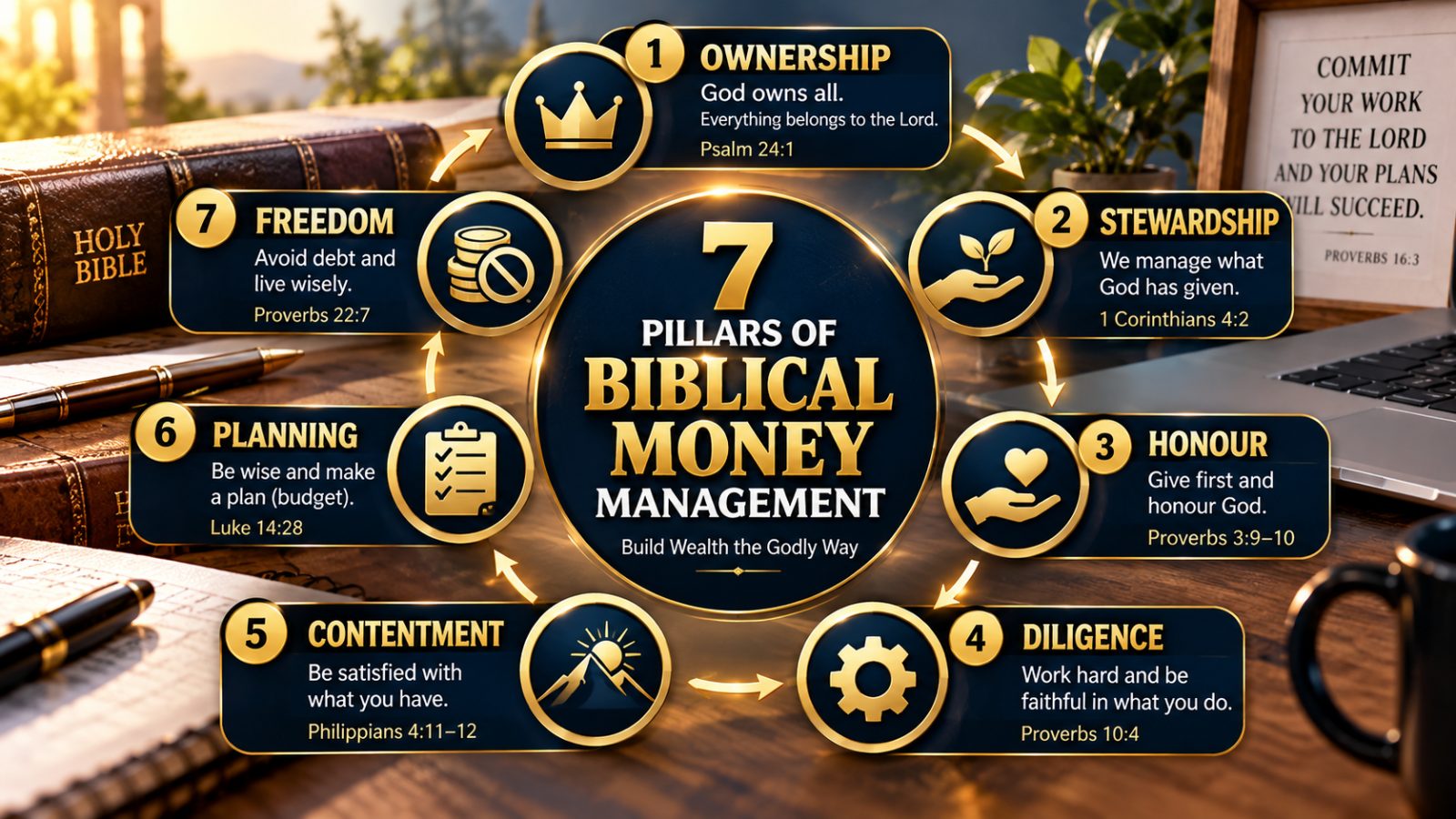
The first and most important principle is that God owns it all. This is not a nice religious sentiment; it is a legal reality in the Kingdom of Heaven. "The earth is the LORD'S, and the fulness thereof; the world, and they that dwell therein" (Psalm 24:1, KJV). If He owns the earth and everything in it, that includes your house, your car, your savings account, and your next paycheque.
Most of us live as if we are the owners and God is a consultant we occasionally tip 10% to keep the "blessing" coming. That is a pagan mindset dressed in Christian vocabulary. When you believe you are the owner, you carry the full weight of worry. If the economy dips, you panic because your "stuff" is at risk. But when you realise you are a manager, your primary concern is simply: "What does the Owner want me to do with His money today?"
I remember when I first grasped this. I was looking at a bill I couldn't pay and felt the weight of the world on my shoulders. Then it dawned on me: this isn't my bill, it's God's bill because this isn't my life, it's His. My job was to be faithful with what He put in my hand, not to manufacture what wasn't there yet. That change of perspective changes everything about how you pray and how you plan.
The Hidden Meaning of Management
The English word "management" can feel a bit clinical, like something you do in a corporate office. But the New Testament uses a word that carries a much deeper weight. The Greek word is oikonomos. It is a compound of oikos, meaning "house," and nomos, meaning "law" or "rule." An oikonomos was the person who governed the household according to the owner's law.
"Moreover it is required in stewards, that a man be found faithful" (1 Corinthians 4:2, KJV). In the original context, the oikonomos had total authority over the master's resources, but zero ownership. He didn't get to decide what the goals were; he simply executed the master's will. When we talk about biblical principles of money management, we are talking about oikonomia,the law of the house. You are not managing your salary based on your preferences. You are managing His resources based on His laws.
This reframes every purchase and how you spend the money. It's no longer about whether you can "afford" something, instead its about whether the Master authorised that use of His capital. God is not looking for financial geniuses; He is looking for people who are zeteo,the Greek word for "required" in that verse, which means "sought out" or "demanded." God is actively looking for managers He can trust with more. If you aren't faithful with the little, the "law of the house" says you won't be trusted with the much.
The Principle of Firstfruits and Honour
You cannot manage money biblically if God gets the leftovers. And one of the most neglected biblical principles of money management is the principle of the firstfruits. "Honour the LORD with thy substance, and with the firstfruits of all thine increase" (Proverbs 3:9, KJV). Honour is not a feeling; it is a financial priority, or any outcome from the work of your hands.
Most Christians pay their rent, their utilities, their Netflix subscription, and their grocery bill, and then they see if there is anything left for the Kingdom. That is not stewardship; that is tipping. The principle of the firstfruits means that before a single penny goes to your needs, a portion goes to God's house. This is an act of worship that declares God is your provider, not your employer.
When you give first, you are inviting God into the remaining 90%. I have found that 90% with God's blessing goes much further than 100% without it. If you struggle with this, I recommend reading my deep dive on should you tithe on gross or net income to understand the heart behind those numbers. It isn't about legalism; it's about alignment. You are aligning your heart with the Provider's heart from the very start of the month.
The Principle of Diligence and Hard Work
We often want the "miracle" of provision while ignoring the "mandate" of work. Scripture is incredibly blunt about this: "He becometh poor that dealeth with a slack hand: but the hand of the diligent maketh rich" (Proverbs 10:4, KJV). God provides the seed, but He expects you to till the ground. One of the core biblical principles of money management is simply being a high capacity, and hard working individual.
In 2026, we have so many "get rich quick" schemes and "passive income" promises that bypass the biblical requirement for labour. While there is nothing wrong with making your money work for you, you must never lose the value of honest toil. Wealth that is "gotten by vanity shall be diminished: but he that gathereth by labour shall increase" (Proverbs 13:11, KJV). The Hebrew word for "labour" here implies steady, consistent effort over time.
If you are struggling to make ends meet, the first place to look is your level of diligence. Are you becoming more valuable in the marketplace? Are you working "heartily, as to the Lord, and not unto men" (Colossians 3:23, KJV)? When you work with excellence, you are representing the Kingdom. Excellence is a form of evangelism, and it is usually the vehicle God uses to bring increase into your life.

The Principle of Contentment vs. Consumption
The world's financial system is built on discontentment because it requires you to feel inadequate so that you will buy something to feel better. But the Bible offers a different path: "Let your conversation be without covetousness; and be content with such things as ye have: for he hath said, I will never leave thee, nor forsake thee" (Hebrews 13:5, KJV). Contentment is the greatest "money saver" in existence.
If you aren't content with what you have, you will never be content with what you want. Consumption is a hole that can never be filled. I have seen people earning six figures who are more stressed than those earning a fraction of that, simply because their "wants" always outpace their "wins." They are trapped in a cycle of upgrading their lifestyle every time they get a raise.
Contentment doesn't mean a lack of ambition. It means your joy is not tied to your net worth. It means you can manage a small income with the same peace as a large one. When you are content, you stop making impulsive purchases to impress people you don't even know. This is how you start to break the cycle of living paycheque to paycheque. You decide that God's presence is more valuable than a new possession.
The Principle of Planning and Counting the Cost
Today we have many Christians who think that "trusting God" means being unorganised. They think a budget is a lack of faith. But Jesus Himself taught the principle of planning: "For which of you, intending to build a tower, sitteth not down first, and counteth the cost, whether he have sufficient to finish it?" (Luke 14:28, KJV). If Jesus used a financial illustration to teach about discipleship, then clearly, counting the cost is a spiritual discipline.
A budget is simply you telling your money where to go instead of wondering where it went. It is the practical application of stewardship. If you don't have a plan for the Master's money, you are being a "slothful servant." You need to know the state of your flocks (Proverbs 27:23). In modern terms, that means you need to know your balance, your expenses, and your debts.
If you don't know where to start, I've put together a biblical step-by-step guide to creating a Christian budget. It isn't about restriction; it's about permission. A budget gives you permission to spend on what matters and the power to say no to what doesn't. It is the "nomos" (law) you apply to your "oikos" (house).
The Principle of Debt Avoidance and Freedom
The Bible does not call debt a sin, but it does call it a form of slavery. "The rich ruleth over the poor, and the borrower is servant to the lender" (Proverbs 22:7, KJV). When you are in debt, you have signed away your future freedom to pay for your past desires. You are no longer fully free to follow the leading of the Holy Spirit because you are legally bound to a bank.
Biblical money management seeks to minimize and eliminate debt as quickly as possible. Every interest payment you make is Kingdom capital going into the pockets of lenders rather than into the work of the Gospel or the needs of your family. I have seen so many believers miss out on God's "sudden" opportunities because they were "tied down" by monthly repayments.
If you are currently struggling with this, please know there is a way out. I have written extensively on how to get out of debt as a Christian without stopping giving. The goal is not just to be "debt free," but to be "set free" to serve God with every resource at your disposal. Debt is a weight; stewardship is a wing.
The Principle of Saving and Foresight
There is a fine line between hoarding and saving, and biblical wisdom knows exactly where it is. Hoarding is driven by fear; saving is driven by foresight. The ant is praised in Proverbs 6:6-8 because she "provideth her meat in the summer, and gathereth her food in the harvest." She prepares for a season she cannot see while she is in a season of plenty.
Managing money biblically means acknowledging that "rainy days" are part of a fallen world. Joseph saved 20% of Egypt's grain during the years of plenty to prepare for the years of famine. He didn't lack faith; he had great faith in God's warning. If you spend everything you earn, you are being "foolish" according to Proverbs 21:20: "There is treasure to be desired and oil in the dwelling of the wise; but a foolish man spendeth it up."
I encourage every Kingdom citizen to work toward having a "storehouse." Whether it's a small amount to start or a full emergency fund, having savings allows you to be a blessing to others when a crisis hits. You cannot help someone out of a pit if you are in one yourself.
The Principle of Multiplication and Increase
God is not a fan of stagnation. In the Parable of the Talents (Matthew 25), the master was not pleased with the servant who simply "kept" the money. He was pleased with the servants who "traded" and multiplied it. One of the most misunderstood biblical principles of money management is that God expects a return on His investment in you.
This is where wise investing comes in. If you have been taught that investing is "worldly," you need to reread the words of Jesus. The master tells the slothful servant he should have at least put the money to the "exchangers" so it could earn interest. We are called to be productive with what we have been given. This isn't about greed; it's about stewardship of the time value of money.
Whether you are growing a business or investing for the future, your motive should be to increase your capacity to fund the Kingdom. If you increase your wealth but don't increase your giving, you aren't a steward; you're a reservoir that has become a swamp. True biblical increase is a river,it flows in so it can flow out.
Applying These Principles in Your Daily Life
Knowing these principles is one thing and applying them is another. Biblical money management is a daily walk of faith. It requires you to constantly check your heart for the "love of money," which is the root of all evil (1 Timothy 6:10, KJV). Notice it doesn't say money is the root, but the love of it.
Start small. If you haven't been tithed, start there. If you don't have a budget, create one this weekend. If you are drowning in debt, stop borrowing today. These principles are not a magic wand that will make you a millionaire overnight, but they are a solid foundation that will give you peace that passes all understanding.
I am praying for you as you take these steps. I know it isn't easy to go against the current of a culture that screams "spend, spend, spend." But you aren't a citizen of that culture. You are a Kingdom citizen, and your Father is the King who owns the cattle on a thousand hills. Trust His laws, follow His lead, and watch how He manages His resources through your hands.
Where To Read Next
What Does Proverbs Say About Money And The Financial Wisdom Most Believers Never Apply?
How to Create a Christian Budget When Money Is Tight: A Biblical Step by Step Guide
How to Get Out of Debt as a Christian Without Stopping Giving: A Biblical Approach
Is Investing Biblical for Christians? How to Tell Wise Investing From Greed
Frequently Asked Questions
How do I start applying biblical principles of money management when I'm already struggling?
You start by shifting your mindset from ownership to stewardship and creating a simple plan for every penny you currently have. Even if you are in a deficit, acknowledging God's ownership and being honest about your numbers is the first step toward breakthrough. "He that is faithful in that which is least is faithful also in much" (Luke 16:10, KJV).
Is it a sin to not tithe 10% as a Christian?
The New Testament emphasizes the heart of the giver, but the principle of the firstfruits suggests that we should give our best to God first. While we are under grace, the 10% tithe remains a powerful biblical floor for training our hearts in generosity and honouring God as our primary provider. "Every man according as he purposeth in his heart, so let him give; not grudgingly, or of necessity: for God loveth a cheerful giver" (2 Corinthians 9:7, KJV).
What does the Bible say about saving money for the future?
The Bible commends saving as an act of wisdom and foresight, provided it is not done out of fear or a desire to hoard wealth. Like the ant in Proverbs or Joseph in Egypt, we are encouraged to gather during seasons of plenty to provide for future needs and crises. "There is treasure to be desired and oil in the dwelling of the wise; but a foolish man spendeth it up" (Proverbs 21:20, KJV).
Should Christians use credit cards or take out loans?
The Bible warns that the borrower becomes a servant to the lender, so Christians should approach debt with extreme caution and a plan for rapid repayment. While not explicitly called a sin, debt often limits your ability to be generous and follow God's leading, so avoiding it is the wisest path to financial freedom. "Owe no man any thing, but to love one another" (Romans 13:8, KJV).
Can I be a good Christian and still want to be wealthy?
It is not wrong to desire increase, provided your motive is to fund the Kingdom and provide for others rather than to find security in riches. Wealth is a tool for stewardship, but we must constantly guard our hearts against the love of money and the pride that often accompanies success. "But thou shalt remember the LORD thy God: for it is he that giveth thee power to get wealth" (Deuteronomy 8:18, KJV).
Found this helpful? Share it with someone who needs it.