I was sitting on the floor the other day, just watching my little girls play. They were chasing each other around the living room, laughing, completely unaware of the weight of the world. To them, life is just one long game of tag. They think it will always be like this. They do not know that one day, I will not be here to catch them when they fall or fix their toys. It hit me like a physical weight in my chest. What exactly am I leaving for them?
I am not just talking about the house or the bank account. I am talking about the truth, the culture of our home, and the character they will need to survive when my voice is gone. Will they grow up to be women who know how to build, or will they just spend what I struggled to save? I realised that if I do not teach them now, I am failing them later. Survival is not an inheritance, and just getting by is not a legacy.
I learned the hard way that true legacy outlasts the owner. It is not about whether you are physically in the room. It is about whether you impacted their lives so deeply that they do not need you there to keep building what you started. You look at your children sitting at the kitchen table, and that quiet ache begins. You want more for them than the struggle you went through. You want them to stand on your shoulders, not start from the dirt.
Most of us think generational wealth happens by accident if we just pray hard enough and work a job for forty years. But the truth is, God does not drop inheritances from the sky into the hands of the unprepared. If you and I want to shift our family tree, we have to look past our own retirement and start building for people we might never even meet. You are holding a baton. The only question is whether you are going to pass it or drop it.
The Hebrew Meaning of Inheritance and Why It Matters
When we hear the word inheritance, we usually think of a windfall. We think of a surprise cheque that shows up after a funeral. But the Bible sees it differently. In the Hebrew text, the word used for inheritance in Proverbs 13:22 is nachalah. This is a powerful word. It does not just mean cash. It means a possession, a portion, or a permanent property passed down through a covenant line.
A nachalah was something that stayed in the family forever. It was their stake in the land, their foundation. When God gave the tribes of Israel their inheritance, He was giving them the means to produce wealth for generations. It was an established, functioning estate. It was meant to secure the future of the entire household, not just give one person a holiday.
Then you have the second half of that famous verse: "and the wealth of the sinner is laid up for the just" (Proverbs 13:22, KJV). The word for wealth here is chayil. This is the same word used to describe the virtuous woman in Proverbs 31. It means strength, efficiency, might, and substance. It is not just coins in a bag. It is the capacity to create results. A godly inheritance is the transfer of chayil , the strength and the means to thrive , down through your bloodline.
When you understand these two words, your whole approach to money shifts. You stop asking what you can buy this weekend. You start asking what foundation you are pouring for your grandchildren. As I explain in my post on Kingdom money principles from the Bible, God's economic system is always intergenerational. He is the God of Abraham, Isaac, and Jacob. His blessing is designed to flow like a river, not pool in a puddle around you.
You are not just a consumer. You are a steward of a family estate that is supposed to grow over time. If you only think about your own comfort, you are cutting off the flow of the nachalah. You have to see yourself as a link in a chain. Your job is to make sure that link is strong enough to carry the weight of the next generation's dreams.
Why Most Christian Inheritances Disappear So Quickly
There is a sad reality we have to face. Statistics show that most inherited wealth is gone by the second generation, and almost all of it is vanished by the third. Parents work sixty hours a week, pay off the mortgage, build a portfolio, and leave it all behind. Within ten years, the house is sold, the money is spent on cars and clothes, and the grandchildren are right back at zero. It is a tragedy that happens every single day.
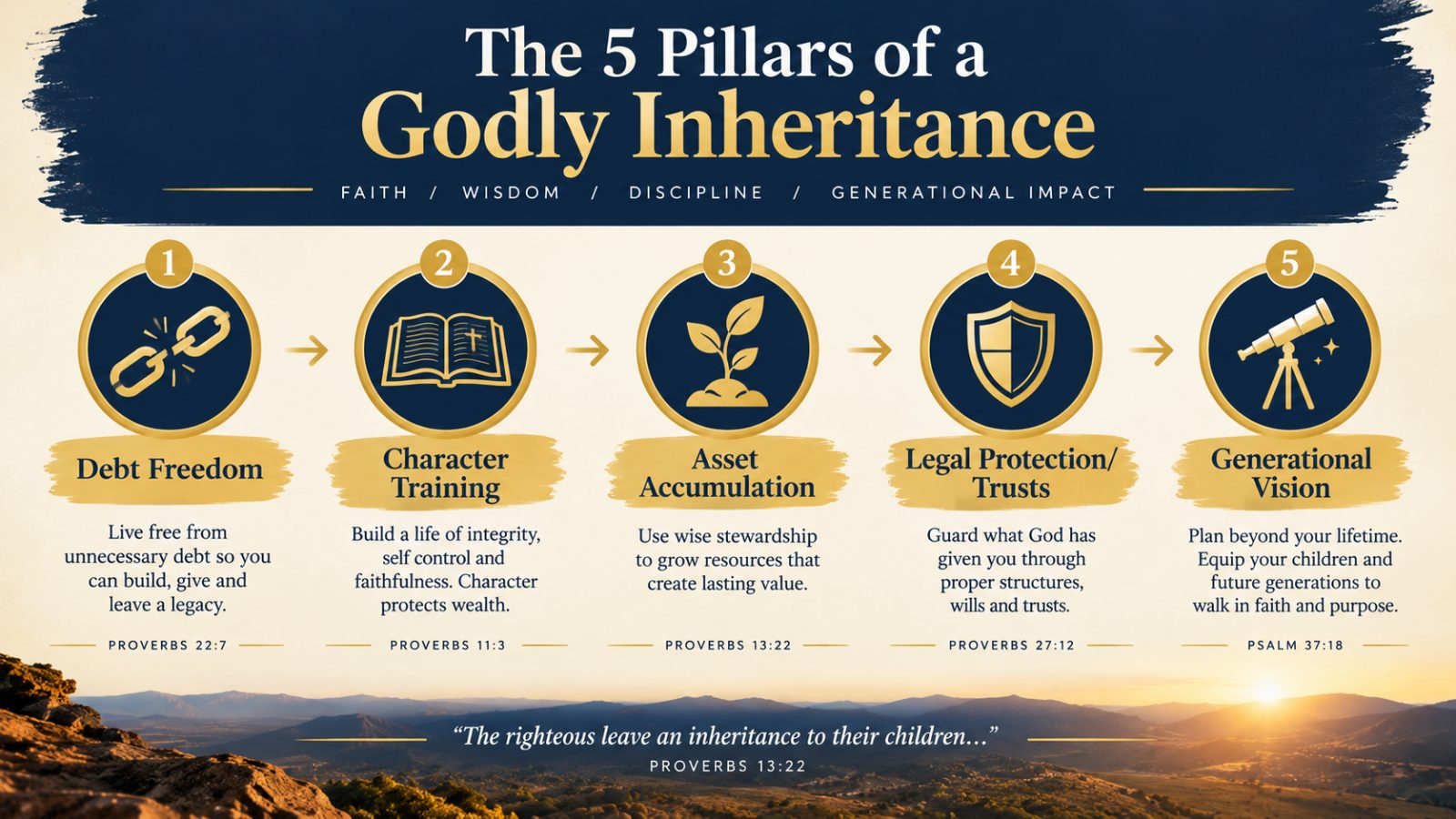
Why does this happen? It is because we focus entirely on transferring the asset while completely ignoring the character needed to keep it. If you give a Ferrari to someone who does not know how to drive, you have not given them a gift. You have given them a death trap. In the same way, if you hand a large sum of money to a child who has never been taught stewardship, you are funding their destruction.
The Word warns us about this. "An inheritance may be gotten hastily at the beginning; but the end thereof shall not be blessed" (Proverbs 20:21, KJV). Wealth that is received without the discipline to manage it will always collapse. You cannot outsource the financial education of your children to a school system that wants them to be lifelong debtors. You have to be the one to open the bank statements and show them how the world works.
I remember when I first started learning about this. I realized I was praying for God to bless my children, but I wasn't teaching them how to handle a single pound. I was doing all the work and giving them all the fruit without showing them how to plant the seeds. That is not love. That is sabotage. We have to teach them the difference between an asset that feeds them and a liability that eats them.

Is It Worldly to Leave a Large Financial Estate?
I have met many believers who think that saving for the future is a sign of a lack of faith. They say things like, "The Lord is coming back soon," or "We should just give it all away and trust God." While that sounds spiritual, it actually contradicts the plain teaching of Scripture. You are not being more holy by leaving your children with nothing. You are actually neglecting a fundamental duty.
The Apostle Paul made this very clear. "But if any provide not for his own, and specially for those of his own house, he hath denied the faith, and is worse than an infidel" (1 Timothy 5:8, KJV). That is some of the harshest language in the entire New Testament. Providing for your house does not just mean buying groceries today. It means securing their future. Paul also said, "for the children ought not to lay up for the parents, but the parents for the children" (2 Corinthians 12:14, KJV).
God expects the flow of resources to go from the older generation to the younger. When you build an estate, you are echoing the heart of God. Think about it. He did not put Adam and Eve in a desert and tell them to figure it out. He prepared a garden first. He put the gold in the ground and the fruit on the trees before they even arrived. Preparing a place for those who come after you is a divine principle.
If you are struggling with the idea that wealth is bad, you might need to look at why so many believers struggle with money in the first place. Often, it is a poverty mindset masquerading as piety. True faith is not being broke. True faith is having the resources to do what God called you to do and making sure your children can do the same. Wealth is a tool for the assignment, not a trophy for your ego.
The Abrahamic Model of Generational Wealth Transfer
If we want to see how this works in practice, we have to look at Abraham. He did not just leave Isaac some sheep and goats. He left him a covenant, a reputation, and a massive functioning business. Abraham was "very rich in cattle, in silver, and in gold" (Genesis 13:2, KJV). But more importantly, he was a man who commanded his household to keep the way of the Lord.
Abraham understood that wealth without the Word is a curse. He spent years training Isaac. By the time Abraham passed away, Isaac knew how to dig wells, how to manage servants, and how to hear the voice of God. He didn't just inherit money; he inherited a system of living. This is why the blessing of Abraham is still being talked about thousands of years later. It was built on a solid foundation of character and competence.
You can see this pattern throughout the lives of the patriarchs. I talk more about this in my study on how Abraham, Isaac, and Jacob built generational wealth. They didn't just save cash. They built family institutions. They understood that their work was about more than their own lifetime. They were building a nation. When you start seeing your family as a "nation" in the making, you stop making small, short-term decisions.
You have to ask yourself: am I building a business that my children can run? Am I buying land that they can build on? Or am I just working a job that disappears the moment I stop showing up? The Abrahamic model requires you to think in decades, not months. It requires you to be intentional about what you are passing down. It is about the name, the values, and the assets, all working together to glorify God.
Practical Steps to Build Your Family's Nachalah
Good intentions do not pay for university or fund a mission trip. You need a plan. If you want to leave a godly inheritance, you have to move from wishing to execution. It starts with the boring stuff that most people want to avoid. But this is where the nachalah is actually built. You cannot build a legacy on top of a mountain of consumer debt.
The first step is to kill the thieves. High-interest debt is a thief that steals your children's future to pay for your today. "The rich ruleth over the poor, and the borrower is servant to the lender" (Proverbs 22:7, KJV). You cannot leave an inheritance if you are a servant to a bank. You have to get aggressive about clearing those credit cards and loans so that your capital can start working for you instead of against you.
Next, you have to focus on income-generating assets. A house you live in is a blessing, but it is not an income-generating asset unless you sell it or rent it. You need things that produce cash flow without you being there. This could be real estate, a business, or dividend-paying stocks. The goal is to create a pool of resources that grows on its own. This is how you ensure that the chayil continues after you are gone.
Establish a family trust. This protects your assets from being wasted or lost in legal battles. It ensures that the money is used for the purposes you intended, like education or starting a business.
Use life insurance as a tool. A good policy can create an instant inheritance that provides a safety net for your family. It is one of the simplest ways to obey the command to "lay up" for your children.
Invest in their education and skills. The greatest asset you can leave is a mind that knows how to create value. I have written before about teaching children about money the biblical way, and it is the best investment you will ever make.
Buy land. There is something biblical about family land. It is a tangible nachalah that provides security and a sense of belonging.
Teaching Your Children to Be Stewards, Not Just Heirs
There is a massive difference between an heir and a steward. An heir thinks about what they are going to get. A steward thinks about what they are going to manage. If your children have an "heir" mindset, they will spend the inheritance. If they have a "steward" mindset, they will grow it. This is why you have to involve them in the process while you are still alive.
I started bringing my daughters into my financial world in small ways. We talk about giving, we talk about saving, and we talk about why we don't buy everything we see. You have to let them see the "how" behind the wealth. If they only see the result but never the process, they will never respect the money. They need to see the sacrifice, the planning, and the prayer that goes into every pound.
Remember the parable of the talents. The master didn't give the servants money to spend; he gave it to them to trade. "And so he that had received five talents came and brought other five talents, saying, Lord, thou deliveredst unto me five talents: behold, I have gained beside them five talents more" (Matthew 25:20, KJV). Your children need to know that the inheritance is "seed" for the future, not "bread" for today. If they eat the seed, the harvest stops with them.
This is where many Christian parents fail. We are so busy protecting our kids from the world that we don't prepare them to manage it. You have to give them opportunities to fail with small amounts of money now so they don't fail with large amounts later. Let them manage a budget for a family dinner. Let them see how much the electricity bill costs. Education is the bridge between a windfall and a legacy.
The Spiritual Inheritance: The Foundation of Everything
I would be lying to you if I said money was the most important thing you can leave. It isn't. If you leave your children a million pounds but they don't know Jesus, you have failed them. A financial inheritance without a spiritual one is like building a skyscraper on sand. It might look good for a while, but it won't stand the storm. The primary nachalah must be the Word of God.
King David is a great example of this. Before he died, he gave Solomon the plans and the gold for the Temple. But look at what he said to him: "And thou, Solomon my son, know thou the God of thy father, and serve him with a perfect heart and with a willing mind" (1 Chronicles 28:9, KJV). David knew that all the gold in Israel wouldn't save Solomon if his heart wasn't right with God. The spiritual foundation is what gives the financial inheritance its purpose.
You have to leave them a legacy of prayer. They should remember the sound of your voice interceding for them. They should see you tithing and giving generously, even when it’s hard. They should know that your wealth came from the hand of God, not just your own cleverness. When they see your faith in action, they learn how to trust God for their own provision. That is a wealth that no bank can ever freeze.
We often talk about what Proverbs says about money, but we forget that it starts with the fear of the Lord. If you teach them to fear God, they will naturally handle money with wisdom. If you don't, no amount of financial planning will save them. You are building a house of faith where money is just one of the rooms. Make sure the foundation is Christ.

Leaving a Name That Opens Doors
You have to think about your reputation. "A good name is rather to be chosen than great riches" (Proverbs 22:1, KJV). Your name is part of the inheritance. If you spend your life cutting corners, lying in business, and being greedy, you are leaving a "stink" on your name that your children will have to wash off. But if you live with integrity, your name will open doors for them long after you are gone.
I want my girls to be able to walk into a room and have people say, "I knew your father. He was a man of his word. He was a man who loved God." That kind of social capital is worth more than a huge inheritance tax bill. It gives them a head start in life. It gives them a network of people who trust them because they trusted you. Your character is the silent partner in their future success.
Building a godly inheritance is not about being "rich." It is about being faithful. It is about making sure that the resources God entrusted to you are used to advance His Kingdom through your children and their children. It is hard work. It requires saying "no" to yourself so you can say "yes" to them. But when you see your family line walking in the blessing of God, you will know it was worth every sacrifice.
Where To Read Next
If you are ready to take this seriously, you need to look at the foundations. Here are the best places to start your journey toward a generational legacy.
How Did Abraham, Isaac, and Jacob Build Generational Wealth? What the Bible Teaches
What Does Proverbs Say About Money And The Financial Wisdom Most Believers Never Apply?
Frequently Asked Questions
Is it wrong to leave more to one child than another?
The Bible does not give a strict rule that every child must receive an identical amount, but it does warn against favouritism that causes strife. In the Old Testament, the firstborn often received a double portion to carry the responsibility of the family estate. You should pray for wisdom to distribute your estate in a way that supports each child's calling and maintains family peace.
What if I don't have much to leave my children right now?
An inheritance is built over time, not overnight. Start by leaving them a legacy of zero debt and a solid spiritual foundation. Even if you only leave a small amount of savings, the wisdom and character you teach them will be worth more than millions. Focus on being faithful with the little you have today, and God can multiply it for the future.
Should I tell my children how much they will inherit?
It is generally wise to have open conversations about your family's financial plan as they become mature enough to understand. You don't necessarily have to give them exact figures, but they should understand the responsibilities that come with the estate. This prevents surprises and allows you to mentor them in stewardship while you are still here.
Is life insurance a biblical way to leave an inheritance?
Yes, life insurance is a practical tool that allows you to "lay up" for your children as the Word commands. It is a way of providing a safety net and an immediate estate in the event of your passing. When used with a right heart, it is a responsible act of stewardship that protects your family from financial hardship.
How do I prevent my children from wasting their inheritance?
The best protection is character training and legal structures like trusts. A trust can specify that funds are only released for certain purposes, such as education, a home deposit, or at a specific age. However, no legal document can replace the need to teach your children the fear of the Lord and the principles of biblical management.
Found this helpful? Share it with someone who needs it.