
God does not scale a mess. He scales a system. I have seen so many gifted Christian entrepreneurs pray for growth while their current operations are held together by nothing but prayer and caffeine. They want the harvest of Joseph, but they are still managing their business like a backyard garden. If you are asking God to expand your territory, you must first ask yourself if your current tent stakes can actually hold the weight of what is coming.
The story of Joseph is often taught as a lesson in personal resilience or forgiveness, but for those of us building enterprises, it is the ultimate masterclass in administrative scaling. Joseph did not just survive a famine; he built a national agricultural conglomerate that eventually owned the entire economy of Egypt. To understand how he did it, we have to look past the "coat of many colours" and look at the "officers" and "storehouses" he established.
In my own walk, I had to learn that my "anointing" was not a substitute for an "accounting system." I used to think that being "led by the Spirit" meant being spontaneous and unorganised, but the more I study the Word, the more I realise that the Spirit of God is a Spirit of order. If you want to move from a small operation to a scalable enterprise, you need to understand the foundation of stewardship.
The word "stewardship" in the New Testament comes from the Greek word oikonomia. It is where we get our English word "economy." It literally means "household management." When Paul says in 1 Corinthians 4:2 (KJV) that it is required in stewards to be found faithful, he is talking about the oikonomos , the manager of the estate. Joseph was the ultimate oikonomos, first for Potiphar, then for the keeper of the prison, and finally for Pharaoh himself.
Oikonomia is about the rules and systems that govern a house so it can thrive. If you do not have rules for how your money moves, how your time is spent, and how your team operates, you are not a steward; you are just a worker. Scaling is the process of turning your personal effort into a governing system that can grow without breaking.
What Joseph Knew About Systems That Most Entrepreneurs Miss
Most entrepreneurs are "gatherers" by nature. We love the hunt, the sale, and the immediate result. But Joseph knew that gathering grain was only 10% of the job; the other 90% was the system that protected and distributed that grain. When Pharaoh had his dream, Joseph did not just interpret it; he immediately proposed a management framework.
I remember when I first started my own business, I was doing everything myself. I was the salesperson, the bookkeeper, and the customer service repand at the same time was the creating content and planning. I thought I was being "diligent," but I was actually being a bottleneck. I was preventing God from giving me more because I had no place to put it. I had to learn that building income as a Christian and turning your gifts into work requires you to build a container before you ask for the wine.
Joseph told Pharaoh, "Let Pharaoh do this, and let him appoint officers over the land, and take up the fifth part of the land of Egypt in the seven plenteous years" (Genesis 41:34, KJV). Notice the first thing he suggests: appointing officers. Scaling requires you to stop being the only person with a brain in your business.
"And let them gather all the food of those good years that come, and lay up corn under the hand of Pharaoh, and let them keep food in the cities." (Genesis 41:35, KJV)
If your business cannot run for a week without you answering every WhatsApp message or approving every tiny expense, you do not have a scalable business. You have a high pressure job that you happen to own. Joseph’s strategy was to build a layer of middle management , the "officers" , who could execute the plan in every province simultaneously.

The Power of the Fifth Part: Strategic Resource Allocation
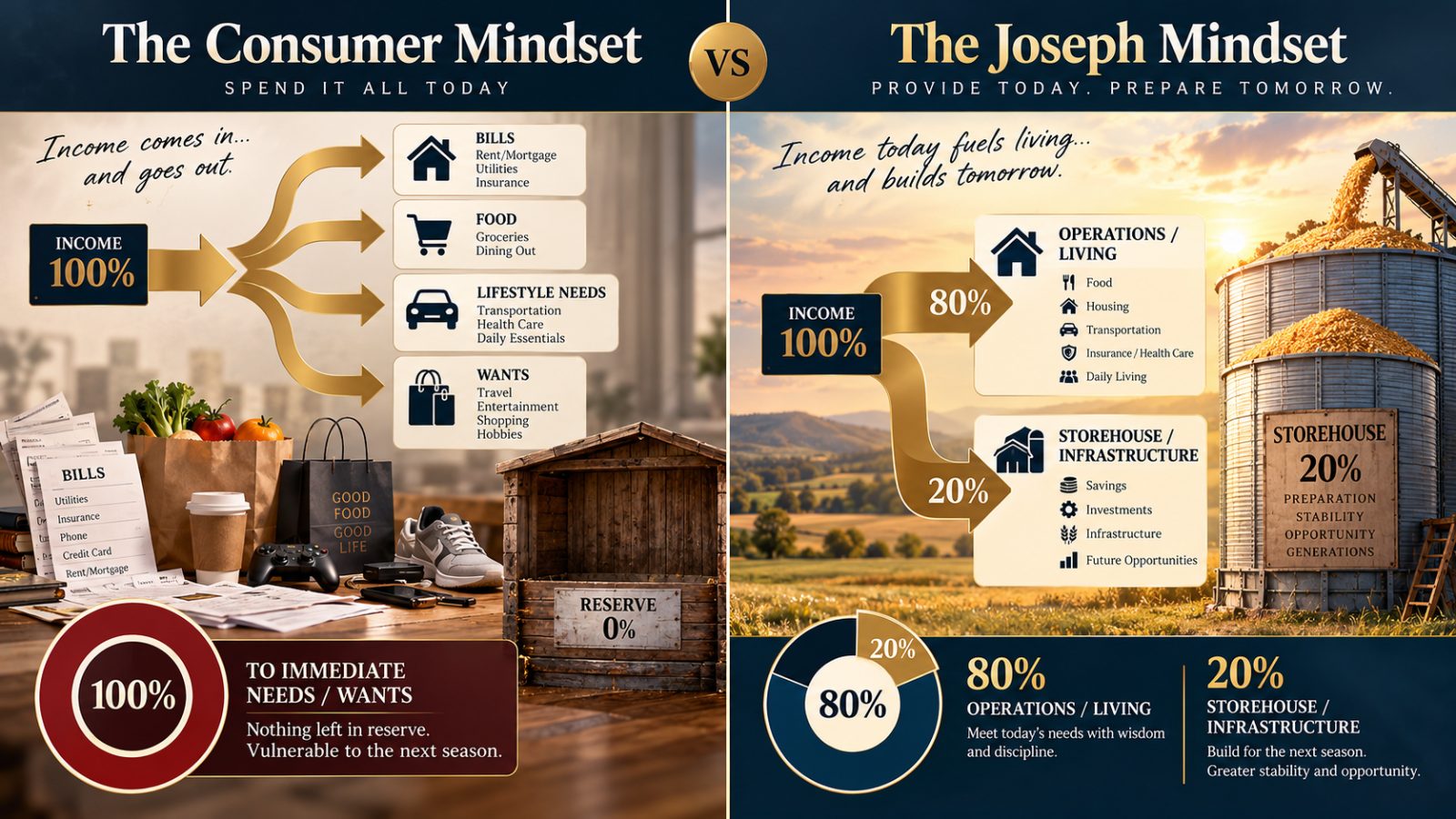
Joseph’s "fifth part" rule was a 20% reserve system. While everyone else was likely feasting on the 100% abundance of the good years, Joseph mandated a 20% "tax" or "savings rate" on the entire nation's production. This is the first rule of enterprise scaling: you must create a margin that is reinvested into the infrastructure of the future.
In modern terms, this is your retained earnings. If you are taking every penny of profit out of your business to fund a "blessed" lifestyle, you are eating the seed that is supposed to fund your scale. Joseph did not save the 20% to keep it; he saved it to deploy it when the market changed. I have spoken before about whether business profit is actually biblical, and the answer is found in how you use it.
Profit is not just for your pocket; it is for the "storehouse." Joseph built cities specifically to hold the grain. He invested in infrastructure during the years of plenty so that he had the capacity to handle the demand during the years of famine. If you want to scale, you have to invest in your capacity before the demand arrives.
This means hiring that assistant before you are completely overwhelmed. It means buying the better software before your current system crashes. It means setting aside that 20% of every invoice into a "Scale Fund" that you do not touch for personal bills. You are acting in faith that the growth is coming, and you are preparing the storehouse to receive it.
Scaling Through the Three Phases of Joseph's Career
We often forget that Joseph did not start in the palace. He had to learn how to scale in the small, painful places first. If you cannot manage a small team or a small budget, why would God entrust you with a nation? You have to be faithful in the "little" before you are made ruler over "much."
The first phase was scaling in someone else's house. In Potiphar’s house, Joseph was so efficient that Potiphar "knew not ought he had, save the bread which he did eat" (Genesis 39:6, KJV). Joseph handled everything. He learned how to manage assets that were not his own. This is where you learn the character required to carry greater responsibility as a leader.
The second phase was scaling in the dark. Even in prison, Joseph’s administrative gift rose to the top. The keeper of the prison committed to Joseph's hand all the prisoners that were in the prison. He was managing a "business" in the worst possible conditions. Right now If you are in a season where things feel restricted or "dark," do not stop building. Your systems should work even when the economy is in a "prison" state. I encourage you not wait for things or conditions to get better, but deploy your gifts and skills withthout waiting for that bright day.
The third phase was scaling the nation. This is where the systems Joseph developed in the small places were applied to the entire world. He didn't have to learn how to be an administrator when he got to the palace; he was already one. The palace was just a larger platform for the systems he had already mastered. Brethren, the palace is not where you learn to scale; the palace is where you apply what you learned in the pit.
The Storehouse Principle: Managing Data and Inventory
Joseph "gathered corn as the sand of the sea, very much, until he left numbering; for it was without number" (Genesis 41:49, KJV). But before it became "without number," he was numbering it. He had a system for tracking what was coming in and what was going out. You cannot scale what you do not measure, this is why today we have so many faithful men and women with ni idea or whatsoever where the money and resources are going.
In my early days, I used to guess my numbers. I "felt" like I was making money. I "felt" like my expenses were low. But feelings are not a foundation for a Kingdom enterprise. Joseph had to know exactly how many bushels were in which city to ensure the nation didn't starve. He was a master of data long before computers existed.
You need to have a "dashboard" for your business. What are your key metrics? How much does it cost you to get a customer? What is your monthly overhead? If I asked you right now how much grain is in your "storehouse," could you tell me? If not, you are not ready to scale. You are still just "gathering."
Scaling requires centralised information. Joseph made sure the food was kept "in the cities" (Genesis 41:35, KJV). He didn't have one giant pile of grain in the middle of the desert; he had a distributed network of storehouses. This allowed for local distribution while maintaining central control. This is how you manage multiple locations, multiple products, or multiple teams.
Why Your Business Must Scale to Serve the Kingdom
We do not scale just to see our names on a taller building. We scale because the bigger the storehouse, the more people we can feed. When the famine hit, it wasn't just Egypt that was hungry. "And all countries came into Egypt to Joseph for to buy corn; because that the famine was so sore in all lands" (Genesis 41:57, KJV). Joseph’s scale became the salvation of the known world.
If your business stays small because you are afraid of the "stress" of scaling, you are limiting your ability to be a blessing. A small business can support a family. A scaled business can support a community, fund a ministry, and provide jobs for hundreds of Kingdom citizens. I have discussed how Joseph saved and managed money to prepare for this exact moment.
Scaling is an act of service. It is making your value available to more people without your personal presence being the limiting factor. If Joseph had insisted on personally handing out every bag of grain, the people would have died in the queues. He had to build a system so the blessing could flow faster than his own two hands could move.
"And God sent me before you to preserve you a posterity in the earth, and to save your lives by a great deliverance." (Genesis 45:7, KJV)
Your scale is someone else's "great deliverance." When you build a business that works, you are creating a platform for God to move. You are becoming a Kingdom Financier. You are moving from a "job" to an "assignment." To understand this shift, you should look at treating your business like a kingdom assignment rather than just a way to pay bills.

Practical Steps to Start Scaling Like Joseph Today
You might be thinking, "That sounds great, but I'm just a one person show right now." That is exactly where Joseph started. He started by being the best servant in Potiphar's house. Scaling starts with your mindset before it hits your bank account. Here is how you start the process this week.
Audit your time: Write down every task you do for three days. Which of these could a "system" or an "officer" do? If you are still doing $10/hour tasks, you will never build a $1M/year business.
Build one "Storehouse": Create one Standard Operating Procedure (SOP). Document exactly how you do one repetitive task. This is the first brick in your administrative wall.
Implement the 20% Rule: Open a separate account today. Move 20% of your next payment into it. This is not for tax; this is for your "Scale Fund."
Stop being the "Numberer": Get a professional bookkeeping system or hire a part time bookkeeper. You need to see your grain levels clearly.
Remember, guys, Joseph didn't just have a dream; he had a plan. God gave the dream, but Joseph built the storehouses. Faith is not an excuse for poor management. Faith is the reason we manage with excellence, because we know Who we are representing.
I want to encourage you, child of God. The fact that you feel the "stretch" right now is a sign that God is trying to increase your capacity. Don't pull back because it feels uncomfortable. Lean into the systems. Appoint your officers. Build your storehouses. The famine may be coming, but for the prepared steward, the famine is simply an opportunity for the Kingdom to shine.
May God grant you the wisdom of Joseph as you build. May He give you the spirit of oikonomia to manage your household and your business with such order that the world takes notice. Walk in faith, steward with wisdom, and watch what He does through your prepared hands.
Where To Read Next
If you are ready to take your business and your stewardship to the next level, I have written more about how these biblical principles work in the real world. Start with these:
Frequently Asked Questions
Is it biblical to want to grow a large business?
Yes, growth is a biblical principle provided your motive is stewardship and service rather than greed. Joseph grew Egypt's economy to save lives during a famine, and the Parable of the Talents shows that God expects us to multiply what He has given us. When we scale, we increase our capacity to fund the Kingdom and provide for others.
What is the difference between scaling and just working harder?
Working harder is "linear growth" where your income is tied directly to your hours. Scaling is "exponential growth" where you build systems, hire "officers," and create infrastructure that allows the business to grow without you doing all the work. Joseph didn't farm the grain himself; he managed the system that gathered and stored it.
How do I know when I am ready to hire my first "officer"?
You are ready to hire when your personal capacity is the only thing stopping the business from growing. If you are turning away customers or failing to deliver quality because you are too busy with administrative tasks, it is time to delegate. Like Joseph, start by finding someone faithful to handle a "fifth part" of the responsibility.
Does the 20% rule apply if I am already tithing?
The 20% "Joseph Rule" is a business reinvestment and reserve strategy, not a religious requirement. It is separate from your tithe. While your tithe is your firstfruits to God, the 20% reserve is your stewardship of the business's future, ensuring you have the capital to survive lean times and invest in growth.
Found this helpful? Share it with someone who needs it.