
Many Christians feel a quiet sense of guilt whenever they make a profit. They feel as though charging a fair price is somehow unchristian. They worry that making money is the opposite of serving people, and this silent friction keeps them stuck in financial survival mode.
But this is a complete misunderstanding of Scripture. If you want to build a sustainable source of income, you have to overcome this internal barrier and see business through the eyes of the Creator. Let us look at what God actually says about the rewards of honest work.
Is Business Profit Biblical? The Hebrew Root of Increase
To understand whether surplus is pleasing to God, we must look past modern financial jargon and look at the language of Scripture itself. In the Old Testament, the writer of Proverbs uses a specific Hebrew word when discussing the reward of hard work. That word is mothar.
I want you to see this clearly in the book of wisdom: "In all labour there is profit: but the talk of the lips tendeth only to penury." (Proverbs 14:23, KJV)
The English word "profit" here can sound cold and clinical, but the Hebrew mothar carries a much richer meaning. It comes from the root word yathar, which literally means to leave over, to exceed, or to abound.
It refers to abundance, preeminence, surplus, or that which is left over after all expenses and needs have been met. When you understand this root, you realise that God designed work to produce a remainder. This is the foundation of what it really means to build income as a Christian without feeling guilty about your success.
The original Hebrew audience did not view this surplus as a sign of greed or exploitation. They understood it as the natural, healthy result of diligent, honest work.
God did not design the world for us to live in a state of constant depletion. He designed the ground to produce a harvest that exceeds the seed we planted.
When your business generates a surplus, you are participating in a divine pattern of multiplication that God established from the very beginning. Surplus is not a sin; it is a sign of productivity.
Why Do We Feel Guilty for Making Money?
Many fellow believers I talk to are trapped in a strange paradox. They want to serve God, and they want to help their communities, yet they feel deeply uncomfortable when they have to name their price.
I have seen this happen to so many gifted Christian business owners. They offer excellent services, but they undercharge to the point of financial ruin because they confuse business with charity.
Let us be clear: charity is a beautiful, biblical command. But a business is not a charity; it is an economic engine that requires fuel to run.
If your engine has no fuel, you cannot drive anyone anywhere. When you refuse to make a profit, you are essentially saying that your time, skills, and resources have no value.
I had to learn this the hard way in my own business journey. You cannot bless others out of an empty cup, and if you do not value your work, your customers will not value it either.
The belief that poverty equals holiness is a trap. True stewardship means managing resources so they multiply, not watching them slowly disappear.

What Jesus Said About Return on Investment
Some people believe that Jesus was against any form of financial gain. But when we look closely at His teachings, we find a very different picture of how He viewed productivity. Consider the Parable of the Talents in Matthew 25. A master travels to a far country and entrusts his goods to his servants, giving them different measures of resources based on their ability.
The servants who received five and two talents went and traded with them. They did not just protect the money; they put it to work in the marketplace. "And so he that had received five talents came and brought other five talents, saying, Lord, thou deliveredst unto me five talents: behold, I have gained beside them five talents more." (Matthew 25:20, KJV)
The master did not rebuke them for making a profit. He did not call them greedy or capitalistic for generating a hundred per cent return on investment.
Instead, he said, "Well done, thou good and faithful servant" (Matthew 25:21, KJV). He rewarded their productivity with greater responsibility.
The servant who was condemned was the one who hid his talent in the earth. He returned exactly what he was given, with zero growth, because he was ruled by fear.
This parable shows us that God expects us to be productive with what He gives us. If you want to understand this more deeply, you should read about how to know what God has called you to do with your work so you can align your business with His purposes.
Using your skills to generate a profitable return is a sign of faithfulness, not selfishness. God is glorified when we multiply the resources He places in our hands.
The Difference Between Honest Gain and Covetousness
Of course, we must not ignore the warnings in Scripture about wealth. The Bible is filled with sharp rebukes for those who love money and make it their primary pursuit.
Paul warned Timothy that "the love of money is the root of all evil" (1 Timothy 6:10, KJV). But notice the distinction: it is the love of money, not the money itself, that causes destruction.
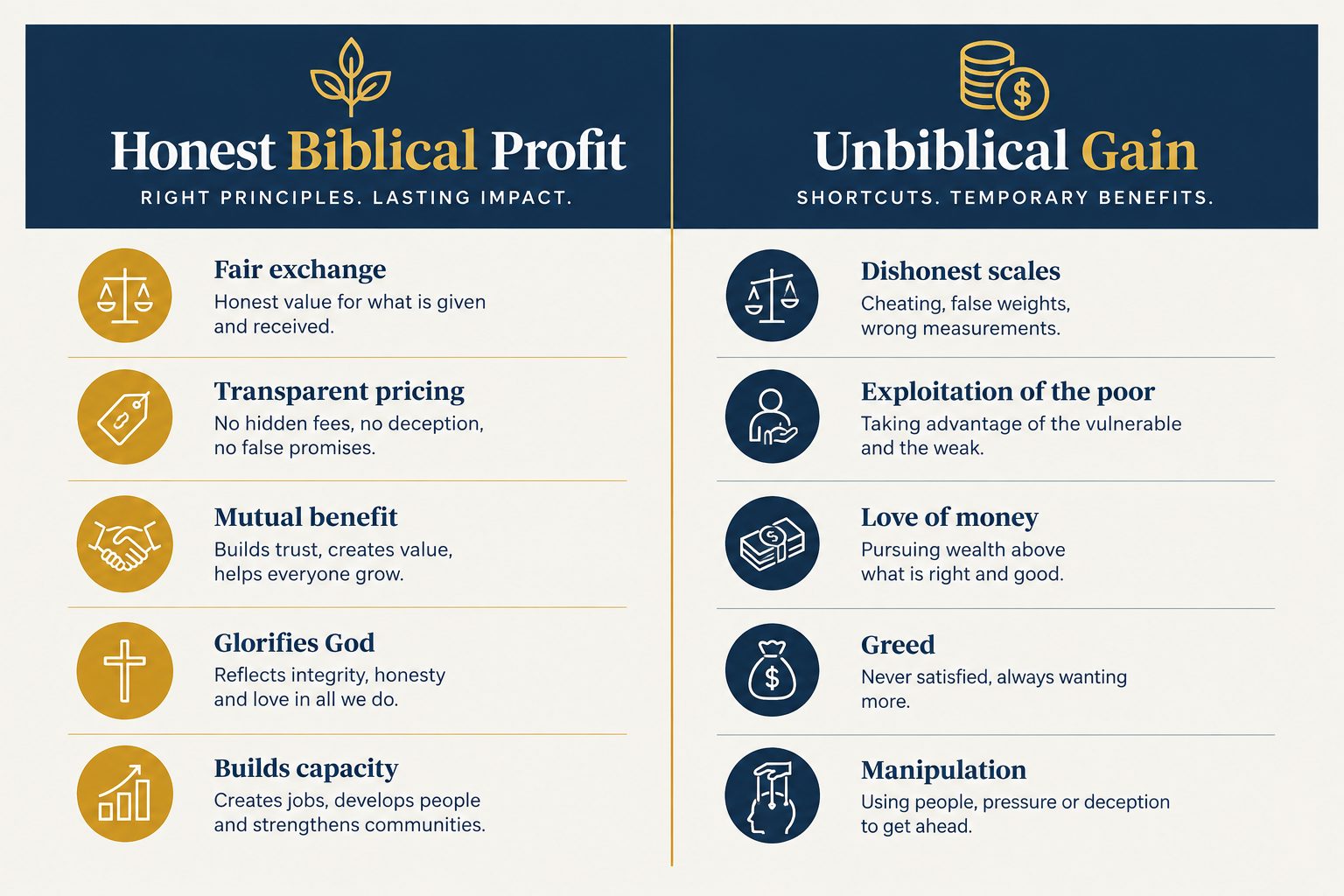
The question of whether business profit is biblical comes down to your methods and your motives. Are you charging a price that reflects the true value of your work, or are you cheating people?
God hates dishonest business practices and demands absolute integrity in the marketplace. He expects us to be fair and transparent in all our dealings. "A false balance is abomination to the LORD: but a just weight is his delight." (Proverbs 11:1, KJV)
An honest business profit is built on mutual benefit. Your customer has a problem, and you have the solution, creating a fair exchange of value.
When the transaction is complete, both parties should be better off. That is not exploitation; that is honest commerce that honours God.
If you are struggling with this boundary, it is worth exploring whether desiring financial success is actually a sin when your heart is aligned with God's Word.
We must learn to separate the clean, biblical practice of honest profit from the dirty practice of extortion. Honest profit is the reward of excellent service.
The Danger of the "Just Enough" Mentality
Many believers pray for just enough to get by. They look at the model of the wilderness, where God provided manna daily, and assume that is the standard for the Christian life.
But the wilderness was a temporary place of transition, not the final destination. The promised land was a place of abundance, wells they did not dig, and vineyards they did not plant.
When you pray for "just enough" for yourself, you are praying a highly individualistic prayer. If you only have enough for your own bills, you cannot help the widow next door. You cannot fund a missionary who is taking the gospel to unreached places, nor can you build a business that employs others in your community.
If you are stuck in this mindset, you are likely struggling with breaking the cycle of living from paycheque to paycheque because your capacity is limited.
God wants to bless you so that you can be a blessing to others. He wants to give you seed for the sower and bread for food. If you consume all your seed, you will have no harvest. If you make no profit, you have no seed to sow into the lives of others.
We must break free from the poverty mindset that limits our usefulness in the Kingdom of God. Profit is the seed that funds your future generosity.
How Profit Serves Your Neighbour and Builds the Kingdom
Let us look at this from a practical perspective. When a business makes a profit, it is not just the owner who wins; the entire community benefits from that success.
A profitable business can afford to pay fair wages to its employees, creating stability for families. It can afford to invest in better equipment, improving the quality of the products it delivers.
Furthermore, a profitable business pays taxes that support local infrastructure, and it has the financial margin to support charitable causes.
"But thou shalt remember the LORD thy God: for it is he that giveth thee power to get wealth, that he may establish his covenant..." (Deuteronomy 8:18, KJV)
Notice that God gives you the power to get wealth for a specific purpose: to establish His covenant. That covenant is established through preaching the gospel and caring for the poor.
Neither of those things can be done effectively without financial resources. It takes money to print Bibles, build churches, feed the hungry, and send workers into the field.
When you view profit as a tool for Kingdom advancement, the guilt disappears. You begin to see your business as a ministry that funds the work of God on the earth.
Your profit margin is the measure of your capacity to do good. The larger your margin, the greater your ability to serve.

Practical Steps to Price Your Work Without Guilt
Now that we have established the biblical foundation, we need to talk about how to apply this to your daily business decisions. Pricing is where the spiritual battle usually meets the physical reality.
If you want to run a healthy, God honouring business, you must learn to calculate your prices based on facts rather than emotion.
I want to give you three simple steps to help you set prices that reflect both fair value and healthy profit margins:
Calculate your true costs. This includes not just the raw materials, but your software, your workspace, your taxes, and the value of your time.
Add a margin for sustainability. A business that only covers its costs is one emergency away from closing down. You must build in a surplus to protect the business.
Research the market value. Ensure your prices are fair and competitive, reflecting the high standard of excellence you bring to your work.
If you are offering services or products based on your natural talents, you must remember that why your raw talents still require structured training is because excellence commands respect and fair compensation in the marketplace.
Do not let fear dictate your pricing strategy. If you are doing excellent work, you deserve to be compensated fairly for that work.
When you price your work correctly, you are showing respect for your own calling and for the customers who rely on your expertise. Fair pricing is a form of truth telling in business.
Go forward with confidence, brethren, knowing that your productivity is a service to others and an honour to God.
Where To Read Next
If you want to continue building your financial capacity and aligning your work with God's Word, I highly recommend reading these articles next:
Frequently Asked Questions
Is it a sin for a business to make a profit?
No, it is not a sin for a business to make a profit. Scripture encourages honest gain through diligent labour, as seen in Proverbs 14:23, where profit is described as the natural reward of hard work. Profit becomes sinful only when it is obtained through dishonest scales, deception, or the exploitation of others.
What does the Bible say about charging fair prices?
The Bible commands believers to use just weights and fair balances in all business transactions, as highlighted in Proverbs 11:1. Charging a fair price means reflecting the true value of your materials, expertise, and time without deceiving the buyer. It ensures that both the buyer and the seller benefit from the transaction.
How can a Christian business owner avoid greed?
A Christian business owner can avoid greed by keeping their heart anchored in God rather than their bank balance. This is done by practicing consistent tithing, giving generously to the poor, and viewing profit as a tool to advance the Kingdom of God rather than a measure of personal worth. Greed is a heart issue, not a margin issue.
Did Jesus teach about profit and return on investment?
Yes, Jesus addressed financial return directly in the Parable of the Talents in Matthew 25. He praised the servants who traded wisely and multiplied the resources entrusted to them, calling them good and faithful. Conversely, He condemned the servant who hid his resource and failed to produce any increase.
Should a Christian business ever offer services for free?
While personal charity and giving are biblical, running a business entirely on free services is unsustainable and poor stewardship. You may choose to gift your services to those in genuine need as an act of personal generosity, but your business must generate a profit from paying clients to remain viable and continue serving the community.
Found this helpful? Share it with someone who needs it.