I have carried a personal saying for years: money does not simply move towards the person who desires it most. It often moves towards value.
I first pictured this through something very ordinary. A chicken may run when someone chases it, but it comes closer when it sees food in the person's hand. In the same way, chasing money without becoming useful can leave a person exhausted. Developing a skill, solving a real problem, and serving people honestly creates value that others may be willing to pay for.
That saying is not a verse from the Bible, and it is not a complete theory of economics. Some highly valuable people are still underpaid, and injustice can keep diligent people poor. But the saying helped me notice something Proverbs repeats: character, wisdom, skill, diligence, restraint, and attention shape what happens when money enters our hands.
What does Proverbs say about money? It gives practical wisdom, but it also refuses to separate financial life from the person handling the money.
Money can increase my options, but it cannot supply the wisdom and character required to use those options well.
How to Read Financial Proverbs Without Turning Them Into Guarantees
Proverbs are wisdom sayings. They describe patterns that are generally true in God's moral world, but they are not mechanical promises that remove every exception.
“Diligent hands bring wealth” does not mean every poor person is lazy. Proverbs itself recognises injustice, including the field of the poor being swept away by injustice in Proverbs 13:23. A skilled person may be overlooked. An honest business can suffer during a crisis. A generous person can still face hardship.
The wisdom of Proverbs teaches the kind of character and action that normally support a stable life. It does not give me permission to judge everyone whose circumstances are difficult.
This chapter sits inside the wider Kingdom Money Principles From the Bible framework, because Proverbs gives wisdom for work, debt, saving, generosity and character.
Honest Money Builds More Slowly, but It Builds on a Foundation
Proverbs 13:11 contrasts dishonest wealth with money gathered little by little. I return to that verse because it describes two different ways of building.
Dishonest gain may arrive quickly, but it carries hidden costs. It can destroy trust, damage a name, attract legal consequences, and teach the person who gained it that manipulation works. Even when the money remains, the foundation is unstable.
Little by little can feel frustrating. Yet gradual growth gives me time to learn how to manage what I receive. I can correct mistakes before they become disasters. I can build relationships based on reliability rather than excitement.

Wisdom refuses financial fog and learns the true condition of what has been entrusted.
I have learned that credibility is a financial asset. Once people no longer believe my word, every future opportunity becomes more expensive.
Money in the Hands of a Fool Does Not Become Wisdom
Proverbs does not describe a fool mainly as someone with a low intelligence score. The fool repeatedly resists correction, acts without understanding, and allows appetite to govern judgement.
That is why receiving more money does not automatically improve a person's life. More money gives existing habits greater reach.
Proverbs 21:20 says the wise keep valuable resources in reserve while the fool consumes what is available. I recognise how easy it is to treat every amount that arrives as permission to spend. The pressure can be strongest after a difficult season because immediate enjoyment feels like proof that the struggle is over.
Wisdom creates space between receiving and consuming. It asks what must be protected, what responsibility is coming, and what portion should remain available for the future.
The Parable of the Talents adds the responsibility to act faithfully with what has already been entrusted.
Money Reveals Character, but Poverty Does Not Automatically Reveal Failure
I once knew someone whose character seemed settled while money was limited. After employment and income arrived, his behaviour changed dramatically. Relationships became disposable, appetite became louder, and people who had trusted him began to see another side of him.
That experience stayed with me. Money did not create everything that appeared. It gave hidden desires more opportunity.
Still, I need to state the lesson carefully. Poverty is not proof of virtue, and wealth is not proof of corruption. Money can expose both generosity and selfishness. It can allow a disciplined person to serve more people, or it can allow an undisciplined person to cause more damage.
The deeper question is whether my character can carry the options money creates.
What Proverbs Says About Debt
Proverbs 22:7 says the borrower becomes servant to the lender. That sentence is intentionally uncomfortable. Debt places part of my future income under another person's claim and can reduce freedom.
Yet I do not read the verse as a declaration that every loan is sinful. Some borrowing can support housing, education, or productive work. The question is whether the debt is understood, affordable, and directed towards something that justifies the risk.
Proverbs also warns about guaranteeing another person's debt. Compassion does not require signing an obligation I cannot afford to carry. There may be wiser ways to help, including a smaller gift, practical advice, or support that does not place both households in danger.
Before borrowing, I should understand the total cost, the repayment schedule, the consequences of default, and what happens if income falls. Desire without knowledge is not good.

Skill and a trustworthy name are forms of capital that money alone cannot manufacture.
When borrowing is already pressing the household, the Christian debt guide turns this warning into an ordered repayment response.
Skill and a Good Name Are Financial Assets
Proverbs 22:29 praises the person skilled in their work. Skill creates the ability to solve a problem consistently, not only once by accident.
I love leadership and writing, but interest alone is not mastery. I still have to study, practise, receive correction, and produce work that can withstand examination.
Proverbs 22:1 adds that a good name is more desirable than great riches. Today we might speak about reputation, credibility, or brand, but the biblical idea is deeper than marketing. A good name is the accumulated testimony of how I have treated people over time.
Skill may open a door. Character determines whether people continue to trust me once I enter.
Generosity Is Not a Trick for Multiplying Money
I grew up seeing situations where respect was influenced by what a person could provide. Help could become a form of social power, and generosity could quietly become an exchange for loyalty.
Proverbs describes a generous person as one who refreshes others. That is different from giving in order to control people or force God into a repayment agreement.
Proverbs 3:9 calls God's people to honour Him with wealth and firstfruits. I receive that as worship and priority, not as a promise that every gift will produce an immediate financial return.
Generosity should make another person's burden lighter, not make them feel owned.
Diligence Matters, but So Do Justice and Opportunity
Proverbs 10:4 contrasts lazy hands with diligent hands. Consistent work matters. Showing up, learning, finishing, and improving normally create better possibilities than neglect.
But I should not use diligence verses to explain every person's poverty. Proverbs also acknowledges unjust systems and people whose productive fields are swept away.
This balance protects two truths. I am responsible for the effort, discipline, and decisions within my control. I am also responsible not to ignore unfair conditions that prevent other people from benefiting from their work.
Biblical financial wisdom is personal, but it is never blind to justice.
Know the Condition of Your Flocks
Proverbs 27:23 tells the reader to know the condition of the flocks because riches do not endure forever.
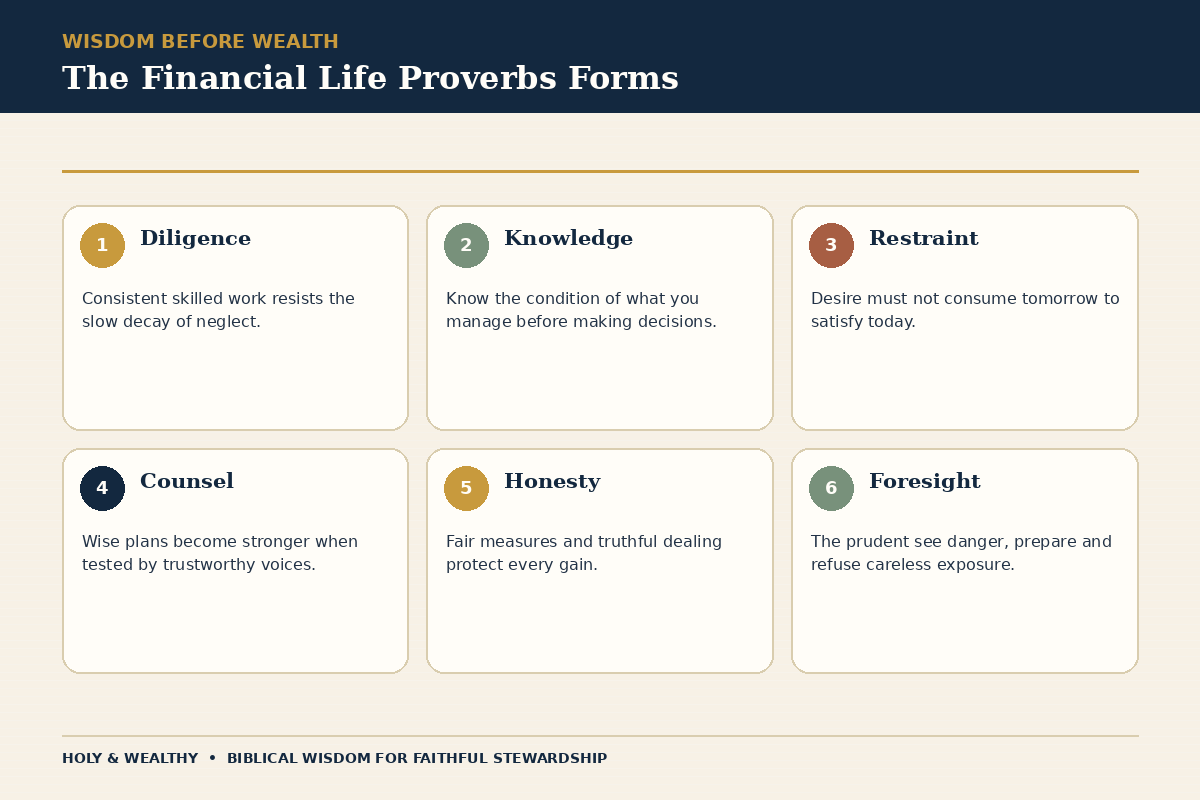
Proverbs forms a complete financial life through diligence, knowledge, restraint, counsel, honesty and foresight.
For an ancient household, livestock could represent food, trade, labour, and stored value. The instruction was to pay attention.
In my world, this means knowing the balance, expenses, debt, inventory, subscriptions, savings, and obligations. Avoiding the numbers does not protect me from them.
I do not have to love mathematics to practise financial attention. I need simple records, regular review, and the honesty to notice when a pattern is becoming dangerous.
A Christian budget is one practical way of obeying this command to know what is coming in, what is leaving and what must be protected.
Seven Financial Habits I Take From Proverbs
Earn honestly. A financial gain that destroys trust is more expensive than it first appears.
Build gradually. Little-by-little growth can produce knowledge and stability that sudden money does not provide.
Keep something in reserve. Not every amount that arrives must be consumed immediately.
Avoid obligations you do not understand. Debt and guarantees should never be entered through pressure or vague promises.
Develop useful skill. The ability to solve problems well creates durable value.
Protect your name. Reputation can outlast a single season of income.
Pay attention. Regular records and review prevent quiet decline.
The practical guide to saving on a small income shows how foresight can begin before income feels abundant.
The Book Gives Wisdom, but I Still Have to Apply It
Proverbs gives me no shortage of practical instruction. The challenge is not finding another verse. The challenge is allowing wisdom to enter an actual decision.
Will I tell the truth when dishonesty appears profitable? Will I keep a portion when spending everything feels easier? Will I develop the skill rather than demand the reward before the work? Will I refuse a dangerous obligation even when someone may be disappointed?
Financial wisdom becomes visible through repeated choices.
I do not expect one perfect month to transform my financial life. I expect patient application, correction, and character to change its direction over time.
Where to Read Next
Kingdom Money Principles From the Bible
The Parable of the Talents Is a Business Plan
Found this helpful? Share it with someone who needs it.